Galactic Energy Profiles: GEP II. In-System and Background Energy Densities
Update: I decided to publish this work, part of the GEP series, on Zenodo without peer review and to use it as a basic tool for building a subsequent dataset (GEP III). Note: This work is version 2.0 of the previous NAGE II work, which has been superseded.
Abstract
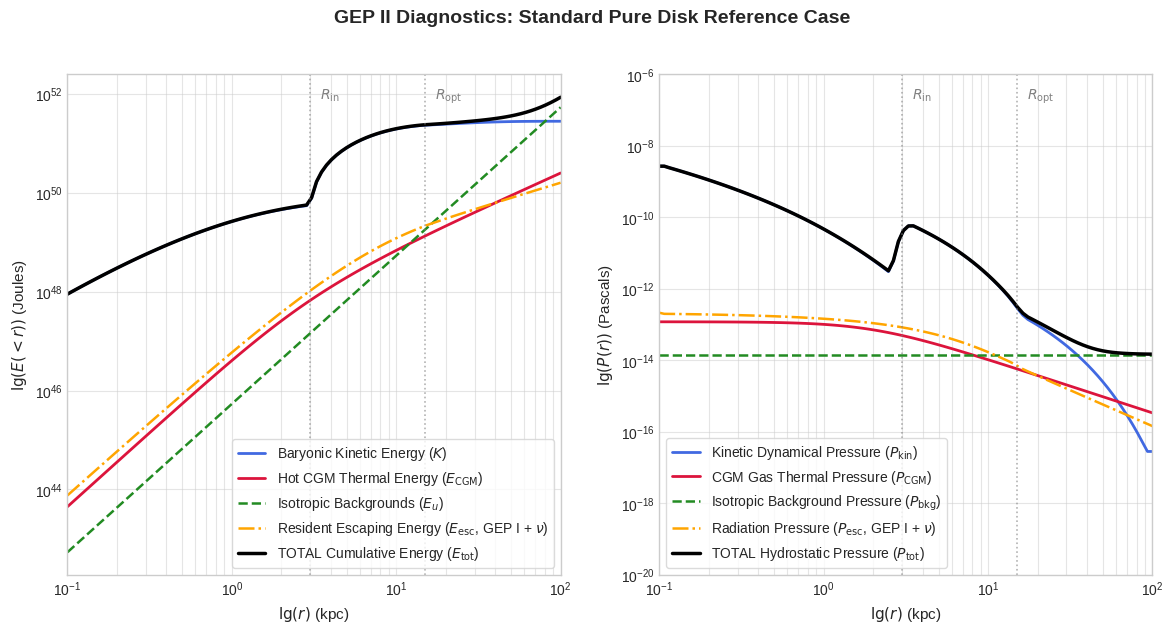
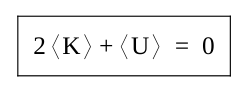
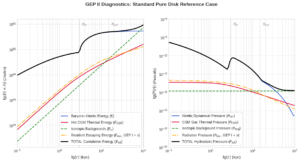
Standard galactic energy inventories typically focus on virialized components, namely kinetic and gravitational potential energy derived from baryonic mass distributions, together with energy inferred from bolometric luminosities. In the first paper of the Galactic Energy Profiles (GEP) series, we introduced a reproducible geometric framework for the radiant and relativistic fluxes of galactic origin, accounting for their finite escape time across the Halo. In this second work, we extend the framework toward a volumetric energy inventory, where bolometric luminosity is complemented by energy densities persistently present within the galactic volume. We consider the thermal and kinetic energy of baryonic matter—including bulk motions, turbulence, and rotational degrees of freedom from large-scale dynamics down to the intrinsic angular momentum of bound systems—together with cosmic rays confined by magnetic fields and extragalactic backgrounds (photons, neutrinos, and diffuse fields) permeating the Halo. This approach distinguishes between flux-based contributions and volume-based reservoirs, providing a complementary description of the total galactic energy budget. Crucially, by resolving these volumetric reservoirs into local radial profiles, we characterize the multi-component pressure support (including thermal, magnetic, cosmic ray, and radiant pressures) available to sustain the circumgalactic medium (CGM) in hydrostatic equilibrium. Although these components vary with morphology and evolutionary state, this study is purely theoretical and simplifies the extreme variability of galactic systems to derive reference estimates and ‘standard cases’. The resulting parametrized framework, supported by publicly available Python scripts, is intended as a further methodological baseline for the sample-wide application planned in later work.
Keywords
galactic energy inventory; galactic energy density; galactic Halo energy; energy distribution based on galactic morphology
Here is the Zenodo version of the paper (1.1 MB):
 Brussi 2026_GEP II
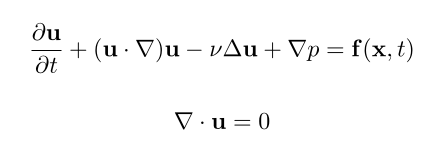
 Brussi 2026_Navier-Stokes Millennium Problem