I have decided to use GitHub for the software distribution supporting my manuscripts, still routing through the Data Download page.
please, rate this post
My Science & Epistemology Researches
This section hosts my official independent research papers and academic manuscripts.
While some works are currently undergoing formal peer-review or awaiting deposit in institutional archives, the preprints are shared here to foster scientific discussion and open collaboration. I encourage your feedback and open dialogue on my standard and non-standard frameworks.
I have decided to use GitHub for the software distribution supporting my manuscripts, still routing through the Data Download page.
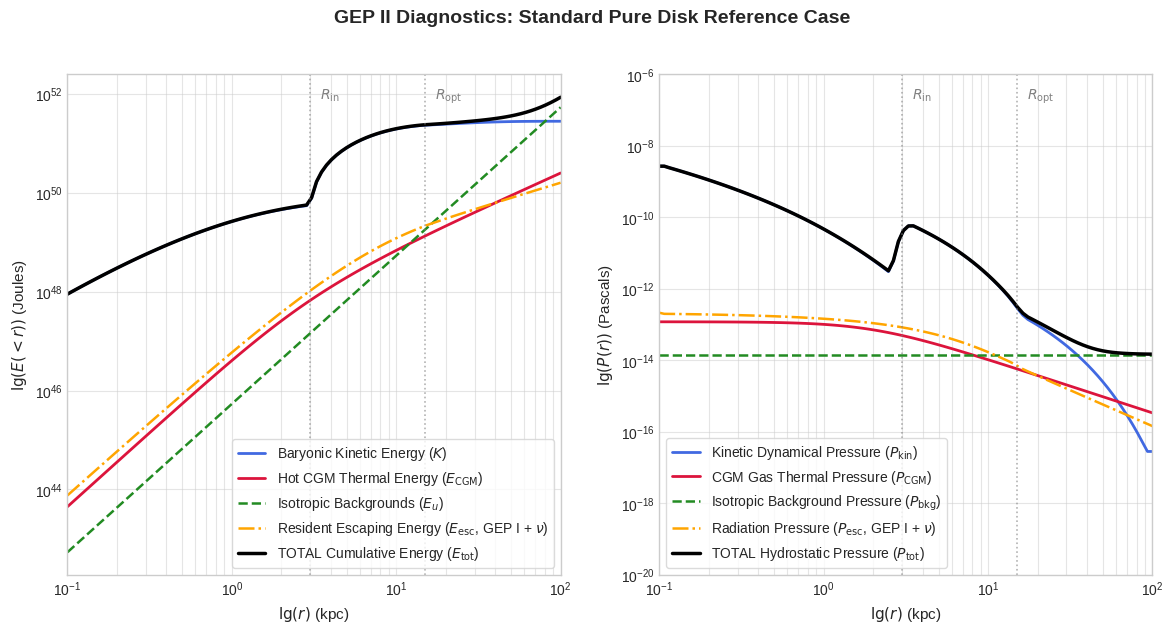
Galactic Energy Profiles: GEP II. In-System and Background Energy Densities
Update: I decided to publish this work, part of the GEP series, on Zenodo without peer review and to use it as a basic tool for building a subsequent dataset (GEP III). Note: This work is version 2.0 of the previous NAGE II work, which has been superseded.
Abstract
Standard galactic energy inventories typically focus on virialized components, namely kinetic and gravitational potential energy derived from baryonic mass distributions, together with energy inferred from bolometric luminosities. In the first paper of the Galactic Energy Profiles (GEP) series, we introduced a reproducible geometric framework for the radiant and relativistic fluxes of galactic origin, accounting for their finite escape time across the Halo. In this second work, we extend the framework toward a volumetric energy inventory, where bolometric luminosity is complemented by energy densities persistently present within the galactic volume. We consider the thermal and kinetic energy of baryonic matter—including bulk motions, turbulence, and rotational degrees of freedom from large-scale dynamics down to the intrinsic angular momentum of bound systems—together with cosmic rays confined by magnetic fields and extragalactic backgrounds (photons, neutrinos, and diffuse fields) permeating the Halo. This approach distinguishes between flux-based contributions and volume-based reservoirs, providing a complementary description of the total galactic energy budget. Crucially, by resolving these volumetric reservoirs into local radial profiles, we characterize the multi-component pressure support (including thermal, magnetic, cosmic ray, and radiant pressures) available to sustain the circumgalactic medium (CGM) in hydrostatic equilibrium. Although these components vary with morphology and evolutionary state, this study is purely theoretical and simplifies the extreme variability of galactic systems to derive reference estimates and ‘standard cases’. The resulting parametrized framework, supported by publicly available Python scripts, is intended as a further methodological baseline for the sample-wide application planned in later work.
Keywords
galactic energy inventory; galactic energy density; galactic Halo energy; energy distribution based on galactic morphology
Here is the Zenodo version of the paper (1.1 MB):
Galactic Energy Profiles: GEP I. Radiant and Relativistic Fluxes
Update: I decided to publish this work, part of the GEP series, on Zenodo without peer review and to use it as a basic tool for building a subsequent dataset (GEP III). Note: This work is version 2.0 of the previous NAGE I work, which has been superseded.
Abstract
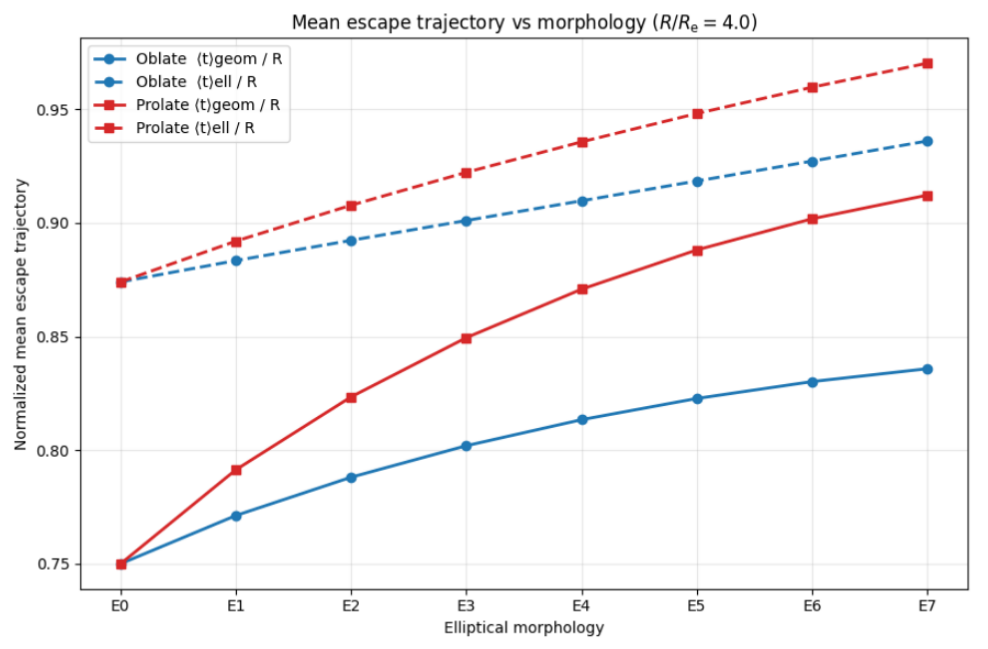
Standard galactic energy inventories typically focus on the virialized components of the system, namely the kinetic and gravitational potential energy, derived from baryonic mass distributions and stellar luminosity. This paper, the first in the Galactic Energy Profiles series, introduces a reproducible geometric framework for accounting radiant and relativistic fluxes as a standing energy reservoir. By considering the photon and neutrino escape time τ across the galactic Halo, we quantify the energy density of radiation currently in transit as a component of the total galactic budget, complementary to the standard flux-based description. The resulting closed-form expressions, together with the accompanying open-source Python implementation, are intended as a calibrated methodological baseline for the subsequent application of this framework to observed galactic samples.
Keywords
galactic energy inventory; energy residence time; galactic radiant fluxes; galactic Halo energy; galaxy morphology
Here is the Zenodo version of the paper (1.1 MB):
The URD Framework: Cosmological Distances from Redshift in a Non-Standard Context
While I am still developing the project —including through parallel studies on the Tolman test and the quality of indirect data obtained from recent galaxy surveys— I am making my work public as a preprint. I always hope that someone might be interested in my conjectures or perhaps even willing to collaborate with me to address the critical issues of the URD Framework.
Abstract
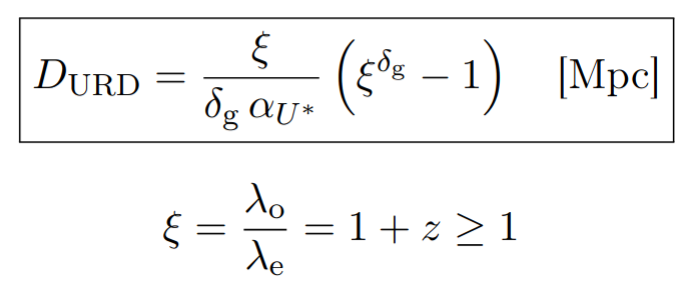
A phenomenological framework for determining cosmological distances is proposed, based on a non-expanding spacetime interpretation consistent with current observational datasets. The model introduces a redshift mechanism associated with cumulative photon energy attenuation along the line of sight, formulated in a way that is not equivalent to standard tired light scenarios. The approach is constructed to remain compatible with established relativistic principles whereas adopting boundary conditions distinct from the metric expansion paradigm. Distance estimation is achieved through the URD equation (U energy density, Redshift, Distance), which incorporates two phenomenological parameters that describe conformal geometric dissipation in extended gravity and an effective relativistic path-length correction. Within this formulation, the model addresses the primary shortcomings traditionally associated with energy dissipation effects, specifically reconciling time dilation in supernova light curves and the Tolman surface brightness relation. The model is calibrated using the Pantheon+ supernova sample by comparing and cross-validating distances inferred from the proposed redshift mapping with redshift-independent indicators, with additional comparison performed against baryon acoustic oscillations, radio galaxy samples, and high-energy quasars. Across these datasets, the framework reproduces observational constraints over a wide redshift range within a phenomenological, non-standard cosmological setting. The results indicate that alternative, non-expansion-based mappings between redshift and distance can be constructed that remain consistent within the observational range considered, suggesting a phenomenological alternative worth further study.
Keywords
cosmological distance ladder; redshift-distance relation; non-expanding spacetime; cosmic microwave background; extended gravity; Pantheon+ sample; baryon acoustic oscillations; Tolman test; time dilation; geodetic correction
Here is the last version of the preprint (5.1 MB):
 Brussi 2026_URD Framework Preprint
Version uploaded to Zenodo:
My thesis work (written in italian) is published in the University of Padova archive:
 Brussi 2025_Epistemology of time and cosmological interpretations
As an appendix to the same thesis I put a first development draft of the non-standard framework, which, after significant revisions, later became my work
 The URD Framework.
Abstract
The aims of this study on time are first to explore its ontological meaning in the historical developments that have accompanied its interpretative evolution, and then to examine some theoretical critical issues raised by recent literature. With some original theses, some alternative explanations for the expansion of the universe are then analyzed, which the current interpretation claims to be observed experimentally, by means of a model based on the ‘specific time’ of photons as an alternative to the ‘universal time’. Furthermore, it is hypothesized a model that considers the presence of an energy density in the cosmic fluid (called aether) that interacts with the incident radiation, thus determining a redshift effect in the wavelength, or an even longer time for the same radiation to diffuse. The consistency of ‘specific time’ has been verified with Minkowski spacetime, with Einstein’s principles of special relativity, and with Friedman’s equations of cosmic dynamics. Having demonstrated the fallacy of this ‘specific time’ hypothesis, the positive conclusion is that there is no need to postulate a universal time. Once one is defined, its uniqueness or universality can be demonstrated (within the limits of the adopted models). To complement the study, possible causes of the redshift, alternative to the standard cosmological model, were analyzed. It has been taken in consideration the hypothesis that the same universe behaves like a black body, emitting a radiation (the cosmic microwave radiation) that can interact with the observed photons coming from remote sources, attenuating their energy and determining their redshift. A cross section for photons, and a model for photon-photon interactions that respects the law of conservation of energy have therefore been hypothesized. As a basis for the conjectures, direct observational evidence was considered, not interpreted by means of theories, obtaining (from the comparison with other standard candles) better distance estimates than the official ones based on Hubble’s law. This addendum is included as an Annex, believing that the same conjectures and some original models can represent a reference for future in-depth studies.
The work is written in Italian (1.8 MB):
Brussi 2025_Epistemologia del tempo e interpretazioni cosmologiche

