Mathematical and historical foundations of Extended Theories of Gravity (ETG)

A short paper, in english, on a fascinating development of General Relativity.

Abstract
Extended Theories of Gravity (ETG) represent a prominent framework in modern theoretical physics and cosmology, aimed at modifying or extending Albert Einstein’s General Relativity to address open phenomenological questions at both ultraviolet (early universe) and infrared (galactic and cosmological) scales.

pdf Brussi 2026 Mathematical and historical foundations of ETG (305 KB)

ETG

please, rate this post

References for laymen: What is energy?

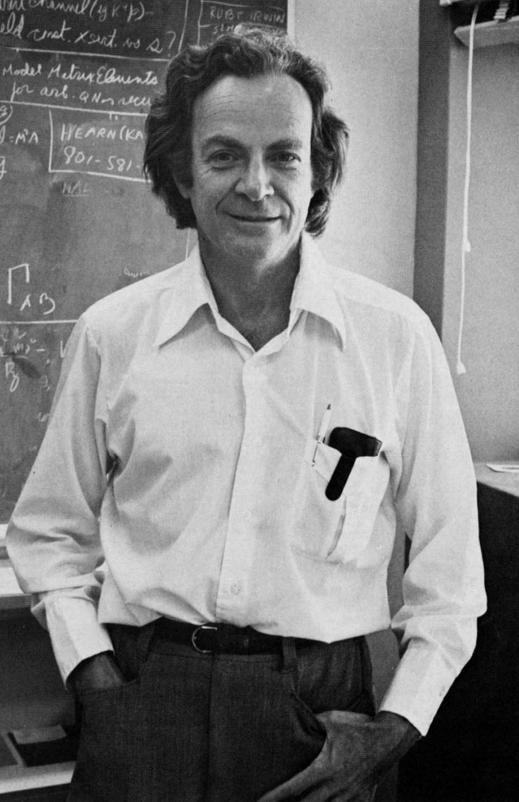
The great physicist Richard Feynman (1918-1988) honestly admitted that in modern physics we have no idea what energy ‘per se’ is. He described it as a kind of magical accounting: in the universe (or rather, in an isolated system), a lot of things happen, but at the end of each day, if we add up certain numbers characteristic of each event, the total is always the same. That number that never changes is energy. It is never created or destroyed, but always transformed.

The scholastic answer, “Energy is the capacity to do work” (given as known the concepts of work, force, etc.), is actually incorrect, because energy naturally tends to ‘spread’; that is, it prefers disorder. And as described by Ludwig Boltzmann (1844-1906), the measure of this disorder, called entropy, always increases in an isolated system. But since entropy also defines energy’s ability to do work, this ability actually always decreases, whereas energy is always conserved.

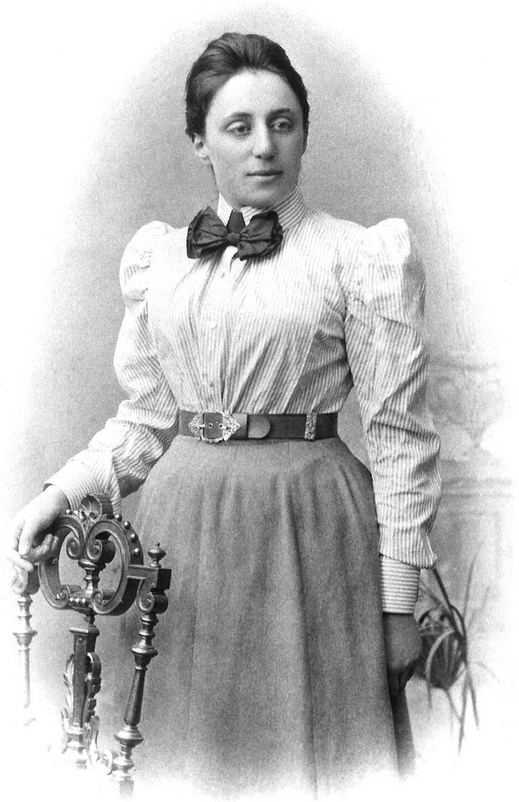
A more technical way to think about energy comes from Emmy Noether (1882-1935), who demonstrated that every conservation law in physics derives from a symmetry: energy is conserved because the Universe has a “translational time symmetry,” meaning the laws of physics remain the same as time passes, and the quantity that mathematically must remain constant is energy. In these terms, one could say that energy is time.

One way to calculate energy is the one defined by Einstein (see Einstein’s formula for energy), even if we don’t know what ‘stuff’ it’s made of. Simply put: even if an object is still and tiny, it hides a monstrous amount of energy within itself thanks to its mass (the constant of proportionality c² is a really huge number). And if it then begins to move due to external action, this energy increases.

Conclusion
We could define energy as the invisible ‘engine’ of reality. We can’t ‘touch’ it, but it ensures that the universe keeps its accounts in order (including the symmetry of time). Every time we do something, or even simply exist, we participate in this immense exchange of ‘tokens’ that has been going on ‘forever’.


Richard Feynman e Emmy Noether

Richard FeynmanEmmy Noether

please, rate this post

Einstein’s formula for energy

The most famous physics formula in the world is probably that of Albert Einstein (1879-1955):
(1) E = mc²
that is, the energy of a body is equal to its mass times the speed of light squared.
Perhaps not many have truly understood it, but certainly almost no one (without university studies) knows the complete formula, which takes into account both moving bodies and the energy of massless particles.

For moving bodies, a multiplication factor must be considered:
(2) E = γ mc²
According to Einstein’s own special relativity (work from 1905), if we consider ‘particles’ moving in four-dimensional spacetime, the change in their momentum (p), is expressed by the relativistic formula of four-momentum. This is a four-vector* in which the time component is represented by energy and the space components by momentum. In particular, in the case of a moving body, its inertia increases, as in (2), according to a factor proportional to the velocity, called the Lorentz factor (after Hendrik Lorentz, 1853-1928):
γ = 1 / √ (1-v²/c²)
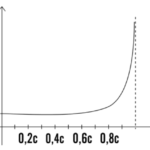
where v is the velocity of the body and c is the speed of light. As can be seen from the formula and from Figure 1 which traces its progression, γ increases as the velocity increases, but remains very close to 1 until the velocities are of the order of magnitude of that of light. For this reason, it is generally omitted, considering γ ≈ 1 . The asymptotic behavior of γ also highlights the difficulty of accelerating material bodies to speeds approaching that of light, whose inertia would have an equally asymptotic behavior.


Figura 1 (credits: youmath.it)
gamm


But the four-momentum also takes into account particles that have no mass, such as photons. From the intuition of Louis de Broglie (1892-1987), the wavelength of a photon is inversely proportional to its momentum:
λ = h / p
where h is Planck’s constant. Recalling that the photon’s energy can be expressed as:
E = hc / λ
it is easy to obtain the relation:
(3) E = pc

Einstein’s complete formula for the energy equation is therefore:
(4) E² = (pc)² + (mc²)²

It is easy to see how, in the case of a massless photon, (4) reduces to (3), the energy of the photon, and in the case of a non-moving particle, (4) reduces to (1), the energy of matter at rest. In the case of a moving body, both the energy due to the movement and the energy at rest must be taken into account, i.e. relation (2).


  • A four-vector is a four-dimensional vector defined in (relativistic) Minkowski (Hermann Minkowski 1864-1909) spacetime. It unifies a temporal quantity and the three corresponding spatial quantities (for example, time and space, or energy and momentum) into a single mathematical object.
    Its fundamental characteristic is that its magnitude (its length) remains unchanged for every observer, ensuring that the laws of physics remain the same even when observed from reference frames in relative motion to each other.
please, rate this post

Ontology vs. Epistemology of Time

My belief is that time does not exist in Nature.

To understand how time can be nonexistent in Nature while general relativity (GR) remains valid, it is necessary to distinguish between what the world is and how we describe it:
– Ontological Plane (Nature): Reality is an accident of events according to a ‘grammar’ of cause and effect. In this view, time does not exist as an external container or clock; there is only the logical necessity that certain events presuppose the occurrence of others. Nature does not ‘wait’ for time to pass: it acts according to an intrinsic causal ladder.
– Epistemological Plane (GR): General Relativity is our logical ‘map’. Since the human mind cannot perceive the entire network of atomic and discrete events, it uses the construct of spacetime to organize, measure, and, above all, predict.

Causality as the Skeleton of GR
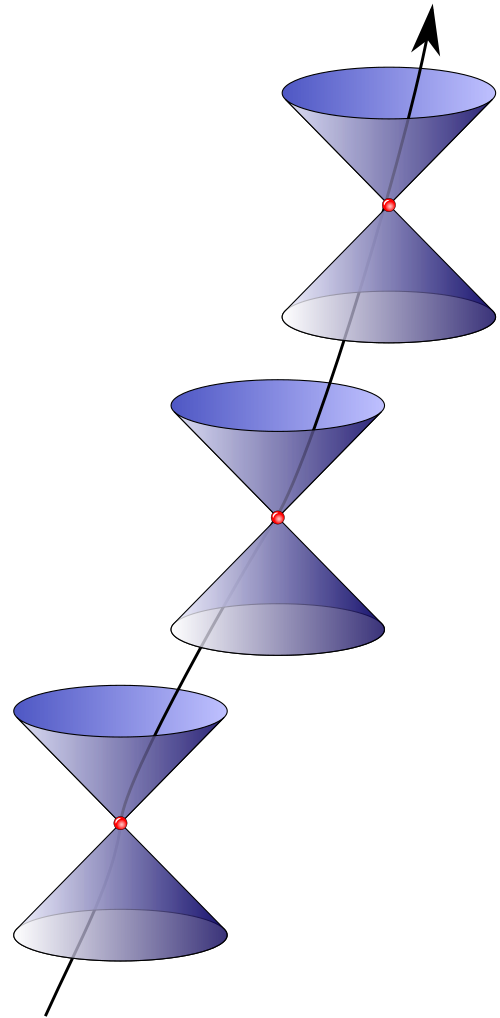
In physics, the causal structure of a manifold is defined by the set of precedence relations between events. If Nature operates according to a ‘causal ladder’ (A must precede B), GR encodes this necessity through the metric tensor*.
The fact that GR ‘works’ means that its mathematical architecture faithfully respects the logical sequence of natural events. The coordinated time t of GR is nothing more than a numerical index that we assign to events to keep track of their causal succession.

Predictability vs. Occurrence
The difference between the anthropic and natural visions lies in the concept of determinism vs. necessity:
– For Nature: Things happen when they are meant to happen. There is no delay or waiting; there is only the satisfaction of causal conditions.
– For Human Beings (GR): We need predictability. For us, it is not enough to know that B will follow A; We want to know when (according to our parameters) and where. GR introduces tools like Cauchy hypersurfaces to allow us to calculate the ‘future’. This computational capacity is a human need: Nature does not calculate its next state, it simply executes it.

GR as a relational model
GR remains valid because it describes how matter-energy influences the configuration of causal links. Even if we eliminate the idea of ​​a ‘container’ time, GR continues to tell us how the logical proximity between events is altered by the presence of mass. In this sense, the curvature of spacetime is not the deformation of a ‘time substance’, but the deformation of the network of causal relations that constitutes the world.

In short: Nature is the ‘ladder’ of facts, GR is the technical manual that humanity has written to index that ladder and transform it into prediction.


Universe line (credits: wikipedia)


universe line


* The Metric Tensor (gμν)
Mathematically, a tensor can be understood here as a matrix that establishes how coordinates—representing spacetime events—transform from one reference frame to another while preserving physical invariants. The metric tensor specifically dictates the geometry of this manifold. In every point of the universe, it acts as a local ‘ruler’ and ‘chronometer’ by defining the spacetime interval (ds2 = gμνdxμdxν). Most crucially for causality, it shapes and tilts the light cones, which delineate the absolute geometric boundaries beyond which information cannot travel. Therefore, the metric tensor is the mathematical structure that translates the causal sequence (event A preceding event B) into the invariant fabric of spacetime geometry.

please, rate this post

The Stage of Reality – Why gravity is not a force and the speed of light is not a speed

Introduction
What we are about to explore is what I call ‘the stage of reality’, the place where we, and everything around us, move (a trivial side note: nothing is truly ‘at rest’ in our universe, as there is no absolute reference frame against which to measure motion). This stage is what we call spacetime, composed of the three familiar spatial dimensions plus time, which is simply an additional dimension. We cannot ‘visualize’ it unless we imagine removing one of the spatial dimensions, as seen in the famous Minkowski diagrams (see Figure, Hermann Minkowski, 1864-1909).
It was Albert Einstein (1879-1955), in his brilliant work in the early 1900s, who viewed the universe not as an empty space where time flows separately, but as a single four-dimensional context. These dimensions are inextricably linked by a metric governed by the laws of gravitation. In this scenario, time is not an external clock, but a real direction in which we move, just as we move North or South, to put it in geographic terms.

Gravity
Why is the force of gravity not a force? For centuries, thanks to Isaac Newton (1643-1727), we thought of gravity as a kind of ‘invisible hand’ that ‘pulls’ objects. But if we apply what Einstein called the equivalence principle (which he described as “the happiest thought of my life”), we discover a fundamental concept. He imagined being in an elevator in deep space, far from any gravitation, accelerating upwards (remember that acceleration is the variation of velocity). You would feel pressed to the floor exactly as you do on Earth. If you were to release Newton’s legendary apple, it would ‘fall’ toward the floor. Yet, there is no gravity ‘pulling’ it; there is only acceleration. Einstein realized that gravity is not a force acting in space; rather, the effect we observe and call ‘force’ is the consequence of the curvature of spacetime itself. In fact, the presence of mass —or rather, mass-energy, since they are the same thing except for a conversion factor (the famous E=mc² )— warps the fabric of spacetime like a weight on an elastic sheet. For example, the Earth, with its concentration of mass-energy, creates a geometric deformation: the apple doesn’t fall because a force pushes it, but because it is simply following the straightest possible line (called a geodesic) in a space that has become curved.
According to Newton’s laws of motion, a body with no forces acting upon it moves with uniform rectilinear motion (respecting the principle of inertia). According to Relativity, an apple falling in a gravitational field is, paradoxically, the only object experiencing no force at all (respecting the principle of inertia). To quote Einstein again: “Matter [mass-energy] tells spacetime how to curve, and spacetime tells matter how to move.”

Light
Now let’s consider light. We attribute a ‘speed’ to it (which we define as a change in position), but as physicist Leonard Susskind (1940-) explains, it is not a speed in the common sense of the term (like that of a car). Instead, it is a fundamental property of the geometry of spacetime —a simple ‘conversion factor’ between spatial and temporal coordinates.
In the four-dimensional universe in which we exist, space and time are different directions of the same thing, and  c  is the number that tells us how many meters are equivalent to one second. That is: time=space / c .
The value of the universal constant c is approximately 300,000 km per second, or just over a billion km per hour (approx. 1.08 billion km/h).
Susskind’s profound suggestion is that every object in the universe always and constantly moves at the exact same speed:
– When we are ‘still’ in space—for instance, sitting in our chairs—we are traveling at the speed of light along the axis of time
– If we start moving through space, we must ‘subtract’ speed from time to compensate for the spatial movement (as if paying a toll using the conversion factor, ). From this, the relativistic time dilation is derived (e.g., the twin paradox).
There are no variable speeds; there is only a distribution of the ‘total speed’ among different dimensions. Therefore, light isn’t ‘racing’: we could say that light spends its entire ‘allowance’ on space, leaving zero for time, based on the conversion factor c .
This constant —the speed of light— is the geometric limit of what can happen in the universe.

Conclusions
There is, therefore, no speed limit; there is only a global geometry in which we are all immersed. Gravity is the curvature of the road; the constant holds together the very fabric of the reality surrounding us. Physics does not describe ‘what happens’, but describes the geometric structure in which everything is already contained.
Understanding this means stopping looking at ‘things’ that move and starting to look at the shape of the stage on which they move.


A Minkowsky diagram (credits to medium.com)
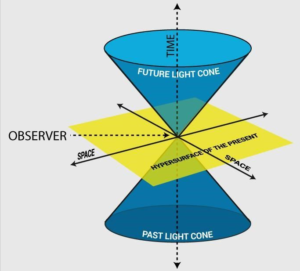

MInkowsky diagram

please, rate this post

Cosmology for a static universe

Abstract

This brief work, then became an Appendix to my URD Framework study, proposes a cosmological model characterized by a globally flat, spatially infinite, and non-time-limited spacetime. It challenges the standard application of the Friedmann-Lemaître-Robertson-Walker metric by reinterpreting general relativity as a strictly local phenomenon within a non-continuum matter distribution. In this framework, the observed flatness of the universe is a fundamental geometric property rather than a dynamical result of inflation, and cosmological redshift is modeled as a cumulative energy dissipation process rather than metric expansion.

pdf  Brussi 2026_Cosmology for a static universe


gravitational emotion

Ai generated image from free Adobe stock

please, rate this post

Changing perspective: Einstein between Kant’s certainties and Hume’s doubts

We can imagine the context in which Albert Einstein’s Gedankenexperimente (thought experiments) were born: the study of philosophy. To dismantle the idea that space and time were the same for everyone, the young physicist had to engage in an intellectual duel with two giants of thought: Immanuel Kant and David Hume.

Kant’s legacy: space as an objective necessity
From an early age, Einstein had studied Kant in depth, and from him he learned a fundamental concept: we are not passive spectators of the world; our mind does not simply record reality, but actively processes it. Kant argued that space and time are internal structures of the mind, the necessary conditions for having any experience at all. See also my post Kant and Space.
This idea was crucial for Einstein because it helped him understand that science is not merely a collection of data, but a construction of reason. However, the limit of Kant’s thought lay in the claim that these structures must be rigid and identical for every rational being. For Kant, space was only the one described in Euclid’s geometry books, and time was a universal flow, the same for everyone.

Hume’s inspiration: the courage to doubt
When Einstein began working on his thought experiments about light, he realized that Kant’s ‘fixed rules’ no longer worked. To move beyond them, David Hume’s philosophy was certainly of help.
Hume was a radical philosopher who urged people to take nothing for granted. His motto was simple: if a concept cannot be verified by the senses or through a concrete measurement, then it is suspicious. Hume taught Einstein to have the courage to doubt concepts that seem obvious to ‘common sense’. Einstein was aware that no one had ever measured ‘absolute time’, flowing identically for all; it was only a belief grounded in habit, not in physical evidence.

The synthesis: Relativity is born
Without the support of Hume’s skepticism, Einstein might not have had the audacity to question time. He understood that if the speed of light must remain constant, then time and space must be able to change depending on the speed of the observer (the principles of Special Relativity).
In this way, Einstein went beyond Kant using Hume’s method: he retained the Kantian idea that the mind must create categories to read the world, but he showed that these categories are not immutable. Space and time are not unchanging a priori forms, but physical quantities that can contract or stretch.

Einstein was thus a philosopher among physicists. He learned from Kant that the mind must anticipate reality (that is, describe it even before physical observations) with a coherent theoretical model, but he learned from Hume that no idea is untouchable. In this way, he found the courage to understand that if old theories had become full of gaps or incapable of describing the universe in a unified (that is, invariant) way, one had to have the audacity to redesign the very structure of thought itself, even before the facts forced it.


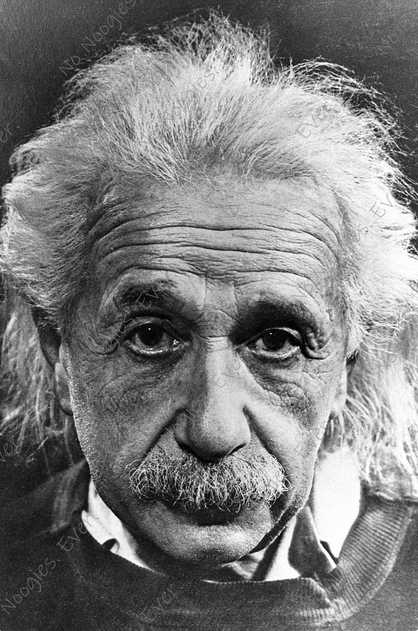
Albert Einstein

please, rate this post

My thesis work

My thesis work (written in italian) is published in the University of Padova archive:
pdf_ita  Brussi 2025_Epistemology of time and cosmological interpretations

As an appendix to the same thesis I put a first development draft of the non-standard framework, which, after significant revisions, later became my work
link  The URD Framework.


Abstract
The aims of this study on time are first to explore its ontological meaning in the historical developments that have accompanied its interpretative evolution, and then to examine some theoretical critical issues raised by recent literature. With some original theses, some alternative explanations for the expansion of the universe are then analyzed, which the current interpretation claims to be observed experimentally, by means of a model based on the ‘specific time’ of photons as an alternative to the ‘universal time’. Furthermore, it is hypothesized a model that considers the presence of an energy density in the cosmic fluid (called aether) that interacts with the incident radiation, thus determining a redshift effect in the wavelength, or an even longer time for the same radiation to diffuse. The consistency of ‘specific time’ has been verified with Minkowski spacetime, with Einstein’s principles of special relativity, and with Friedman’s equations of cosmic dynamics. Having demonstrated the fallacy of this ‘specific time’ hypothesis, the positive conclusion is that there is no need to postulate a universal time. Once one is defined, its uniqueness or universality can be demonstrated (within the limits of the adopted models). To complement the study, possible causes of the redshift, alternative to the standard cosmological model, were analyzed. It has been taken in consideration the hypothesis that the same universe behaves like a black body, emitting a radiation (the cosmic microwave radiation) that can interact with the observed photons coming from remote sources, attenuating their energy and determining their redshift. A cross section for photons, and a model for photon-photon interactions that respects the law of conservation of energy have therefore been hypothesized. As a basis for the conjectures, direct observational evidence was considered, not interpreted by means of theories, obtaining (from the comparison with other standard candles) better distance estimates than the official ones based on Hubble’s law. This addendum is included as an Annex, believing that the same conjectures and some original models can represent a reference for future in-depth studies.

The work is written in Italian (1.8 MB):

pdf_ita  Brussi 2025_Epistemologia del tempo e interpretazioni cosmologiche

please, rate this post

A historical photo

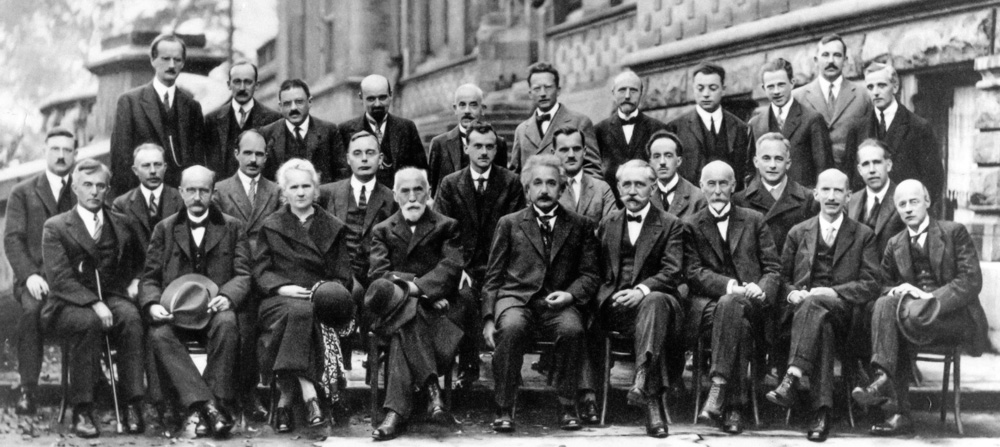
Solvay Conference on Quantum Mechanics, 1927

Solvay Conference on Quantum Mechanics, 1927 (photo by Benjamin Couprie, Institut International de Physique Solvay, Bruxelles, Belgium; I have slightly restored this photo, usually available in a lower detail level).

From behind, left to right: Auguste Piccard, Émile Henriot, Paul Ehrenfest, Édouard Herzen, Théophile de Donder, Erwin Schrödinger, Jules-Émile Verschaffelt, Wolfgang Pauli, Werner Heisenberg, Ralph Howard Fowler, Léon Brillouin, Peter Debye, Martin Knudsen, William Lawrence Bragg, Hendrik Anthony Kramers, Paul Dirac, Arthur Compton, Louis de Broglie, Max Born, Niels Bohr, Irving Langmuir, Max Planck, Marie Skłodowska Curie, Hendrik Lorentz, Albert Einstein, Paul Langevin, Charles-Eugène Guye, Charles Thomson Rees Wilson, Owen Willans Richardson

please, rate this post