My belief is that time does not exist in Nature.
To understand how time can be nonexistent in Nature while general relativity (GR) remains valid, it is necessary to distinguish between what the world is and how we describe it:
– Ontological Plane (Nature): Reality is an accident of events according to a ‘grammar’ of cause and effect. In this view, time does not exist as an external container or clock; there is only the logical necessity that certain events presuppose the occurrence of others. Nature does not ‘wait’ for time to pass: it acts according to an intrinsic causal ladder.
– Epistemological Plane (GR): General Relativity is our logical ‘map’. Since the human mind cannot perceive the entire network of atomic and discrete events, it uses the construct of spacetime to organize, measure, and, above all, predict.
Causality as the Skeleton of GR
In physics, the causal structure of a manifold is defined by the set of precedence relations between events. If Nature operates according to a ‘causal ladder’ (A must precede B), GR encodes this necessity through the metric tensor*.
The fact that GR ‘works’ means that its mathematical architecture faithfully respects the logical sequence of natural events. The coordinated time t of GR is nothing more than a numerical index that we assign to events to keep track of their causal succession.
Predictability vs. Occurrence
The difference between the anthropic and natural visions lies in the concept of determinism vs. necessity:
– For Nature: Things happen when they are meant to happen. There is no delay or waiting; there is only the satisfaction of causal conditions.
– For Human Beings (GR): We need predictability. For us, it is not enough to know that B will follow A; We want to know when (according to our parameters) and where. GR introduces tools like Cauchy hypersurfaces to allow us to calculate the ‘future’. This computational capacity is a human need: Nature does not calculate its next state, it simply executes it.
GR as a relational model
GR remains valid because it describes how matter-energy influences the configuration of causal links. Even if we eliminate the idea of a ‘container’ time, GR continues to tell us how the logical proximity between events is altered by the presence of mass. In this sense, the curvature of spacetime is not the deformation of a ‘time substance’, but the deformation of the network of causal relations that constitutes the world.
In short: Nature is the ‘ladder’ of facts, GR is the technical manual that humanity has written to index that ladder and transform it into prediction.
Universe line (credits: wikipedia)
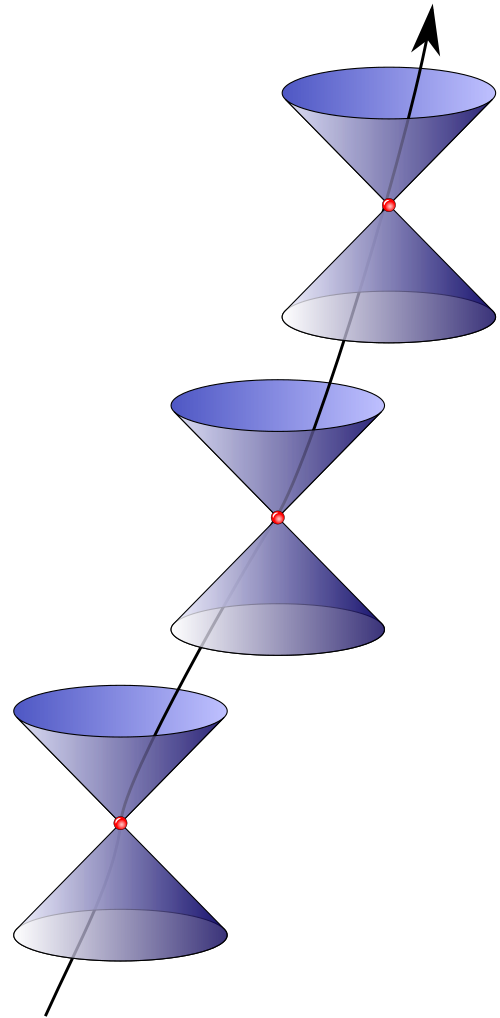
* The Metric Tensor (gμν)
Mathematically, a tensor can be understood here as a matrix that establishes how coordinates—representing spacetime events—transform from one reference frame to another while preserving physical invariants. The metric tensor specifically dictates the geometry of this manifold. In every point of the universe, it acts as a local ‘ruler’ and ‘chronometer’ by defining the spacetime interval (ds2 = gμνdxμdxν). Most crucially for causality, it shapes and tilts the light cones, which delineate the absolute geometric boundaries beyond which information cannot travel. Therefore, the metric tensor is the mathematical structure that translates the causal sequence (event A preceding event B) into the invariant fabric of spacetime geometry.

