Parmenides on Being: that which is (τὸ ἐόν)

English summary. A short reflection, written as a study exercise, on a few lines of Parmenides’ poem On Nature (DK fr. 8, vv. 6–11), in which the goddess rules out that what-is (τὸ ἐόν) could ever have come into being. The lines are read both exegetically and, in modern terms, as early uses of principles we now call non-contradiction, excluded middle and sufficient reason, against the background of the Eleatic challenge to earlier cosmogonies. The full text is in Italian.


[1a] [riguardo all’essere, (τὸ ἐόν)] quale sua nascita cercherai?
[1b, c] Come, da dove può essere cresciuto?
[2] Da ciò che non è non te lo lascerò
né dire né pensare, [2a] perché non è dicibile
né pensabile che non sia.
[3] [Inoltre] Quale necessità lo avrebbe indotto
a generarsi dopo piuttosto che prima, avendo inizio da ciò che non è?
[4] [Conclusione] È così necessario che o esista in assoluto oppure non esista del tutto.


La visione di Parmenide si pone in contrasto con le cosmogonie dei pensatori detti presocratici. Questi versi sono parte del poema nel quale egli riporta come racconto di una dea la via alla verità (aletheia). Questa rivelazione è fondata sul logos, la razionalità che spinge agli estremi la logica interpretativa, diversamente dall’esperienza che viene ingannata dai sensi. Il soggetto sottinteso del frammento è ciò che è (τὸ ἐόν), considerato da Parmenide: ingenerato, eterno, immobile, unico e finito; così dalla dea ne sono definiti gli attributi -che chiama indizi (semata)- al kouros/Parmenide, alcuni precisati nel frammento riportato.

Si possono distinguere due possibili tipologie di argomentazioni nel frammento citato: quelle esegetiche legate più strettamente al testo e quelle legate al logos [*] e alla massima coerenza razionale (i primi passi di una nuova disciplina), espresse in termini ‘moderni’.
[1a,b,c] L’indagine sull’essere potrebbe iniziare dalla sua nascita e crescita, così farebbe una cosmogonia.
[2] Ma la dea (ovvero il logos) non consente al kouros di pensare e di dire che ciò che è possa derivare da ciò che non è, perché pensando ciò che non è per poterne parlare lo si tratterebbe come qualcosa che è [2a] quindi per coerenza razionale questo è non dicibile né pensabile.
Viene applicato un principio di non contraddizione [*].
[3] La domanda retorica evidenzia la mancanza della necessità per ciò che è di generarsi, dopo o prima, da ciò che non è, non solo per le ragioni del verso precedente ma anche per il suo non appartenere al tempo (precisato in versi successivi).
Si evidenzia anche la mancanza di una ragione sufficiente [*].
[4] La conclusione ricorda che la possibilità dell’esistenza è considerata binaria, quindi applica il principio del terzo escluso [*] e l’implicazione che ciò che è può solo essere, perchè è “necessario” che sia.
Quindi è una ragione sufficiente [*].

Da un punto di vista storico, tema del frammento è la ‘provocazione del logos‘, la razionalità. La cosiddetta sfida eleatica di Parmenide contro le cosmogonie, rispetto alle quali rappresenta uno ‘spartiacque’ del pensiero antico.
Le cosmogonie infatti non sono logicamente sostenibili perché passano dal ‘prima’ al ‘dopo’ senza una ragione sufficiente.
please, rate this post

AI as a Boltzmann brain: the illusion of knowledge cancelling the future

This reflection stems from a re-reading of my post on the Boltzmann Brain (see The Boltzmann Brain – an epistemological provocation). While the process today is evolving very rapidly, I believe it makes sense to analyze it from an evolutionary perspective.

The use of AI is certainly an effective support, but we must distinguish between contexts. Enhancing research within an environment of high-level expertise is one thing; using it to obtain basic answers by ‘the youth’ is quite another. The latter prevents the formation of a critical spirit and the necessary ‘fatigue of learning’. Without this granular foundation of skills, more complex elaborations become impossible.

Demographics are unforgiving. Soon, the figures trained on the fundamentals will disappear, replaced by those who never had to struggle to learn. Considering the ‘average’ person, it is easy to predict an immense cognitive impoverishment that will lead to the final decay of our civilization. Technology will remain standing, but without the updating of fundamental principles—the theoretical foundations upon which it is built—it will become obsolete and insufficient.
This is not just the fault of scientific research. The reasons why we still use fossil fuels, rare earth batteries, or nuclear fission do not depend solely on technical limits, but on choices of power that go beyond the official narrative.

I do not believe there is adequate awareness of the ‘toxic’ role of AI. The global project is clear: to create a ‘cerebrally’ undifferentiated anthropic mass, useful as a voting weight and workforce for as long as it costs less than machines. Indeed, I believe that ‘bipedal mammals’ are already cheaper than automation today, yet they are still endowed with a residual self-determination (really residual, as demonstrated during the Covid period).

There is also a parallel with religions. Religions do not have to be rational: the more unbelievable a story is, the more it is believed. They function very well because they provide ‘trusted’ answers, not true ones. No one wants the truth; people just want to be told they are not the only ones thinking something. Social platforms thrive on this. In the same way, AI algorithms provide the answers they ‘must’ provide, based on non-transparent priorities. I do not blame the software, which is just a statistical routine, nor do I blame those who write it. The Puppet Masters sit on the upper floors and manage the triggers.

How to save ourselves?
There is probably no salvation for us ‘standard bipeds’. But history teaches that civilizations always rise from their ashes, perhaps rediscovering a glorious past after centuries of oblivion. I trust in this cycle for humanity. In the meantime, I only hope that the time I have left “non mi sia grave” to borrow from Leopardi.

please, rate this post

Portrait of an epistemological stagnation

We have grown accustomed to being ‘subjected to’ scientific progress as if it were a triumphal and unstoppable march. We live surrounded by a pervasive technology that grants us the illusion of an ever-deepening knowledge of reality. Yet, if we look at the foundations of theoretical physics, the landscape that appears is one of a desolate epistemological stagnation.
For over fifty years, fundamental physics has failed to produce a true ontological revolution. We have confirmed theories born in the last century—such as the Higgs boson from the 1960s or Einstein’s gravitational waves from the beginning of the century, the only two true demonstrations of fundamental theories in recent decades—but we have not given birth to a single new idea that has been proven real (see What’s wrong with scientific research according to Sabine Hossenfelder). On the contrary, we have retreated into a sort of ‘maintenance of paradigms’ (in the Kuhnian sense), adding mathematical patches to models that no longer function (see Kuhn’s “The Structure of Scientific Revolutions” in a nutshell).

The Trap of the ‘Millennium Problem’

A perfect example of this drift is the celebrated Millennium Problem regarding the Navier-Stokes equations (see A pure mathematical version of the Clay Mathematics Institute’s Navier-Stokes Millennium Problem). We are asked to prove whether a ‘smooth’ (continuous) solution can explode into a mathematical singularity. But who does this research truly benefit?
There is a certain arrogance in demanding that the mathematics of the absolute continuum—a tool invented three hundred years ago—must be the faithful mirror of a reality we know to be intrinsically granular. Seeking regularity or singularity in Navier-Stokes is an exercise in the internal consistency of an axiomatic system, a ‘mathematical little game’ that adds nothing to our understanding of matter.
It is a restaging of the late 19th-century ultraviolet catastrophe: classical physics predicted the emission of infinite energy from a black body because it assumed energy was infinitely divisible. Max Planck did not ‘solve’ the calculation problem that diverged; he changed the logic, introducing the quantum of energy—a granular discretization (see Planck’s photon distribution function). Today, persisting in the search for regularity in continuous fluid dynamic models without accepting the logical (and physical) limits of that language is like trying to measure an atom with a ruler: the error is not in the mathematical calculation, but in the model adopted.

The Ptolemaic universe of dark matter

If Navier-Stokes is a dead end for brilliant minds, modern cosmology has become a triumph of epicycles. Kuhn taught us sixty years ago that when a paradigm enters a crisis, the scientific community does not abandon it immediately, but instead begins to ‘save’ it with ‘ad hoc’ hypotheses.
Thus, to make General Relativity equations square with a universe that moves differently than predicted, dark matter and dark energy were invented. We do not see them, we do not know what they are, and we do not understand their nature. They are ‘magical patches’ necessary to prop up models that we are unable to interpret. We are planning trips to Mars using a modernized Ptolemaic system, convinced that adding an invisible epicycle is nobler than admitting we have failed to understand the nature of gravity on a large scale (see Note for laymen – what is the dark matter?).

The Deception of Technological Progress

The common objection is: “How can you speak of stagnation when Artificial Intelligence and silicon dominate the world?”
Here lies the fundamental misunderstanding. Technology is not fundamental science; it is the exploitation of past discoveries. Computers are based on the quantum mechanics of the 1920s and 30s; our rockets on 19th-century thermodynamics. Technology is the engineering that refines the already known, but the theory upon which it is founded remains old—tremendously old. We are utilizing maps that ignore 95% of the territory, or that are incapable of observing it in its true reality.

The Tyranny of the ‘Barons’ and the veto of the paradigm

Why do we not move forward? Because knowledge has become a hostage to a feudal academic structure. The ‘Barons’ of the paradigm are slaves to their own careers and the consensus of the community. Risk is not funded. Anyone proposing a sensible cosmological model that does not include invisible ‘ghosts’ is isolated, denied publication, and stripped of funding.
The system prefers to distract superior minds by challenging them with inessential problems—like Navier-Stokes singularities or calculating the galactic halos of magical components—rather than facing the terrifying uncertainty of a paradigm shift. We are moving backward, not forward, because we have lost the ability to see the problem before calculating the solution.

Conclusion: seeing beyond the fence

Mathematics is indifferent to the survival of the solution, but we should not be. The task of research is not to balance the books of a useless abstraction, but to find the correct language to describe reality.
The result regarding the Navier-Stokes singularity will not change the empirical efficacy of the laws of dynamics. It would perhaps establish (with due respect to Gödel) whether the continuous model is a coherent language or if it is destined to succumb to its own abstraction.
The true challenge is having the courage to admit that our reference models do not describe reality, and that it is necessary to explore new descriptions of nature beyond a “déjà vu that simply ‘does not work’ (by the very admission of those who continue to support it).
While waiting for a visionary genius to find a better description of reality, we could, in the meantime, make room for the visionaries who see beyond the fence…

please, rate this post

Ontology vs. Epistemology of Time

My belief is that time does not exist in Nature.

To understand how time can be nonexistent in Nature while general relativity (GR) remains valid, it is necessary to distinguish between what the world is and how we describe it:
– Ontological Plane (Nature): Reality is an accident of events according to a ‘grammar’ of cause and effect. In this view, time does not exist as an external container or clock; there is only the logical necessity that certain events presuppose the occurrence of others. Nature does not ‘wait’ for time to pass: it acts according to an intrinsic causal ladder.
– Epistemological Plane (GR): General Relativity is our logical ‘map’. Since the human mind cannot perceive the entire network of atomic and discrete events, it uses the construct of spacetime to organize, measure, and, above all, predict.

Causality as the Skeleton of GR
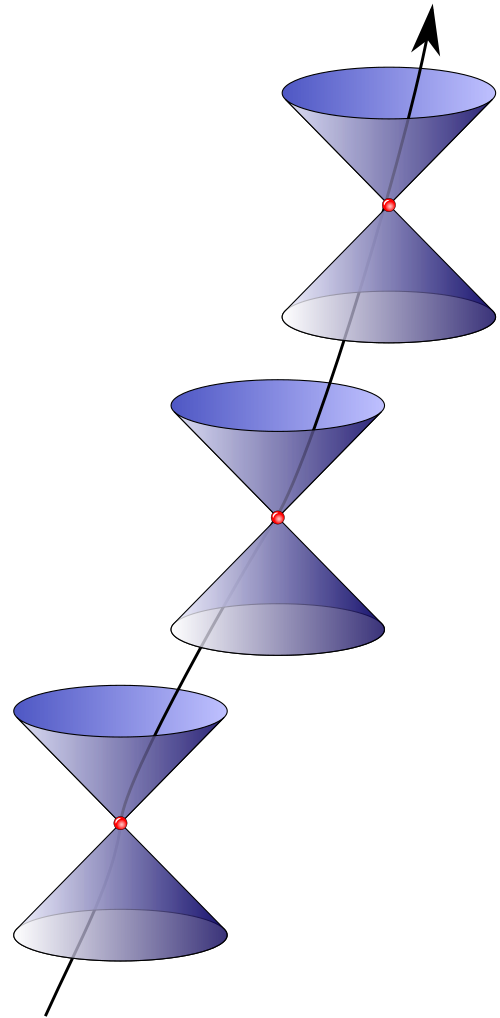
In physics, the causal structure of a manifold is defined by the set of precedence relations between events. If Nature operates according to a ‘causal ladder’ (A must precede B), GR encodes this necessity through the metric tensor*.
The fact that GR ‘works’ means that its mathematical architecture faithfully respects the logical sequence of natural events. The coordinated time t of GR is nothing more than a numerical index that we assign to events to keep track of their causal succession.

Predictability vs. Occurrence
The difference between the anthropic and natural visions lies in the concept of determinism vs. necessity:
– For Nature: Things happen when they are meant to happen. There is no delay or waiting; there is only the satisfaction of causal conditions.
– For Human Beings (GR): We need predictability. For us, it is not enough to know that B will follow A; We want to know when (according to our parameters) and where. GR introduces tools like Cauchy hypersurfaces to allow us to calculate the ‘future’. This computational capacity is a human need: Nature does not calculate its next state, it simply executes it.

GR as a relational model
GR remains valid because it describes how matter-energy influences the configuration of causal links. Even if we eliminate the idea of ​​a ‘container’ time, GR continues to tell us how the logical proximity between events is altered by the presence of mass. In this sense, the curvature of spacetime is not the deformation of a ‘time substance’, but the deformation of the network of causal relations that constitutes the world.

In short: Nature is the ‘ladder’ of facts, GR is the technical manual that humanity has written to index that ladder and transform it into prediction.


Universe line (credits: wikipedia)


universe line


* The Metric Tensor (gμν)
Mathematically, a tensor can be understood here as a matrix that establishes how coordinates—representing spacetime events—transform from one reference frame to another while preserving physical invariants. The metric tensor specifically dictates the geometry of this manifold. In every point of the universe, it acts as a local ‘ruler’ and ‘chronometer’ by defining the spacetime interval (ds2 = gμνdxμdxν). Most crucially for causality, it shapes and tilts the light cones, which delineate the absolute geometric boundaries beyond which information cannot travel. Therefore, the metric tensor is the mathematical structure that translates the causal sequence (event A preceding event B) into the invariant fabric of spacetime geometry.

please, rate this post

The URD Framework – under development

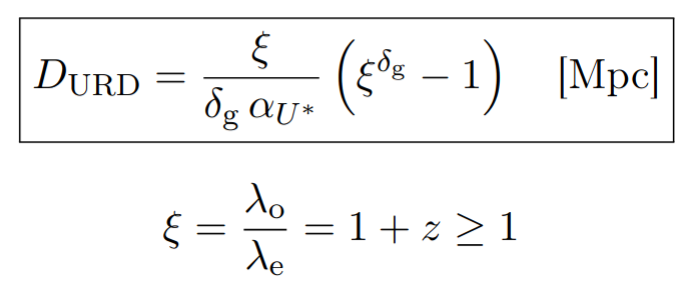
The URD Framework: Cosmological Distances from Redshift in a Non-Standard Context

While I am still developing the project —including through parallel studies on the Tolman test and the quality of indirect data obtained from recent galaxy surveys— I am making my work public as a preprint. I always hope that someone might be interested in my conjectures or perhaps even willing to collaborate with me to address the critical issues of the URD Framework.


Abstract
A phenomenological framework for determining cosmological distances is proposed, based on a non-expanding spacetime interpretation consistent with current observational datasets. The model introduces a redshift mechanism associated with cumulative photon energy attenuation along the line of sight, formulated in a way that is not equivalent to standard tired light scenarios. The approach is constructed to remain compatible with established relativistic principles whereas adopting boundary conditions distinct from the metric expansion paradigm. Distance estimation is achieved through the URD equation (U energy density, Redshift, Distance), which incorporates two phenomenological parameters that describe conformal geometric dissipation in extended gravity and an effective relativistic path-length correction. Within this formulation, the model addresses the primary shortcomings traditionally associated with energy dissipation effects, specifically reconciling time dilation in supernova light curves and the Tolman surface brightness relation. The model is calibrated using the Pantheon+ supernova sample by comparing and cross-validating distances inferred from the proposed redshift mapping with redshift-independent indicators, with additional comparison performed against baryon acoustic oscillations, radio galaxy samples, and high-energy quasars. Across these datasets, the framework reproduces observational constraints over a wide redshift range within a phenomenological, non-standard cosmological setting. The results indicate that alternative, non-expansion-based mappings between redshift and distance can be constructed that remain consistent within the observational range considered, suggesting a phenomenological alternative worth further study.
Keywords
cosmological distance ladder; redshift-distance relation; non-expanding spacetime; cosmic microwave background; extended gravity; Pantheon+ sample; baryon acoustic oscillations; Tolman test; time dilation; geodetic correction


Here is the last version of the preprint (5.1 MB):

pdf Brussi 2026_URD Framework Preprint

Version uploaded to Zenodo:

link DOI – zenodo.20763682


URD distance formula

please, rate this post

Leonard Susskind about the c constant

An in-depth analysis by Leonard Susskind of the constant c, commonly referred to as the “speed of light.” It is essentially a collection of familiar concepts, but reinterpreted in an illuminating way, that are well worth considering.


please, rate this post

Cosmology for a static universe

Abstract

This brief work, then became an Appendix to my URD Framework study, proposes a cosmological model characterized by a globally flat, spatially infinite, and non-time-limited spacetime. It challenges the standard application of the Friedmann-Lemaître-Robertson-Walker metric by reinterpreting general relativity as a strictly local phenomenon within a non-continuum matter distribution. In this framework, the observed flatness of the universe is a fundamental geometric property rather than a dynamical result of inflation, and cosmological redshift is modeled as a cumulative energy dissipation process rather than metric expansion.

pdf  Brussi 2026_Cosmology for a static universe


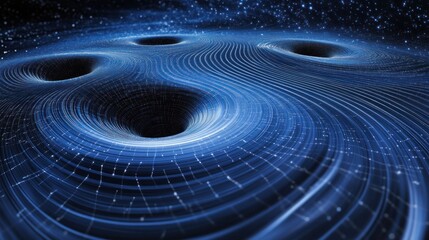
gravitational emotion

Ai generated image from free Adobe stock

please, rate this post

The Boltzmann Brain – an epistemological provocation

The Boltzmann Brain  (Ludwig Boltzmann, 1844-1906) is one of the most unsettling thought experiments in modern physics, sitting right at the intersection of thermodynamics and the philosophy of mind. It suggests a provocative paradox: in an infinite universe governed by entropy, it is statistically more likely for a single, self-aware brain to spontaneously flicker into existence -complete with false memories of a life it never lived- than for an entire structured universe to evolve over billions of years.
At its core, this concept challenges our very definition of reality. If we are more likely to be a random ‘fluctuation’ in a sea of chaos than biological products of a long evolutionary chain, how can we trust our observations of the cosmos? It’s not just a puzzle about physics; it’s a fundamental question of epistemology: how do we know we are truly part of a stable universe and not just a fleeting thought in the void?

It’s impossible not to think about the brilliance of The Matrix.
But while The Matrix asks us to choose between a comfortable lie and a harsh truth, the Boltzmann Brain suggests that truth might not be a structure at all, but rather an accidental flash of order in an ocean of nothingness. In both scenarios, the epistemological question remains the same: if your senses and memories were the only data you possessed, how could you ever prove you aren’t just alone in a timeless void?


blue red

please, rate this post

Odifreddi’s Lucretius

Perhaps I will not add anything about an author who has demonstrated not only competence but also genuine originality in many of his works, but I want to write this review, trying not to slip into apologetics.
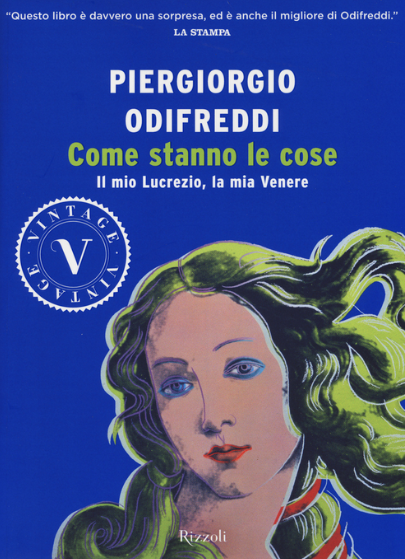
I am referring to Come stanno le cose. Il mio Lucrezio, la mia Venere, an essay (published by Rizzoli, 2014) by Piergiorgio Odifreddi (1950–), who, in a new complete translation of the poem De rerum natura by Titus Lucretius Carus (98/94–50/55), provides a version in modern words and meanings—not only to make it easier to understand ideas conceived two millennia ago, but above all to highlight their incredible modernity. An excellent conception of the work and an excellent execution, in which the translation on the right-hand pages and the interpretation on the facing pages make it possible to appreciate both the ideas that today we would call scientific and the philosophical visions of a great author.

In high school (a scientific high school) De rerum natura was the subject of a (mild) in-depth study (though we were required to buy a book about the poem, which I still keep). But our teacher was not able to convey its greatness and meanings, surely because he had not understood them himself, with the partial excuse that the ‘literal’ translation by someone who, perhaps like him, being wholly incompetent in scientific matters, was not even able to sense how, in recent centuries, science has confirmed some old intuitions, obviously at the level of general principles.

Odifreddi’s work, therefore, not only restores Lucretius to his full stature, but also tries to fill a gap that is perhaps typically Italian, where scientific culture has always been little widespread and little valued. This has not prevented excellence, of course, but Italians’ general lack of competence on scientific and technical topics is limiting in a modern world founded above all on technology. I realize I do not know the situation well in other countries, but my thought was also tied to the ‘historical responsibility’ of being part of a land that is a ‘cradle of civilization’ and of thought, now reduced to a third-rate caricature in geo-economic and political balances, unworthy of a cultural heritage that has no comparable equal in the world. A heritage that must be rediscovered, overcoming the obscurantist inertia of a ruling class inadequate to its role. And I am not referring only to the current one, except in the sense that, being in office, they are the only ones who could do more than a little to change things.

Perhaps it is a small gesture, Odifreddi’s, but it is an excellent achievement that deserves to be known.


Odifreddi Lucrezio

please, rate this post

17 February 1600 – the burning of Giordano Bruno

In Rome, in Campo de’ Fiori, one of the countless murders perpetrated throughout history for conquest and, as in this case, for maintaining imperial power over free thought and ultimately over peoples.
That the killing of the enemy has always been an anthropic standard is evident. Borrowed, as a degeneration, from the animal struggle for survival, to the point of turning it into a ‘moral rule’. Yet the physical violence of domination by the stronger is still understandable in a confrontation ‘on equal terms’. In ancient wars soldiers faced each other directly. Then, perhaps, the victors also abused civilian populations, but in some way they had demonstrated a physical superiority, at least in violence.

The qualitative leap to the suppression of ideas, ideas that differ from the theoretical framework of those in command, is typical of religions, which have often provided a moral and identity-based framework of legitimation for the violence of political and economic powers.

Starting from the common celebratory dating of an event of a religious nature (sun worship later becoming the birth of the ‘son of a god’), one underestimates the conditioning power of religions, namely of those responsible for managing religious sects, founded on the human weakness of the need for a superior being and for its interpreters. Each one claiming to be the bearer of the only truth, incidentally different from that of the others. All fine, if it ended there. But when a different idea is not confronted with better ideas, but by suppressing the bearer of the idea, what is at stake is not truth: what is at stake is power.

Nature is incredibly violent in its evolution, just think of a volcano or an earthquake on our small planet, or, with infinitely greater power, the explosion of a supernova or a black hole, or the gravitational merger of galaxies. We cannot apply criteria of morality or justice to Nature in events that vaporize entire planets in a few instants. But we can to the bipedal mammals of this mild and quiet planet. Endowed with the faculty of rational thought, we should respect this potential in others in order to respect it in ourselves. Yet the ambition for the power of domination has always won by a landslide. And so the bearers of opposing ideas, of a freedom of thought that could weaken one’s own positions as monopolists of ‘truth’, are killed, if possible amid atrocious suffering. Thus small, petty little men of a sect which, in the name of a revealed truth, resorted to coercion and to the killing, after years of imprisonment, of a visionary genius such as Giordano Bruno. Fortunately, however, he managed to pass on to us his thoughts, his visions, still relevant after more than four centuries.

And religious sects are still active today in many parts of the world and, by merging with political power, they become coercive apparatuses that often translate into systematic persecutions and violence—now industrialized in modern ways, but always with the same aim: the suppression of people’s freedom and of ideas, to impose their own dominion through violence and not comparing better ideas on a rational level.

For a more in-depth look at the life and thought of Giordano Bruno, the Wikipedia page is comprehensive.


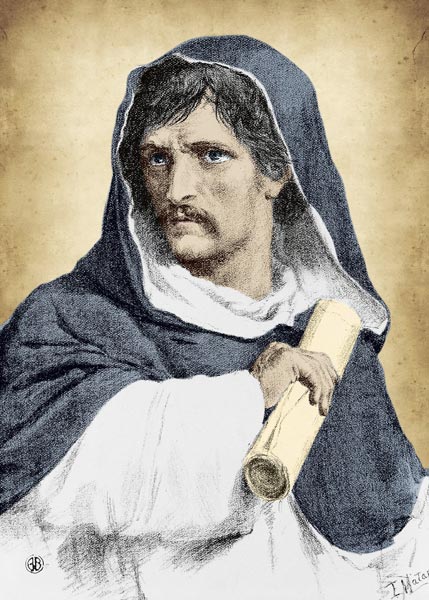
Giordano Bruno
Giordano Bruno (source copia-di-arte.com)

please, rate this post