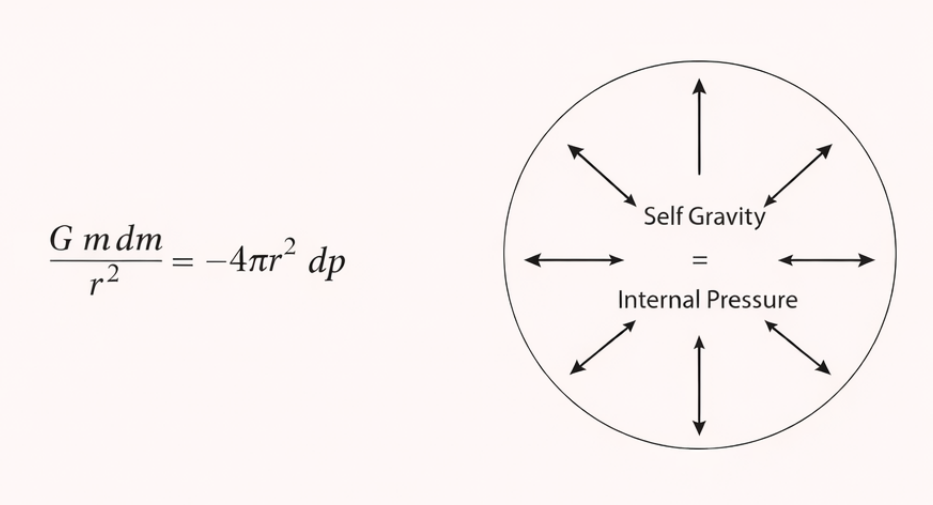
The Eddington luminosity (Lₑ) (named after Arthur Stanley Eddington, 1882-1944), also known as the Eddington limit, is the growth limit of a structure that is in hydrostatic equilibrium (see Figure 1), balancing the outward radiation pressure with the inward gravitational pull.
Figure 1 – Hydrostatic equilibrium
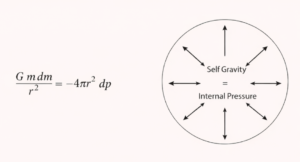
The relationship for the luminosity limit can be easily derived, obtaining:
[1] L ≤ 4π c G M / k = Lₑ
where G is the universal gravitational constant, M is the mass of the object, c is the speed of light, and k is the opacity (ability to absorb radiation) of the material that makes up the object.
As a function of solar parameters, in the case of the model consisting of ionized hydrogen, [1] can be expressed as:
[2] Lₑ ≈ 3.2 * 10⁴ (M/M๏) L๏
where M๏ and L๏ are the mass and luminosity of the Sun.
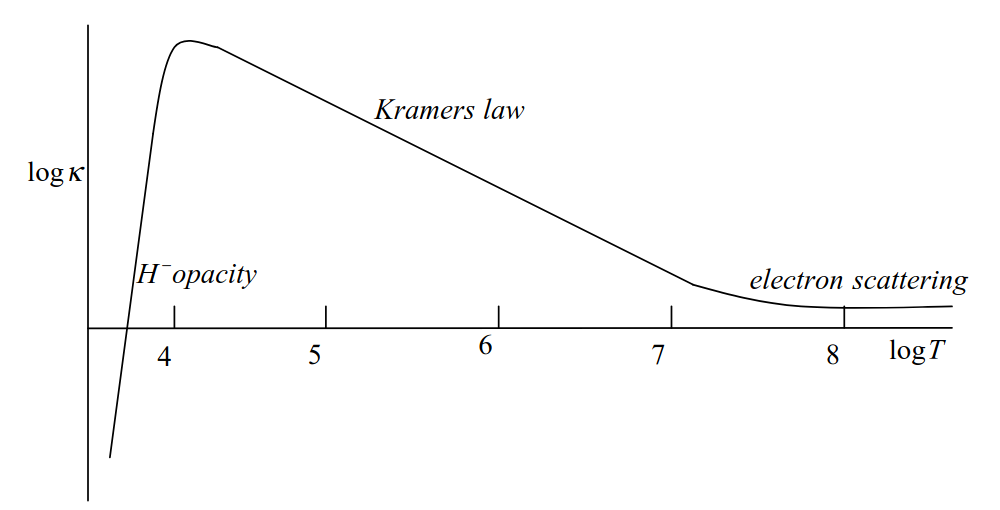
In the very hot core of massive stars (or in accretion disks of black holes), opacity is independent of frequency and temperature, is related to Thomson scattering (see Thomson scattering on Wikipedia for more informations) of free electrons, and can be expressed as:
[3] kₑₛ = σₜ nₑ / ρ
where σₜ is the Thomson cross section for electrons, nₑ is the number density of electrons, and ρ is the density of the medium.
To consider the more general case of models also consisting of helium and metals, the general relationship is expressed as a function of the mass fraction (X) of hydrogen, and the [3] becomes:
[4] kₑₛ = σₜ (1+X) / 2 mₚ ≈ 0.2 (1+X) cm² / gr
where mₚ is the mass of the proton.
Therefore, in the case of a model consisting only of helium, Eddington luminosity would double (with X=0 , [4] is halved and [1] is doubled).
Relationships can also be derived for cases of models that are not fully ionized or colder (for less massive stars), or for highly energetic radiation (e.g., gamma rays as in black hole accretion disks), but these are beyond the scope of this note.
What is notable is that this physical limit explains why we do not observe infinitely large stars; beyond a certain mass limit, the luminosity is such that it disrupts the star.
The Eddington luminosity also defines the maximum rate at which a black hole can grow: if matter falls too quickly, the light emitted repels it back.
 Brussi 2026 Mathematical and historical foundations of ETG (305 KB)