The most famous physics formula in the world is probably that of Albert Einstein (1879-1955):
(1) E = mc²
that is, the energy of a body is equal to its mass times the speed of light squared.
Perhaps not many have truly understood it, but certainly almost no one (without university studies) knows the complete formula, which takes into account both moving bodies and the energy of massless particles.
For moving bodies, a multiplication factor must be considered:
(2) E = γ mc²
According to Einstein’s own special relativity (work from 1905), if we consider ‘particles’ moving in four-dimensional spacetime, the change in their momentum (p), is expressed by the relativistic formula of four-momentum. This is a four-vector* in which the time component is represented by energy and the space components by momentum. In particular, in the case of a moving body, its inertia increases, as in (2), according to a factor proportional to the velocity, called the Lorentz factor (after Hendrik Lorentz, 1853-1928):
γ = 1 / √ (1-v²/c²)
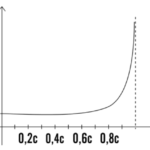
where v is the velocity of the body and c is the speed of light. As can be seen from the formula and from Figure 1 which traces its progression, γ increases as the velocity increases, but remains very close to 1 until the velocities are of the order of magnitude of that of light. For this reason, it is generally omitted, considering γ ≈ 1 . The asymptotic behavior of γ also highlights the difficulty of accelerating material bodies to speeds approaching that of light, whose inertia would have an equally asymptotic behavior.
Figura 1 (credits: youmath.it)
But the four-momentum also takes into account particles that have no mass, such as photons. From the intuition of Louis de Broglie (1892-1987), the wavelength of a photon is inversely proportional to its momentum:
λ = h / p
where h is Planck’s constant. Recalling that the photon’s energy can be expressed as:
E = hc / λ
it is easy to obtain the relation:
(3) E = pc
Einstein’s complete formula for the energy equation is therefore:
(4) E² = (pc)² + (mc²)²
It is easy to see how, in the case of a massless photon, (4) reduces to (3), the energy of the photon, and in the case of a non-moving particle, (4) reduces to (1), the energy of matter at rest. In the case of a moving body, both the energy due to the movement and the energy at rest must be taken into account, i.e. relation (2).
- A four-vector is a four-dimensional vector defined in (relativistic) Minkowski (Hermann Minkowski 1864-1909) spacetime. It unifies a temporal quantity and the three corresponding spatial quantities (for example, time and space, or energy and momentum) into a single mathematical object.
Its fundamental characteristic is that its magnitude (its length) remains unchanged for every observer, ensuring that the laws of physics remain the same even when observed from reference frames in relative motion to each other.

