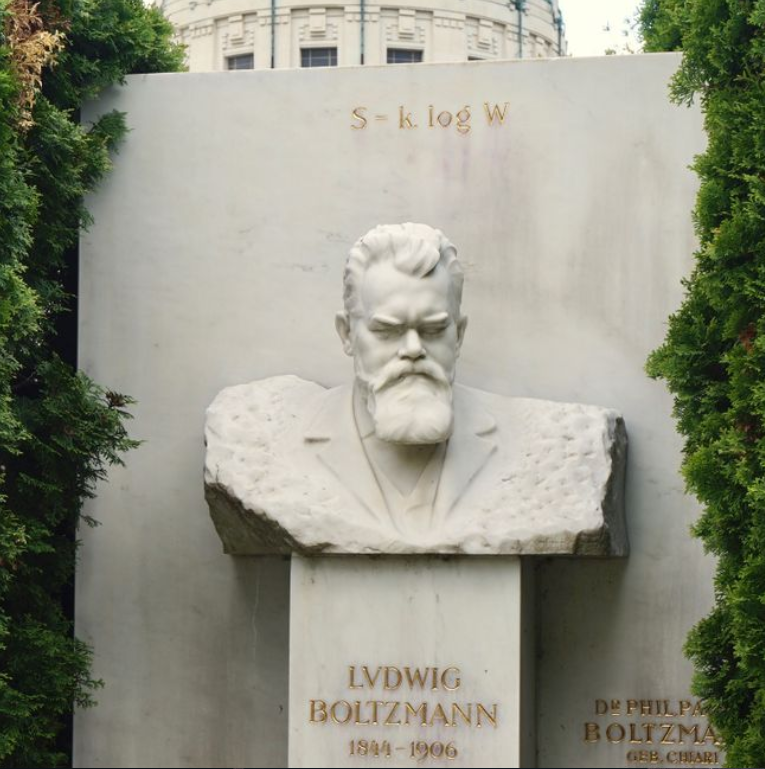
Many are familiar with Albert Einstein (1879-1955) or Isaac Newton (1643-1727), but few know that the profound architecture of the reality we live in today was designed by Ludwig Boltzmann (1844-1906).
If today we naturally accept that everything around us is made of atoms, we have him to thank. But the price Boltzmann paid for this insight was extremely high: intellectual solitude and, ultimately, his life.
The Bet on Atoms
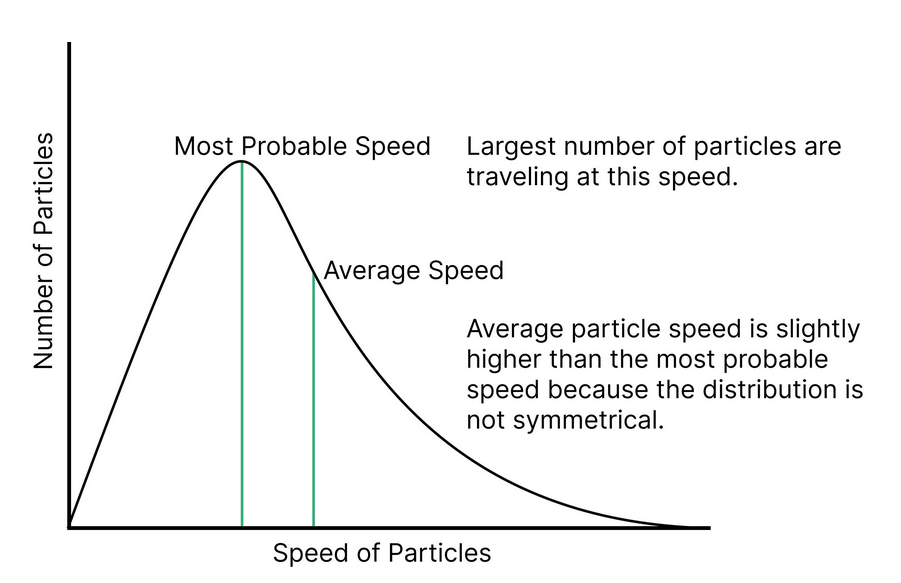
At the end of the 19th century, most scientists (like the influential Ernst Mach, 1838-1916, one of his main detractors) considered atoms merely as “convenient mathematical models,” not as real objects. Boltzmann, on the other hand, was convinced that atoms actually existed. To demonstrate this, he made a logical leap using statistics: he realized that it’s not necessary to know the trajectory of every single molecule to understand how a gas behaves, but rather to calculate the average of their collisions (see Figure 1). From these principles, he developed what later became Statistical Mechanics.
Figure 1 – Diagram of the statistical distribution of particles velocities in a gas (credits: Shutterstock)
Entropy and the ‘arrow of time’
His masterpiece is the famous formula carved on his tomb in Vienna (Figure 2):
S = k log W
This equation connects the visible world (S, entropy) to the invisible world (W, the number of ways atoms can arrange themselves).
One interpretation of entropy is emergent temporal asymmetry: it explains why time only moves forward, not because of a law of mechanics, but because of probability. Heat flows from a hot body to a cold one simply because it is statistically more likely that energy will be dispersed in disorder rather than remain concentrated.
And similarly for the configurational states that hold matter together. Among many, we recall the famous example of the cup falling and breaking into pieces while we don’t observe the pieces spontaneously rejoining to form a whole cup. This happens because the whole cup is a very low-probability state (very ordered); the shattered cup is a very high-probability state (very disordered).
Boltzmann understood that the entire universe is just a gigantic transition to the most probable state.
A misunderstood genius, still underappreciated today
Boltzmann was fiercely attacked by his contemporaries. Scientists of the time, tied to a more continuous view of matter, mocked him. This implacable opposition, combined with a personality prone to depression, led him to commit suicide in 1906, in Duino, near Trieste.
Just a year earlier, in 1905, a young Albert Einstein had published a paper on Brownian motion that proved Boltzmann was right: atoms existed.
He was the first to understand that disorder is the driving force of the universe, and he transformed physics from a science of certainties to a science of probabilities. Without his statistical method and the constant (k) that characterizes it, Max Planck (1858-1947) would never have been able to launch the quantum revolution.
Boltzmann represents the bridge that took physics from the age of steam to the age of the atom and information.
Figure 2 – Ludwig Boltzmann