References for laymen: What is energy?

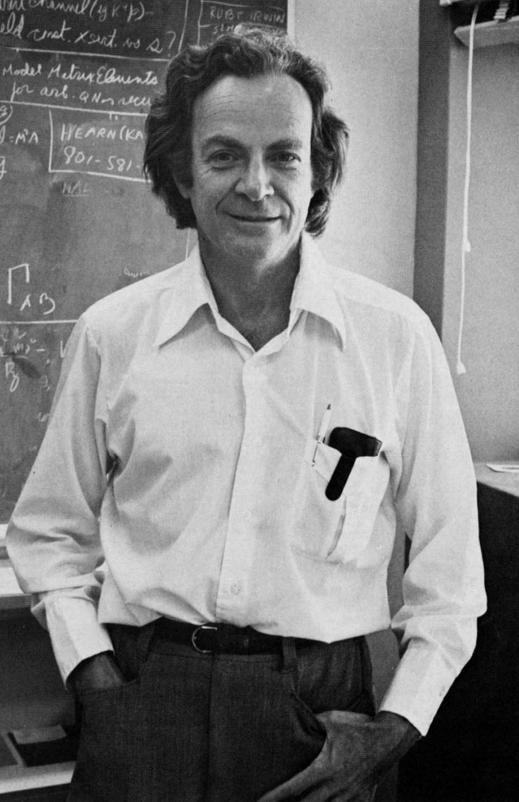
The great physicist Richard Feynman (1918-1988) honestly admitted that in modern physics we have no idea what energy ‘per se’ is. He described it as a kind of magical accounting: in the universe (or rather, in an isolated system), a lot of things happen, but at the end of each day, if we add up certain numbers characteristic of each event, the total is always the same. That number that never changes is energy. It is never created or destroyed, but always transformed.

The scholastic answer, “Energy is the capacity to do work” (given as known the concepts of work, force, etc.), is actually incorrect, because energy naturally tends to ‘spread’; that is, it prefers disorder. And as described by Ludwig Boltzmann (1844-1906), the measure of this disorder, called entropy, always increases in an isolated system. But since entropy also defines energy’s ability to do work, this ability actually always decreases, whereas energy is always conserved.

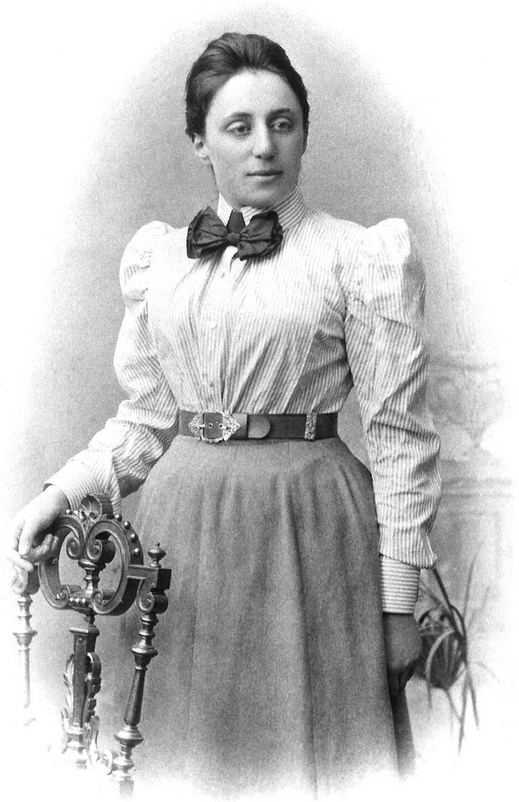
A more technical way to think about energy comes from Emmy Noether (1882-1935), who demonstrated that every conservation law in physics derives from a symmetry: energy is conserved because the Universe has a “translational time symmetry,” meaning the laws of physics remain the same as time passes, and the quantity that mathematically must remain constant is energy. In these terms, one could say that energy is time.

One way to calculate energy is the one defined by Einstein (see Einstein’s formula for energy), even if we don’t know what ‘stuff’ it’s made of. Simply put: even if an object is still and tiny, it hides a monstrous amount of energy within itself thanks to its mass (the constant of proportionality c² is a really huge number). And if it then begins to move due to external action, this energy increases.

Conclusion
We could define energy as the invisible ‘engine’ of reality. We can’t ‘touch’ it, but it ensures that the universe keeps its accounts in order (including the symmetry of time). Every time we do something, or even simply exist, we participate in this immense exchange of ‘tokens’ that has been going on ‘forever’.


Richard Feynman e Emmy Noether

Richard FeynmanEmmy Noether

please, rate this post

The Stage of Reality – Why gravity is not a force and the speed of light is not a speed

Introduction
What we are about to explore is what I call ‘the stage of reality’, the place where we, and everything around us, move (a trivial side note: nothing is truly ‘at rest’ in our universe, as there is no absolute reference frame against which to measure motion). This stage is what we call spacetime, composed of the three familiar spatial dimensions plus time, which is simply an additional dimension. We cannot ‘visualize’ it unless we imagine removing one of the spatial dimensions, as seen in the famous Minkowski diagrams (see Figure, Hermann Minkowski, 1864-1909).
It was Albert Einstein (1879-1955), in his brilliant work in the early 1900s, who viewed the universe not as an empty space where time flows separately, but as a single four-dimensional context. These dimensions are inextricably linked by a metric governed by the laws of gravitation. In this scenario, time is not an external clock, but a real direction in which we move, just as we move North or South, to put it in geographic terms.

Gravity
Why is the force of gravity not a force? For centuries, thanks to Isaac Newton (1643-1727), we thought of gravity as a kind of ‘invisible hand’ that ‘pulls’ objects. But if we apply what Einstein called the equivalence principle (which he described as “the happiest thought of my life”), we discover a fundamental concept. He imagined being in an elevator in deep space, far from any gravitation, accelerating upwards (remember that acceleration is the variation of velocity). You would feel pressed to the floor exactly as you do on Earth. If you were to release Newton’s legendary apple, it would ‘fall’ toward the floor. Yet, there is no gravity ‘pulling’ it; there is only acceleration. Einstein realized that gravity is not a force acting in space; rather, the effect we observe and call ‘force’ is the consequence of the curvature of spacetime itself. In fact, the presence of mass —or rather, mass-energy, since they are the same thing except for a conversion factor (the famous E=mc² )— warps the fabric of spacetime like a weight on an elastic sheet. For example, the Earth, with its concentration of mass-energy, creates a geometric deformation: the apple doesn’t fall because a force pushes it, but because it is simply following the straightest possible line (called a geodesic) in a space that has become curved.
According to Newton’s laws of motion, a body with no forces acting upon it moves with uniform rectilinear motion (respecting the principle of inertia). According to Relativity, an apple falling in a gravitational field is, paradoxically, the only object experiencing no force at all (respecting the principle of inertia). To quote Einstein again: “Matter [mass-energy] tells spacetime how to curve, and spacetime tells matter how to move.”

Light
Now let’s consider light. We attribute a ‘speed’ to it (which we define as a change in position), but as physicist Leonard Susskind (1940-) explains, it is not a speed in the common sense of the term (like that of a car). Instead, it is a fundamental property of the geometry of spacetime —a simple ‘conversion factor’ between spatial and temporal coordinates.
In the four-dimensional universe in which we exist, space and time are different directions of the same thing, and  c  is the number that tells us how many meters are equivalent to one second. That is: time=space / c .
The value of the universal constant c is approximately 300,000 km per second, or just over a billion km per hour (approx. 1.08 billion km/h).
Susskind’s profound suggestion is that every object in the universe always and constantly moves at the exact same speed:
– When we are ‘still’ in space—for instance, sitting in our chairs—we are traveling at the speed of light along the axis of time
– If we start moving through space, we must ‘subtract’ speed from time to compensate for the spatial movement (as if paying a toll using the conversion factor, ). From this, the relativistic time dilation is derived (e.g., the twin paradox).
There are no variable speeds; there is only a distribution of the ‘total speed’ among different dimensions. Therefore, light isn’t ‘racing’: we could say that light spends its entire ‘allowance’ on space, leaving zero for time, based on the conversion factor c .
This constant —the speed of light— is the geometric limit of what can happen in the universe.

Conclusions
There is, therefore, no speed limit; there is only a global geometry in which we are all immersed. Gravity is the curvature of the road; the constant holds together the very fabric of the reality surrounding us. Physics does not describe ‘what happens’, but describes the geometric structure in which everything is already contained.
Understanding this means stopping looking at ‘things’ that move and starting to look at the shape of the stage on which they move.


A Minkowsky diagram (credits to medium.com)
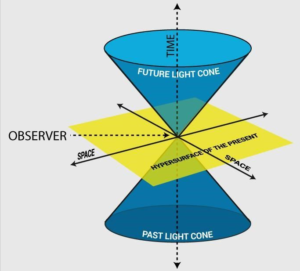

MInkowsky diagram

please, rate this post

Strange mathematical objects: Klein bottle

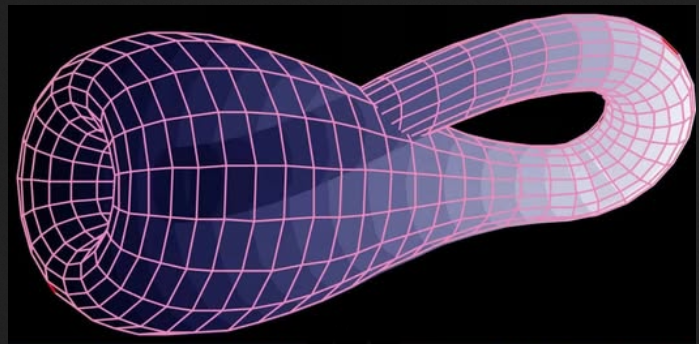
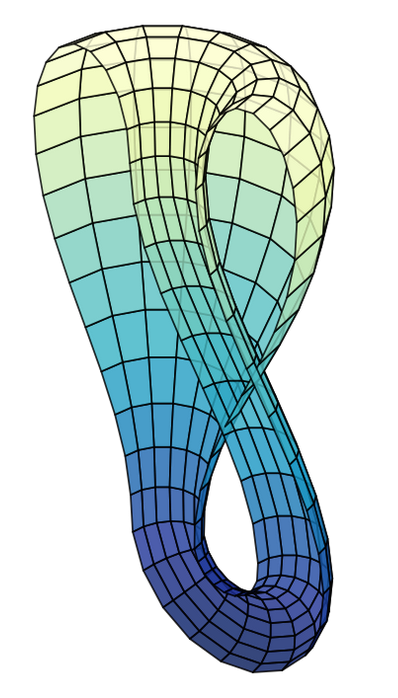
Figure 1 – Klein bottle

Klein bottle


The Klein bottle, or Klein surface, named after the German mathematician Felix Christian Klein (1849–1925), who described it at the end of the 19th century during the development of topology*, it’s an example of one sided surface, with no distinct inside or outside. It is a so-called non-orientable two-dimensional manifold, like the previously seen the Möbius strip, with the important difference that it has no edges.
It is a kind of bottle in which the neck connects to the bottom, having to pass through the wall of the same bottle, as in Figure 1. This is how it appears in a three-dimensional visualization, but like other topological spaces (which we always consider Euclidean), it is not easily visualized in ℝ³. When analyzed in ℝ⁴ there are no overlaps (self-intersections); one understands that the neck does not touch the surface.

Proceeding to higher dimensions, one can imagine a non-orientable three-dimensional manifold that cannot be embedded in ℝ⁴ but can be embedded in ℝ⁵. For example connecting two ends of a Spherinder to each other in the same manner as the two ends of a cylinder for a Klein bottle.

If cut in half, the Klein bottle creates two Möbius strips as in Figure 2, remembering that in reality the intersection does not exist in ℝ⁴.


Figure 2 – A Klein bottle cut in half results in two Möbius strips (source: wikimedia licensed under the Creative Commons Attribution 4.0 Int license)

Klein bottle cut in half


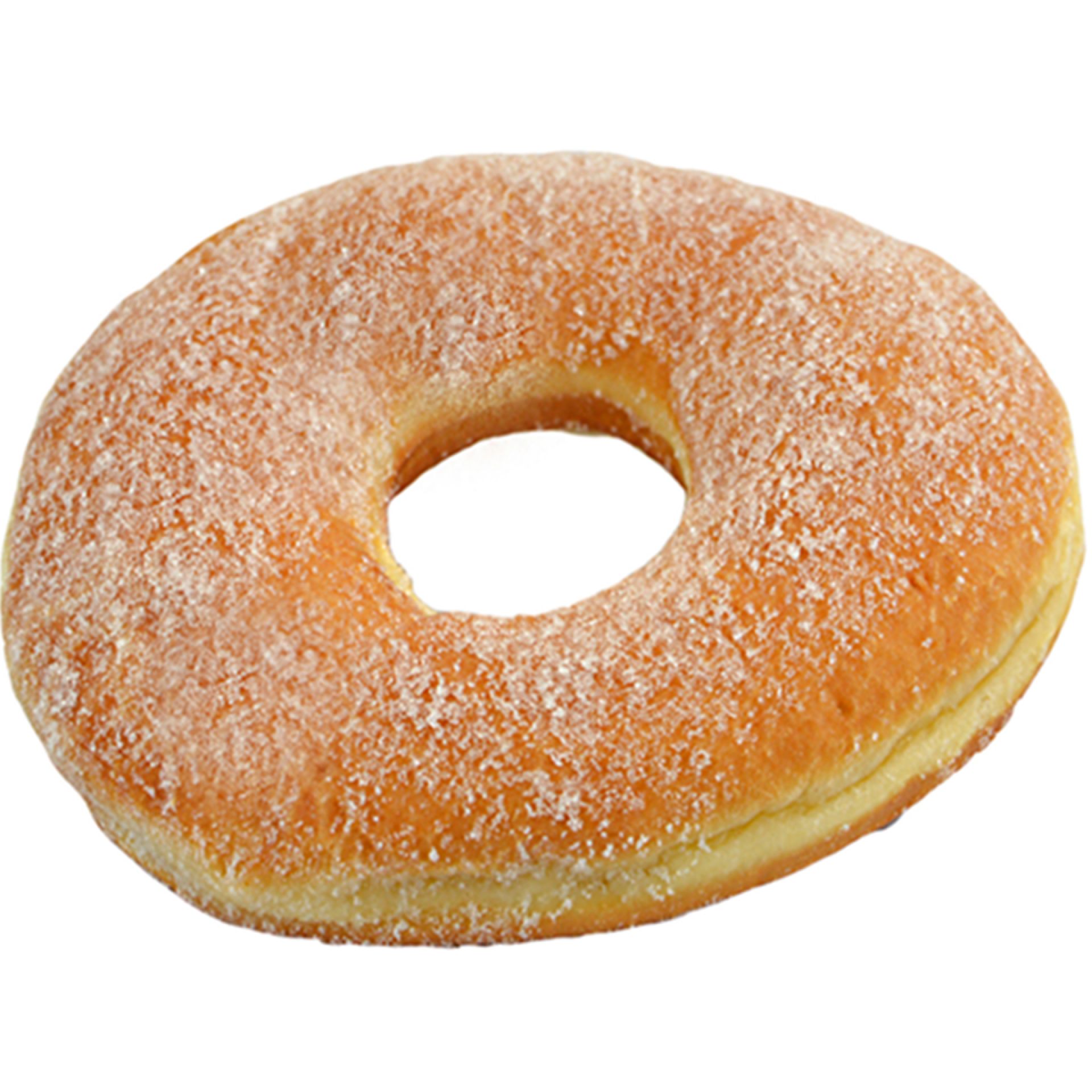
Figure 3 – A tasty solid torus

A tasty solid torus


The traditional (immersed) representation of the Klein bottle is achiral (that is, its mirror image cannot be distinguished from the object). The solid Klein bottle is considered the non-orientable version of the solid torus (such as the one in Figure 3).


Topology*
Topology is an area of mathematics that studies the properties of mathematical objects (shapes) that do not change when a deformation is performed without ‘holes’, ‘overlaps’, or ‘gluing’. For example, a cube is topologically equivalent to a sphere, whereas a torus (a doughnut) is not, because it has a hole that cannot be removed by deformation.
For further reading, the Wikipedia page is comprehensive.

please, rate this post

The virial theorem and stellar equilibrium

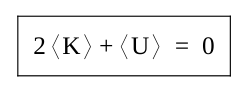
The virial theorem is a fundamental analytical result in the mechanics of particle systems, as it establishes a rigorous connection between the time averages of kinetic and potential energies. Its validity extends to systems in dynamic equilibrium, where internal forces are governed by potentials that depend on distance according to a power law, as in the case of universal gravitation or electrostatics.
The work is written in italian.

pdf_ita Brussi 2026_Il teorema del viriale e l’equilibrio stellare

Teorema del viriale

please, rate this post

Logic pills: the Boolean basics

The mathematician and philosopher George Boole (1815–1864) developed the association between logic and mathematics by analyzing the laws of mental operations underlying reasoning, and expressing them in a symbolic language that would allow logical operators to act like algebraic operators, by means of computable statements. He created what is known as Boolean algebra.

Boolean logic is the foundation of computer science and digital electronics, and it is based on the manipulation of variables that can take only two values: True (1) and False (0). The Boolean logical operators, detailed below, are applied as ‘logic gates’ in electronic devices, making it possible to build the basic operations, then replicated billions of times in modern devices, to create the computers and smartphones we know. More precisely, these include both physical gates, transistors* in hardware, and non-physical gates, in the instructions of operating system and application code.

The fundamental operators are:
AND: returns true (1) only if all inputs are true.
OR: returns true (1) if at least one input is true.
NOT (negation): an operator that inverts the input value: 1 becomes 0, and vice versa.

ABAND (A*B)OR (A+B)
0000
0101
1001
1111

Using the fundamental operators one can build the logic gates:
NAND (Not-AND): output is false only if all inputs are true.
NOR (Not-OR): output is true only if all inputs are false.
XOR (Exclusive OR): true if the inputs are different, false if they are the same.

Combinations of these gates and the fundamental operators, together with an algebra that makes them workable, make it possible to build digital circuits and instruction structures that process and store data.


Transistor*

Transistors are devices made of semiconductor materials (e.g., modified silicon) that behave like a ‘switch’, regulating current flow on the basis of a control signal (in the sense that its value determines whether the flow can pass or not).
OFF state: if there is no signal on the control (value 0), the transistor blocks the flow (open circuit).
ON state: if there is a signal on the control (value 1), the transistor allows the flow (closed circuit).

Logic gates can thus be built:
AND gate: two transistors in series; current flows only if both are ON (1 AND 1 = 1)
OR gate: two transistors in parallel; current flows if at least one of the two is ON (1 OR 0 = 1)
NOT gate: called an inverter; a single transistor configured so as to disconnect the output (open circuit) if it receives the signal (value 1).

please, rate this post

Strange Mathematical Objects: Möbius strip

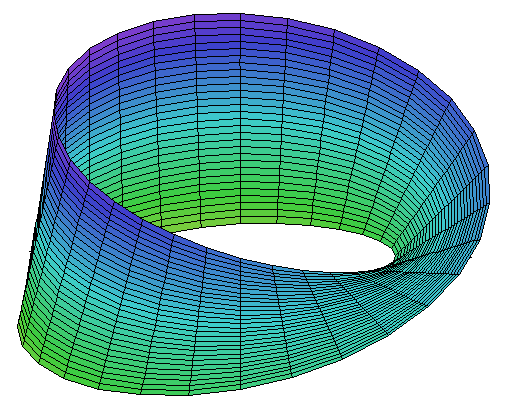
Figure 1 – Möbius strip

Möbius strip


The Möbius strip is a three-dimensional object studied in topology* with unusual characteristics: it has only one side and only one boundary (see Figure 1). It can be easily made from an elongated rectangular strip of paper by joining the short ends after first giving one end a half-twist. With the object in hand, one can immediately verify—also by tracing it with a finger—that it has a single side and a single boundary.

Its name comes from August Ferdinand Möbius (1790–1868), who was the first to study non-orientable surfaces (surfaces on which it is not possible to distinguish positive and negative configurations, an “inside” and an “outside”) and ruled surfaces (which can be obtained as a union of straight lines, such as the plane, the cylinder, and the cone), like this one.

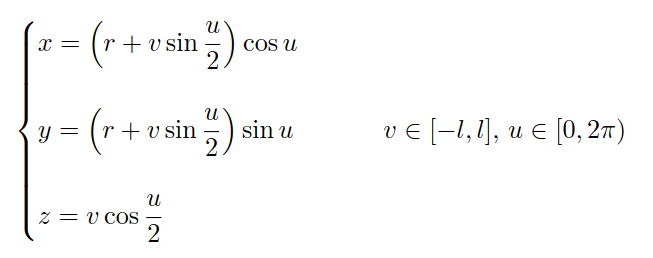
In ℝ³ the strip is described by the following parametric equations in Cartesian coordinates:

 Möbius strip equationswhere r and l are fixed positive numbers with r>l (a necessary condition for the strip to have the possibility of twisting).

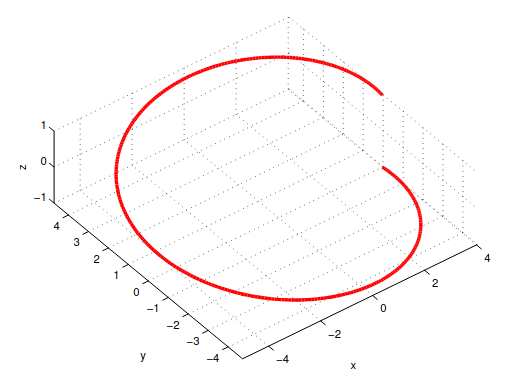
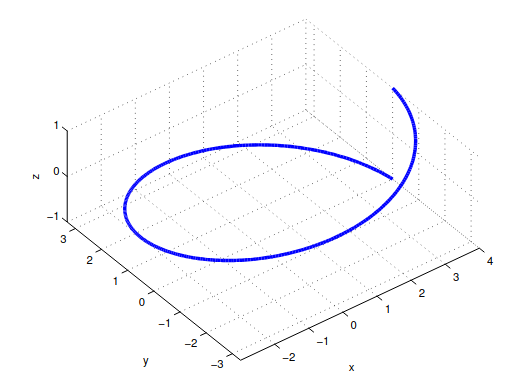
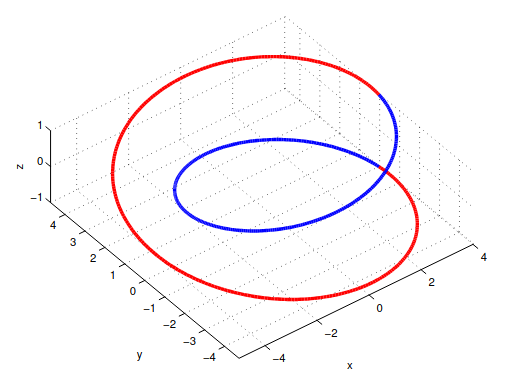
Informally, one can say that the parameter u is an angle that “goes around” the strip counterclockwise, while the parameter v “moves from one side to the other” across the strip. Fixing two values of v, for example v=−1,1, one obtains the curves in Figures 2 and 3, which, taken together, outline the boundary of the strip in Figure 4. As is easy to guess, for v=0 one obtains a circle, i.e., a closed curve halfway along the strip. Interestingly, cutting the strip along this midline does not produce two strips, but a new single strip twisted twice.


Figure 2 – Curve obtained with v=1 (source: Riccardo Dossena, UniPV)

Mobius curve v 1

Figure 3 – Curve obtained with v=−1 (source: Riccardo Dossena, UniPV)

Mobius curve -1

Figure 4 – Curve obtained by combining the previous two, the boundary of the strip (source: Riccardo Dossena, UniPV)

Mobius curve v1 and v -1


Once the boundary is defined, it is easy to understand how the set of all the curves described by the two parameters u,v, over the intervals considered, can define the entire surface of the strip.

Topological considerations are omitted, and the reader is invited to do some experiments by constructing strips with two or more twists of the ends before joining them, and by cutting the strip along its middle in the various cases to see the results… surprising!


Topology*
Topology is an area of mathematics that studies the properties of mathematical objects (shapes) that do not change when a deformation is performed without ‘holes’, ‘overlaps’, or ‘gluing’. For example, a cube is topologically equivalent to a sphere, whereas a torus (a doughnut) is not, because it has a hole that cannot be removed by deformation.
For further reading, the Wikipedia page is comprehensive.

please, rate this post

Strange Mathematical Objects: Torricelli’s Trumpet

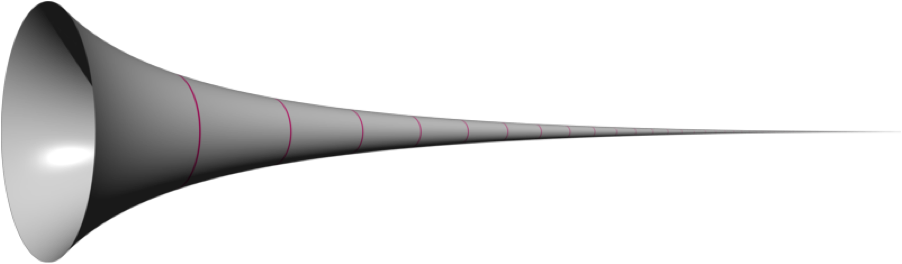
Figure 1 – Torricelli trumpet

Torricelli trumpet

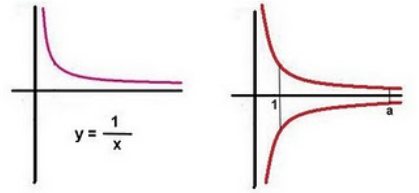
The Torricelli trumpet is a solid obtained by revolving the curve with equation y=1/x around the x-axis over the interval [1,+∞), see Figure 2. It takes its name from Evangelista Torricelli (1608–1647), who studied it in the 17th century.
The peculiarity of this solid is that it has finite volume but infinite surface area.


Figure 2 – Torricelli trumpet 2D equation (source: maeckes.nl)

Torricelli trumpet equation


To verify this today we can easily use integral calculus, which did not exist in Torricelli’s time.

In a coordinate system (x,y,z) the horn is described by the parametric equations:
x(ξ,θ)=ξ
y(ξ,θ)=acos⁡θ/ξ
z(ξ,θ)=asin⁡θ/ξ

The volume and the surface area are computed as follows, where  a > 1  is a value of  x:

Volume and area trumpet

It is therefore clear that as  a → ∞  the volume approaches the finite quantity π , while the surface area diverges.

This apparent paradox, finite and infinite values associated with the same object, can be explained easily mathematically, as follows. If we consider a can of paint, it certainly has a finite volume. If we spread it over a surface, mathematically the thickness could be infinitesimal, so it could indeed cover an infinite area.

please, rate this post

Logic pills: Implies (→) is not follows (⇒)

In classical logic* it is easy to confuse them, but they are different things.
Given two declarative statements to which a truth value can be assigned, an antecedent P (premise) and a consequent C (conclusion), we consider:

P → C (if P then C) a statement with a truth value
P ⇒ C (from P follows C) an inference: C is derivable by assuming P.

The crucial difference lies precisely in this deducibility obtainable in the inference. Instead, the implication P → C is true even when P is false. Therefore it can happen that P is false, C is false, and yet P → C is true. In particular, if P is false, P → C is true whatever C is. For this reason, the implication by itself does not establish (nor prove) the truth of C.
Instead, from P follows C is legitimate only when P is available as a hypothesis in the reasoning: and it is the typical case in which, if P and P → C, then one can conclude C. But if P is false (or is not assumed), the implication is said to be ‘vacuously true’ and it does not authorize any conclusion about C.

If and only if: equivalence as a double inference
The properties of inference make it very useful: a large part of mathematical proofs is based on if and only if, which expresses an equivalence between two statements A and B.
To say:
A if and only if B
means precisely to prove both directions:
A ⇒ B (A is sufficient for B)
B ⇒ A (B is sufficient for A)
When both inferences are valid, A and B are logically equivalent, therefore they have the same truth value.


Classical logic *

This is how one refers to those logical systems (the most used in basic mathematics) in which laws and rules considered traditional hold, such as:

Law of excluded middle: every statement is either true or false (P or not-P)
Non-contradiction: P and not-P cannot both be true
Double negation: negating twice brings one back to the original statement
Explosion (in the presence of contradiction): from a contradiction one can derive any conclusion.

‘Non-classical’ logics arise from wanting to give up or modify some of these features. By way of example:

intuitionistic logic: does not accept the law of excluded middle as a general rule
paraconsistent logics: do not accept explosion (they tolerate contradictions without making everything ‘collapse’)
modal logics: add operators such as necessarily / possibly.

please, rate this post

How lightning works

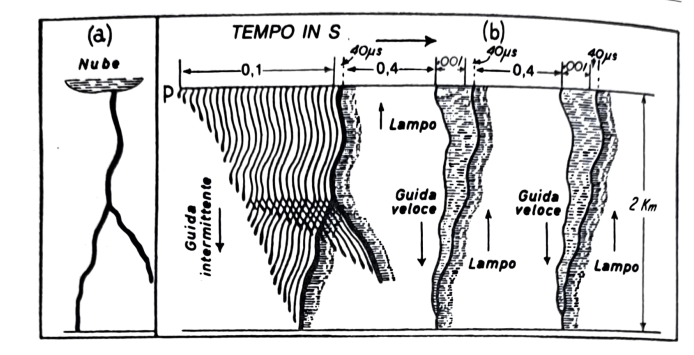
An interesting explanation is given in Ottavio Vittori’s excellent book L’atmosfera del pianeta Terra (Zanichelli, 1992), from which the introductory chapter on this powerful electrical phenomenon is attached with the best intentions.
It’s written in italian.

pdf  Vittori 1992_L’atmosfera del pianeta Terra


Lightnings

please, rate this post

Olbers’ paradox and the dark night sky

Why is the night sky dark?
If universe were infinite, eternal, and static, as Giordano Bruno (1548-1600) claimed, as did cosmology until the early 20th century, adding that it is also populated by stars in a homogeneous manner, the night sky should be bright and not dark. This contradiction was already noted by Johannes Kepler (1571-1630) in 1610 in Dissertatio cum Nuncio Sidereo.
However, the principle was clearly formulated in 1826 by Einrich Wilhelm Olbers (1758-1840), who mathematically demonstrated (see below, optional reasoning which can be skipped) why the night sky should shine according to the cosmology of the time, highlighting a paradox with respect to observation.

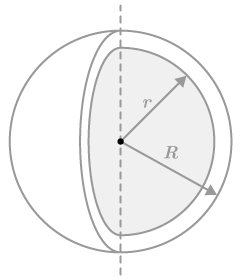
Imagining the universe as consisting of spherical shells concentric with respect to our point of observation (see Figure 1), the intensity of radiation received (flux  f ) from a source ( L ) at a distance ( r ) is inversely proportional to the square of the distance:
[1]    f = L / 4 π r²
The number of sources contained in the shell is proportional to the volume, which increases with the square of the distance (by infinitesimal increments
dr = R – r  with reference to Figure 1):
[2]    dn ∝ dV ≈ 4 π r² dr
Therefore, the effects of [1] and [2] compensate each other and each shell contributes with the same intensity, regardless of distance.
The infinitesimal intensity ( dI ) coming from the infinitesimal shell, multiplying [1] and [2], is:
[3]    dI = f dn = n L dr
Integrating [3] gives the total intensity:
[4]    I =∫₀ᴿ n L dr = n L R
Therefore, for  R → ∞, the intensity [4] should become infinite. So something is wrong with the reasoning (hence the paradox).


Figure 1 – sketch of a spherical shell

spherical shell


The observation of the dark night sky is explained in modern terms (based on cosmological standard model) because the universe has existed for a finite time (Big Bang hypothesis) and is expanding (interpretation of the redshift of radiation from remote sources).
In the first case, it is considered that the light from remote sources, which has a finite speed, simply has not reached us yet.

In the second case, redshift, or the shift of light towards longer wavelengths (for example, in the infrared band, beyond the range visible to the eye), prevents the observation of remote sources.
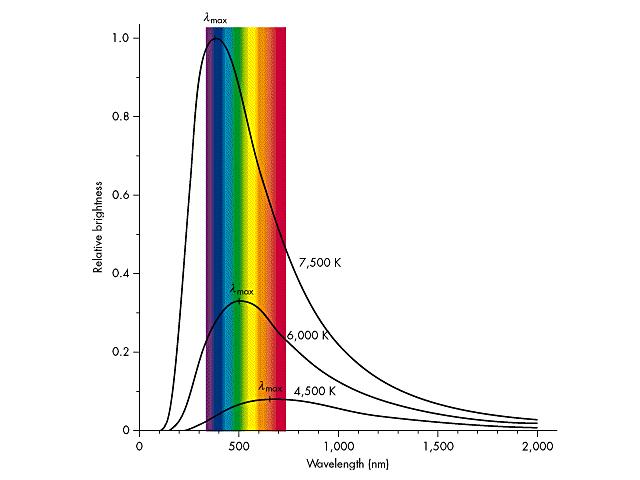
It should also be remembered that the distribution of the intensity of radiation from stellar sources follows a Planckian curve (see Figure 3), which has its maximum in the visible light band. In other words, there are no significant intensities of radiation in a typical stellar source that, moving due to the effect of redshift, could affect this visible band.
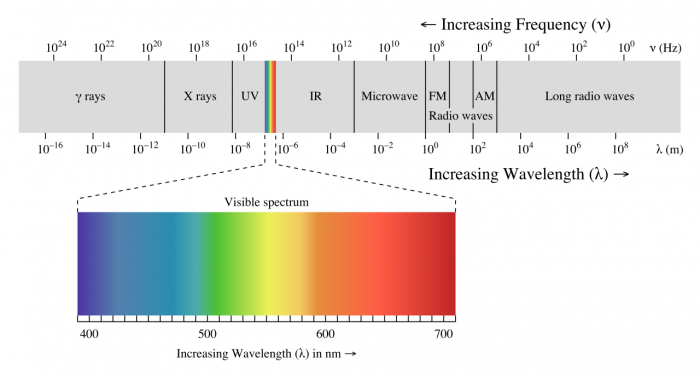
In fact, we emphasize that the range of radiation visible to our eyes is very small compared to the entire spectrum of radiation, as shown in Figure 2.
In reality, redshift alone would explain the dark night sky, even if the universe were infinite and without assuming a Big Bang. And even without expansion, if the observed redshift had a different cause.


Figure 2 – full spectrum of radiation with visible band

fulll spectrum


Figure 3 – A sketch of a Planckian functions of brightness (intensity of radiation emitted per unit solid angle) for stellar sources with different surface temperatures. That of the Sun is approximately 5700 K.

blackbody

please, rate this post