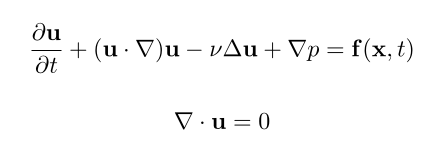
A pure mathematical version of the Clay Mathematics Institute’s Navier-Stokes Millennium Problem

Abstract
This report provides a rigorous transition from the physical formulation of the incompressible Navier-Stokes equations to their pure mathematical representation as defined by the Clay Mathematics Institute for the Millennium Prize Problems. We detail the physical meaning of each term in the classical equations and subsequently reformulate the problem strictly in the language of partial differential equations (PDEs) and operator theory, establishing the axiomatic constraints that govern the variables and parameters of the system.


pdfBrussi 2026_Navier-Stokes Millennium Problem


Version uploaded to Zenodo: link DOI – zenodo.21852870


Navier-Stokes Millennium Problem

please, rate this post

A wearable math problem

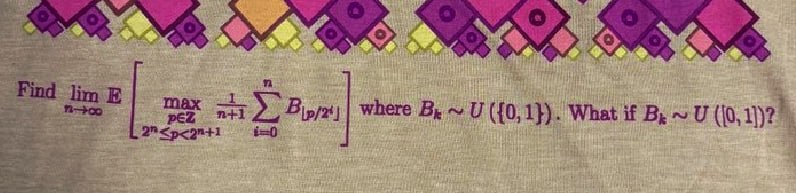
I was given this problem, printed on a T-shirt handed out at a math conference.
Below is my answer to the first part, which I believe is correct.
Does anyone know the answer to the second question as well?


math shirt


The defined structure is a ‘binary’ fractal because it divides into two parts each time.
The first question is to find the maximum expected value for the average of the values encountered when traversing the entire structure, as the number of subdivisions approaches infinity, if the values 0 or 1 are randomly assigned to each small square. That is, the maximum average value obtainable by following one of the paths.
[One path could be, for example, 1+0+1+0+1+0+0+1+1+1+…, another 1+1+1+1+1+1+1+1+1…]
Since the subdivision is binary, the chance of getting a 1 each time is 1/2 (one in two). But the number of paths grows at the same rate at which the probability decreases (doubling at each step), so it should always be possible to find a path where all the squares contain 1s; therefore, I would say the answer for the maximum of this expected value is “1”.
The following “what if” question, however, asks for the same expected value not for two discrete values, {0, 1}, but for the continuous values of the interval [0, 1] …
Not trivial… the chances of obtaining a number are no longer as simple as the 1 in 2 from before…


please, rate this post

Cute math game

Let us consider the number
[1] x=0.9999…
where the dots … indicate that the numbers continue the same without end.

It seems obvious that we can state that
[2] x<1

However, if we carry out the following steps:

x=0.9999…
10x=9.9999…
10x−x=9.000…
9x=9
[3] x=1

Does [3] contradict [2]?

Where is the ‘problem’?

Write your opinion in the comments
let’s see if someone wins a little doll… ; )

please, rate this post

Strange mathematical objects: Klein bottle

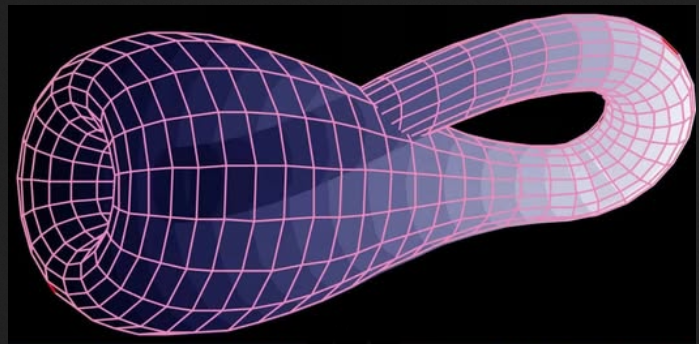
Figure 1 – Klein bottle

Klein bottle


The Klein bottle, or Klein surface, named after the German mathematician Felix Christian Klein (1849–1925), who described it at the end of the 19th century during the development of topology*, it’s an example of one sided surface, with no distinct inside or outside. It is a so-called non-orientable two-dimensional manifold, like the previously seen the Möbius strip, with the important difference that it has no edges.
It is a kind of bottle in which the neck connects to the bottom, having to pass through the wall of the same bottle, as in Figure 1. This is how it appears in a three-dimensional visualization, but like other topological spaces (which we always consider Euclidean), it is not easily visualized in ℝ³. When analyzed in ℝ⁴ there are no overlaps (self-intersections); one understands that the neck does not touch the surface.

Proceeding to higher dimensions, one can imagine a non-orientable three-dimensional manifold that cannot be embedded in ℝ⁴ but can be embedded in ℝ⁵. For example connecting two ends of a Spherinder to each other in the same manner as the two ends of a cylinder for a Klein bottle.

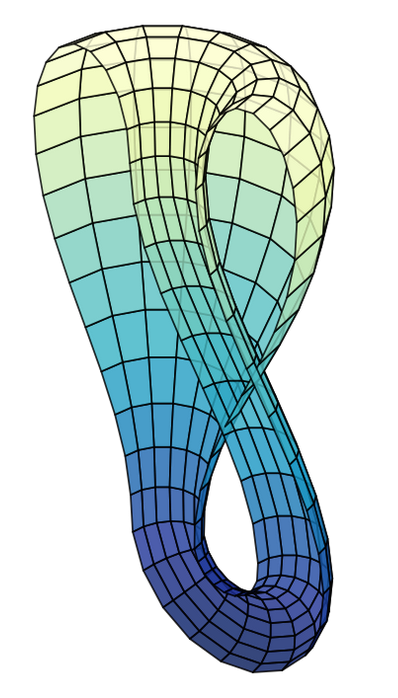
If cut in half, the Klein bottle creates two Möbius strips as in Figure 2, remembering that in reality the intersection does not exist in ℝ⁴.


Figure 2 – A Klein bottle cut in half results in two Möbius strips (source: wikimedia licensed under the Creative Commons Attribution 4.0 Int license)

Klein bottle cut in half


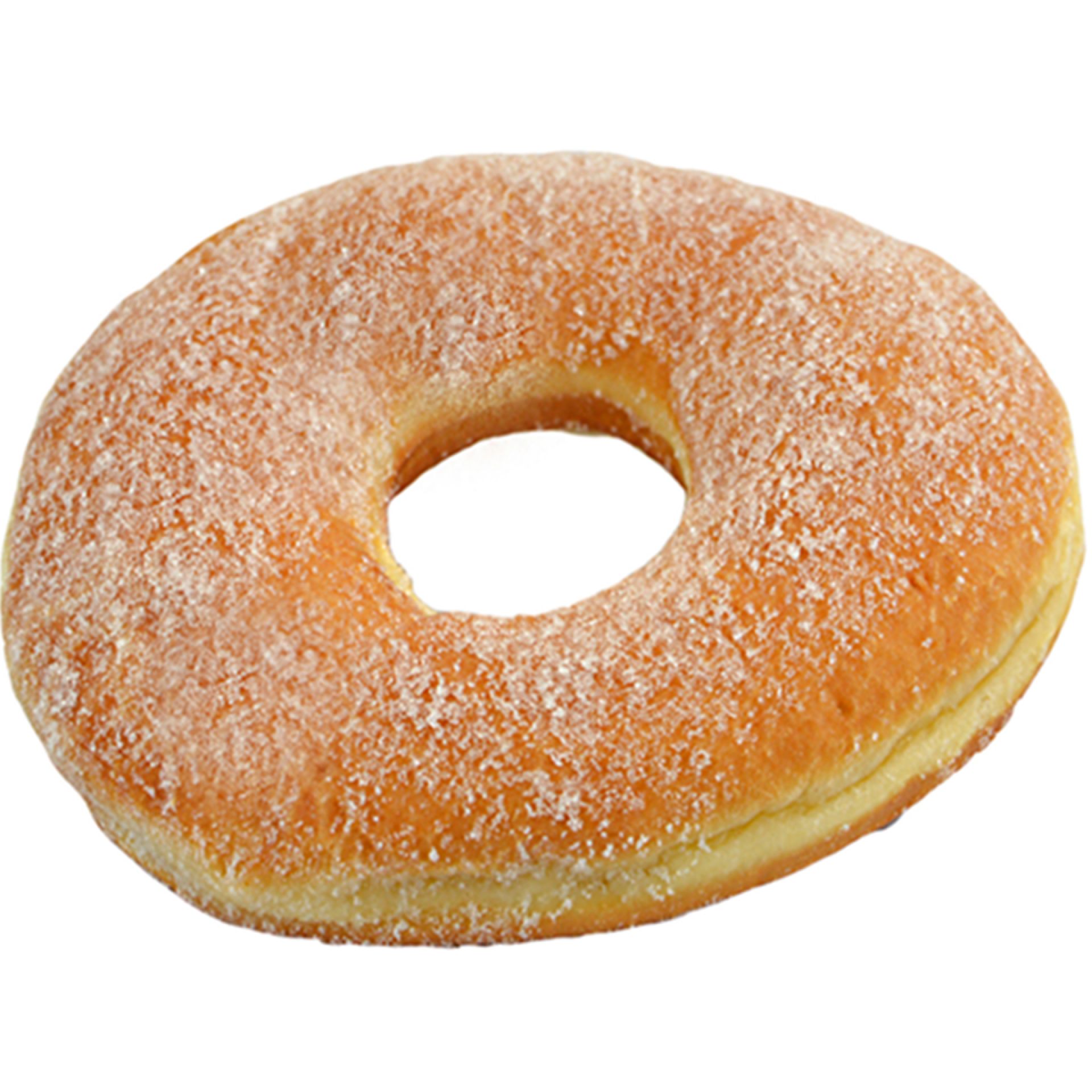
Figure 3 – A tasty solid torus

A tasty solid torus


The traditional (immersed) representation of the Klein bottle is achiral (that is, its mirror image cannot be distinguished from the object). The solid Klein bottle is considered the non-orientable version of the solid torus (such as the one in Figure 3).


Topology*
Topology is an area of mathematics that studies the properties of mathematical objects (shapes) that do not change when a deformation is performed without ‘holes’, ‘overlaps’, or ‘gluing’. For example, a cube is topologically equivalent to a sphere, whereas a torus (a doughnut) is not, because it has a hole that cannot be removed by deformation.
For further reading, the Wikipedia page is comprehensive.

please, rate this post

Strange Mathematical Objects: oloid

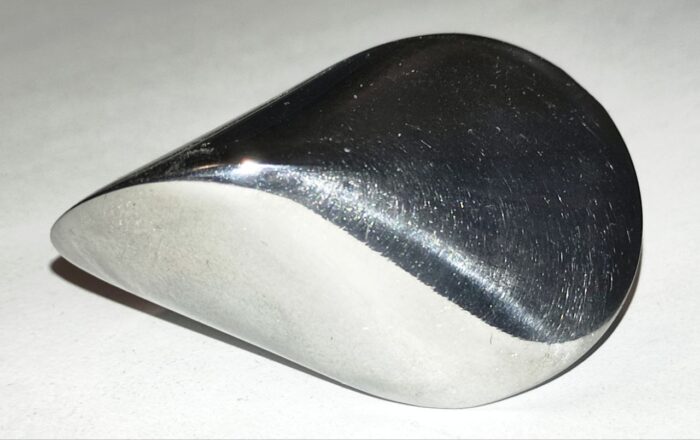
Figure 1 – A steel oloid

Oloid


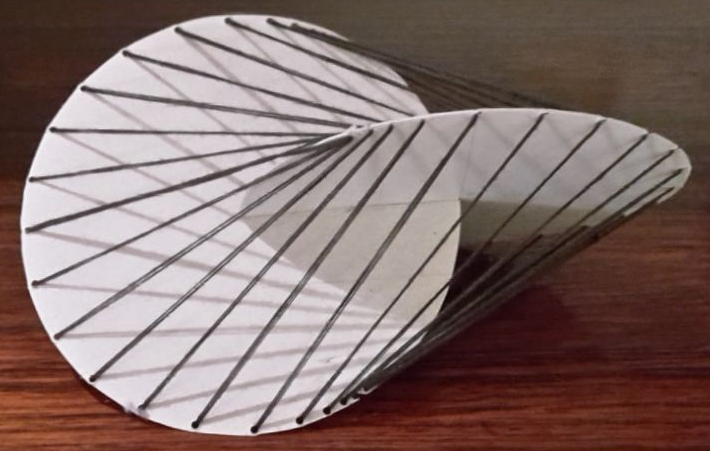
The oloid is a solid discovered by Paul Schatz (1898–1979). It is defined as “the convex hull of two identical circles placed in perpendicular planes, such that the center of each circle lies on the circumference of the other.” Figure 2 clearly shows how it is constructed.


Figure 2 – Oloid model showing the construction of the solid figure (source: Dr. S. Wetzel, licensed under CC BY-SA 3.0 de)

Oloid


One characteristic that is immediately noticeable is that, if it rolls on a plane, it develops its entire surface on that plane; that is, every point on its surface touches the plane. Moreover, despite its rocking motion, its rolling direction is perfectly straight.

During rotation, the distance of its center of mass from the plane does not vary linearly but ‘undulates’, with two minima and two maxima for each full rotation.

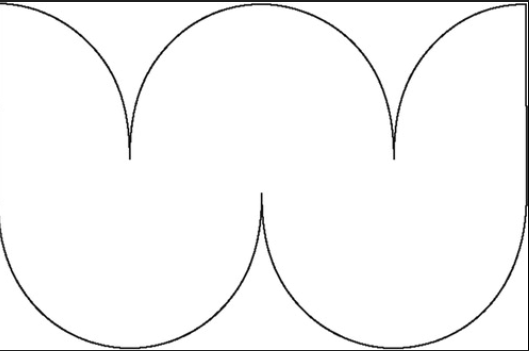
The surface area is easily determined by considering this development, highlighted in Figure 3 for a semi-rotation (half a turn), equal to four semicircles, so its double for a full rotation is:
Aₒ=4πr²
where r is the radius of the generating circle.


Figure 3 – Development of the oloid’s rolling on the surface

Oloid surface


Calculating the volume is very complex; it involves elliptic integrals of the first and second kind, and I will not even report the formula. A numerical computation gives the approximate value:
Vₒ=3.052 r³
where r is the radius of the generating circle. For comparison, recall that the volume of a sphere gives the approximate value:
Vₛ=4.189 r³

In addition to being a very aesthetically pleasing object and a nice presence as a ‘desk toy’, oloids are used industrially for gentle mixing of fluids, thanks to their characteristic of not generating vortices and of preventing foam formation and oxygenation.

please, rate this post

Logic pills: the Boolean basics

The mathematician and philosopher George Boole (1815–1864) developed the association between logic and mathematics by analyzing the laws of mental operations underlying reasoning, and expressing them in a symbolic language that would allow logical operators to act like algebraic operators, by means of computable statements. He created what is known as Boolean algebra.

Boolean logic is the foundation of computer science and digital electronics, and it is based on the manipulation of variables that can take only two values: True (1) and False (0). The Boolean logical operators, detailed below, are applied as ‘logic gates’ in electronic devices, making it possible to build the basic operations, then replicated billions of times in modern devices, to create the computers and smartphones we know. More precisely, these include both physical gates, transistors* in hardware, and non-physical gates, in the instructions of operating system and application code.

The fundamental operators are:
AND: returns true (1) only if all inputs are true.
OR: returns true (1) if at least one input is true.
NOT (negation): an operator that inverts the input value: 1 becomes 0, and vice versa.

ABAND (A*B)OR (A+B)
0000
0101
1001
1111

Using the fundamental operators one can build the logic gates:
NAND (Not-AND): output is false only if all inputs are true.
NOR (Not-OR): output is true only if all inputs are false.
XOR (Exclusive OR): true if the inputs are different, false if they are the same.

Combinations of these gates and the fundamental operators, together with an algebra that makes them workable, make it possible to build digital circuits and instruction structures that process and store data.


Transistor*

Transistors are devices made of semiconductor materials (e.g., modified silicon) that behave like a ‘switch’, regulating current flow on the basis of a control signal (in the sense that its value determines whether the flow can pass or not).
OFF state: if there is no signal on the control (value 0), the transistor blocks the flow (open circuit).
ON state: if there is a signal on the control (value 1), the transistor allows the flow (closed circuit).

Logic gates can thus be built:
AND gate: two transistors in series; current flows only if both are ON (1 AND 1 = 1)
OR gate: two transistors in parallel; current flows if at least one of the two is ON (1 OR 0 = 1)
NOT gate: called an inverter; a single transistor configured so as to disconnect the output (open circuit) if it receives the signal (value 1).

please, rate this post

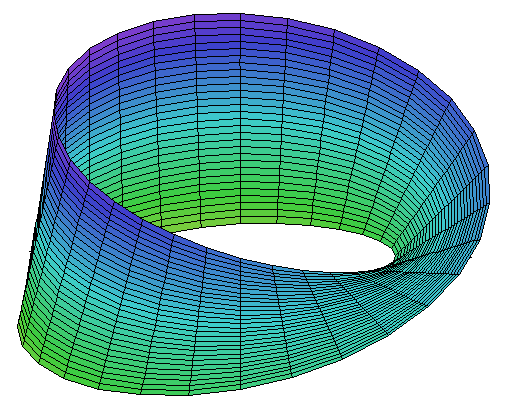
Strange Mathematical Objects: Möbius strip

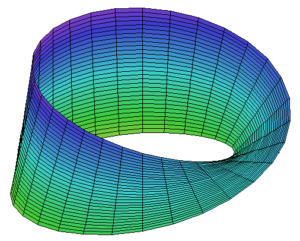
Figure 1 – Möbius strip
Möbius strip


The Möbius strip is a three-dimensional object studied in topology* with unusual characteristics: it has only one side and only one boundary (see Figure 1). It can be easily made from an elongated rectangular strip of paper by joining the short ends after first giving one end a half-twist. With the object in hand, one can immediately verify—also by tracing it with a finger—that it has a single side and a single boundary.

Its name comes from August Ferdinand Möbius (1790–1868), who was the first to study non-orientable surfaces (surfaces on which it is not possible to distinguish positive and negative configurations, an “inside” and an “outside”) and ruled surfaces (which can be obtained as a union of straight lines, such as the plane, the cylinder, and the cone), like this one.

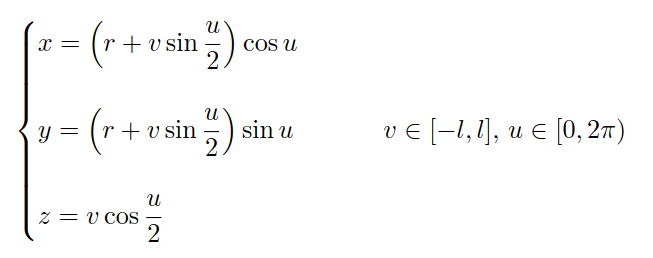
In ℝ³ the strip is described by the following parametric equations in Cartesian coordinates:
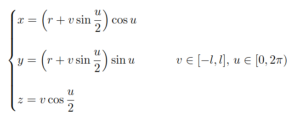
 Möbius strip equationswhere r and l are fixed positive numbers with r>l (a necessary condition for the strip to have the possibility of twisting).

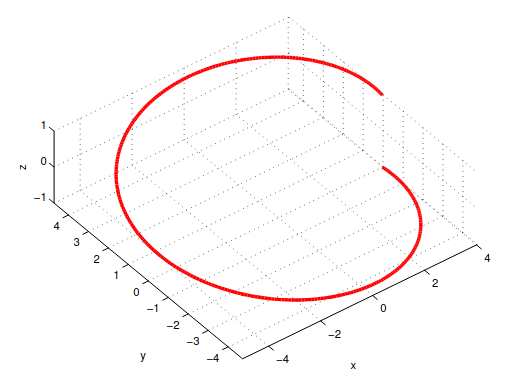
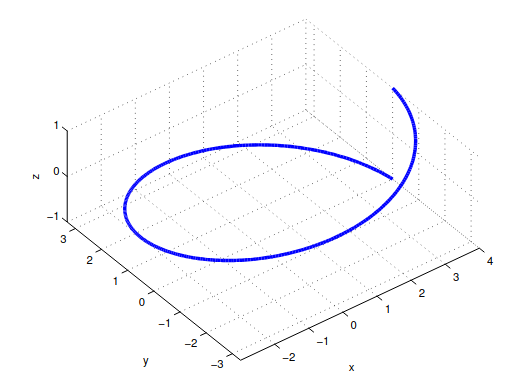
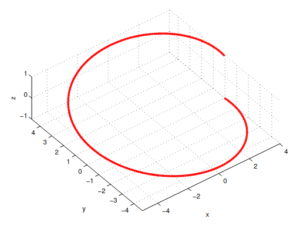
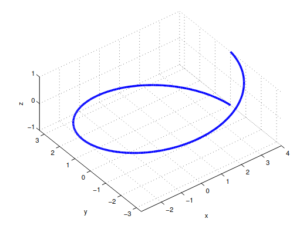
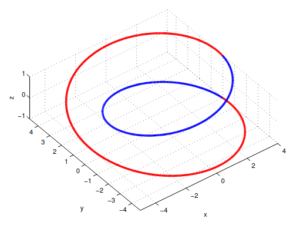
Informally, one can say that the parameter u is an angle that “goes around” the strip counterclockwise, while the parameter v “moves from one side to the other” across the strip. Fixing two values of v, for example v=−1,1, one obtains the curves in Figures 2 and 3, which, taken together, outline the boundary of the strip in Figure 4. As is easy to guess, for v=0 one obtains a circle, i.e., a closed curve halfway along the strip. Interestingly, cutting the strip along this midline does not produce two strips, but a new single strip twisted twice.


Figure 2 – Curve obtained with v=1 (source: Riccardo Dossena, UniPV)
Mobius curve v 1

Figure 3 – Curve obtained with v=−1 (source: Riccardo Dossena, UniPV)
Mobius curve -1

Figure 4 – Curve obtained by combining the previous two, the boundary of the strip (source: Riccardo Dossena, UniPV)
Mobius curve v1 and v -1


Once the boundary is defined, it is easy to understand how the set of all the curves described by the two parameters u,v, over the intervals considered, can define the entire surface of the strip.

Topological considerations are omitted, and the reader is invited to do some experiments by constructing strips with two or more twists of the ends before joining them, and by cutting the strip along its middle in the various cases to see the results… surprising!


Topology*
Topology is an area of mathematics that studies the properties of mathematical objects (shapes) that do not change when a deformation is performed without ‘holes’, ‘overlaps’, or ‘gluing’. For example, a cube is topologically equivalent to a sphere, whereas a torus (a doughnut) is not, because it has a hole that cannot be removed by deformation.
For further reading, the Wikipedia page is comprehensive.

please, rate this post

Strange Mathematical Objects: Torricelli’s Trumpet

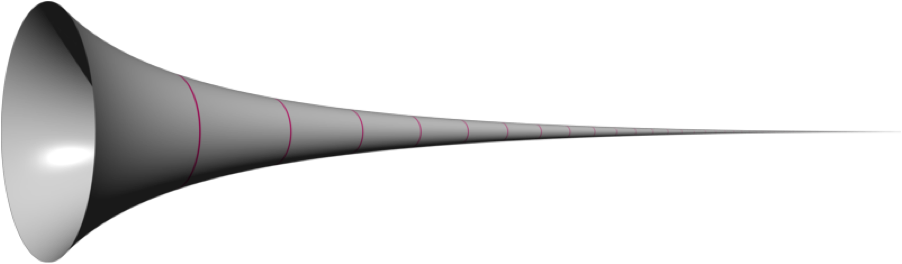
Figure 1 – Torricelli trumpet

Torricelli trumpet

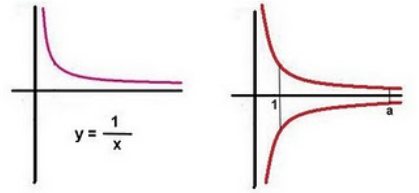
The Torricelli trumpet is a solid obtained by revolving the curve with equation y=1/x around the x-axis over the interval [1,+∞), see Figure 2. It takes its name from Evangelista Torricelli (1608–1647), who studied it in the 17th century.
The peculiarity of this solid is that it has finite volume but infinite surface area.


Figure 2 – Torricelli trumpet 2D equation (source: maeckes.nl)

Torricelli trumpet equation


To verify this today we can easily use integral calculus, which did not exist in Torricelli’s time.

In a coordinate system (x,y,z) the horn is described by the parametric equations:
x(ξ,θ)=ξ
y(ξ,θ)=acos⁡θ/ξ
z(ξ,θ)=asin⁡θ/ξ

The volume and the surface area are computed as follows, where  a > 1  is a value of  x:

Volume and area trumpet

It is therefore clear that as  a → ∞  the volume approaches the finite quantity π , while the surface area diverges.

This apparent paradox, finite and infinite values associated with the same object, can be explained easily mathematically, as follows. If we consider a can of paint, it certainly has a finite volume. If we spread it over a surface, mathematically the thickness could be infinitesimal, so it could indeed cover an infinite area.

please, rate this post

Logic pills: Implies (→) is not follows (⇒)

In classical logic* it is easy to confuse them, but they are different things.
Given two declarative statements to which a truth value can be assigned, an antecedent P (premise) and a consequent C (conclusion), we consider:

P → C (if P then C) a statement with a truth value
P ⇒ C (from P follows C) an inference: C is derivable by assuming P.

The crucial difference lies precisely in this deducibility obtainable in the inference. Instead, the implication P → C is true even when P is false. Therefore it can happen that P is false, C is false, and yet P → C is true. In particular, if P is false, P → C is true whatever C is. For this reason, the implication by itself does not establish (nor prove) the truth of C.
Instead, from P follows C is legitimate only when P is available as a hypothesis in the reasoning: and it is the typical case in which, if P and P → C, then one can conclude C. But if P is false (or is not assumed), the implication is said to be ‘vacuously true’ and it does not authorize any conclusion about C.

If and only if: equivalence as a double inference
The properties of inference make it very useful: a large part of mathematical proofs is based on if and only if, which expresses an equivalence between two statements A and B.
To say:
A if and only if B
means precisely to prove both directions:
A ⇒ B (A is sufficient for B)
B ⇒ A (B is sufficient for A)
When both inferences are valid, A and B are logically equivalent, therefore they have the same truth value.


Classical logic *

This is how one refers to those logical systems (the most used in basic mathematics) in which laws and rules considered traditional hold, such as:

Law of excluded middle: every statement is either true or false (P or not-P)
Non-contradiction: P and not-P cannot both be true
Double negation: negating twice brings one back to the original statement
Explosion (in the presence of contradiction): from a contradiction one can derive any conclusion.

‘Non-classical’ logics arise from wanting to give up or modify some of these features. By way of example:

intuitionistic logic: does not accept the law of excluded middle as a general rule
paraconsistent logics: do not accept explosion (they tolerate contradictions without making everything ‘collapse’)
modal logics: add operators such as necessarily / possibly.

please, rate this post

The error function as an integration trick

The error function, erf(x), represents a statistical function, but it can also be used as an integration trick in the case of complex exponentials, which occur fairly frequently in the study of physics, for example, in differential equations describing heat propagation. It is also used in quantum mechanics to describe particles represented by a wave function, and in astrophysics for the spectroscopic analysis of spectral lines, as in the examples discussed in detail (in english and italian translation).

pdf  Brussi 2026_The error function as an integration trick

pdf_ita  Brussi 2026_La funzione di errore come trucco di integrazione


error function

please, rate this post