Galactic Energy Profiles: GEP I. Radiant and Relativistic Fluxes
Update: I decided to publish this work, part of the GEP series, on Zenodo without peer review and to use it as a basic tool for building a subsequent dataset (GEP III). Note: This work is version 2.0 of the previous NAGE I work, which has been superseded.
Abstract
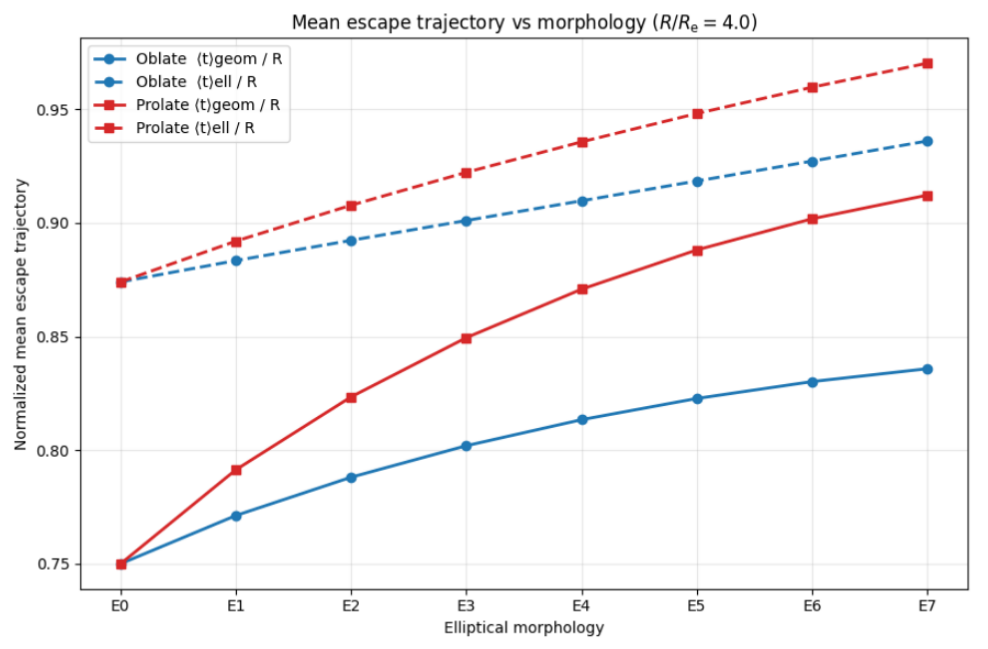
Standard galactic energy inventories typically focus on the virialized components of the system, namely the kinetic and gravitational potential energy, derived from baryonic mass distributions and stellar luminosity. This paper, the first in the Galactic Energy Profiles series, introduces a reproducible geometric framework for accounting radiant and relativistic fluxes as a standing energy reservoir. By considering the photon and neutrino escape time τ across the galactic Halo, we quantify the energy density of radiation currently in transit as a component of the total galactic budget, complementary to the standard flux-based description. The resulting closed-form expressions, together with the accompanying open-source Python implementation, are intended as a calibrated methodological baseline for the subsequent application of this framework to observed galactic samples.
Keywords
galactic energy inventory; energy residence time; galactic radiant fluxes; galactic Halo energy; galaxy morphology
Here is the Zenodo version of the paper (1.1 MB):