Portrait of an epistemological stagnation

We have grown accustomed to being ‘subjected to’ scientific progress as if it were a triumphal and unstoppable march. We live surrounded by a pervasive technology that grants us the illusion of an ever-deepening knowledge of reality. Yet, if we look at the foundations of theoretical physics, the landscape that appears is one of a desolate epistemological stagnation.
For over fifty years, fundamental physics has failed to produce a true ontological revolution. We have confirmed theories born in the last century—such as the Higgs boson from the 1960s or Einstein’s gravitational waves from the beginning of the century, the only two true demonstrations of fundamental theories in recent decades—but we have not given birth to a single new idea that has been proven real (see What’s wrong with scientific research according to Sabine Hossenfelder). On the contrary, we have retreated into a sort of ‘maintenance of paradigms’ (in the Kuhnian sense), adding mathematical patches to models that no longer function (see Kuhn’s “The Structure of Scientific Revolutions” in a nutshell).

The Trap of the ‘Millennium Problem’

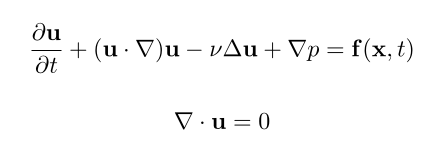
A perfect example of this drift is the celebrated Millennium Problem regarding the Navier-Stokes equations (see A pure mathematical version of the Clay Mathematics Institute’s Navier-Stokes Millennium Problem). We are asked to prove whether a ‘smooth’ (continuous) solution can explode into a mathematical singularity. But who does this research truly benefit?
There is a certain arrogance in demanding that the mathematics of the absolute continuum—a tool invented three hundred years ago—must be the faithful mirror of a reality we know to be intrinsically granular. Seeking regularity or singularity in Navier-Stokes is an exercise in the internal consistency of an axiomatic system, a ‘mathematical little game’ that adds nothing to our understanding of matter.
It is a restaging of the late 19th-century ultraviolet catastrophe: classical physics predicted the emission of infinite energy from a black body because it assumed energy was infinitely divisible. Max Planck did not ‘solve’ the calculation problem that diverged; he changed the logic, introducing the quantum of energy—a granular discretization (see Planck’s photon distribution function). Today, persisting in the search for regularity in continuous fluid dynamic models without accepting the logical (and physical) limits of that language is like trying to measure an atom with a ruler: the error is not in the mathematical calculation, but in the model adopted.

The Ptolemaic universe of dark matter

If Navier-Stokes is a dead end for brilliant minds, modern cosmology has become a triumph of epicycles. Kuhn taught us sixty years ago that when a paradigm enters a crisis, the scientific community does not abandon it immediately, but instead begins to ‘save’ it with ‘ad hoc’ hypotheses.
Thus, to make General Relativity equations square with a universe that moves differently than predicted, dark matter and dark energy were invented. We do not see them, we do not know what they are, and we do not understand their nature. They are ‘magical patches’ necessary to prop up models that we are unable to interpret. We are planning trips to Mars using a modernized Ptolemaic system, convinced that adding an invisible epicycle is nobler than admitting we have failed to understand the nature of gravity on a large scale (see Note for laymen – what is the dark matter?).

The Deception of Technological Progress

The common objection is: “How can you speak of stagnation when Artificial Intelligence and silicon dominate the world?”
Here lies the fundamental misunderstanding. Technology is not fundamental science; it is the exploitation of past discoveries. Computers are based on the quantum mechanics of the 1920s and 30s; our rockets on 19th-century thermodynamics. Technology is the engineering that refines the already known, but the theory upon which it is founded remains old—tremendously old. We are utilizing maps that ignore 95% of the territory, or that are incapable of observing it in its true reality.

The Tyranny of the ‘Barons’ and the veto of the paradigm

Why do we not move forward? Because knowledge has become a hostage to a feudal academic structure. The ‘Barons’ of the paradigm are slaves to their own careers and the consensus of the community. Risk is not funded. Anyone proposing a sensible cosmological model that does not include invisible ‘ghosts’ is isolated, denied publication, and stripped of funding.
The system prefers to distract superior minds by challenging them with inessential problems—like Navier-Stokes singularities or calculating the galactic halos of magical components—rather than facing the terrifying uncertainty of a paradigm shift. We are moving backward, not forward, because we have lost the ability to see the problem before calculating the solution.

Conclusion: seeing beyond the fence

Mathematics is indifferent to the survival of the solution, but we should not be. The task of research is not to balance the books of a useless abstraction, but to find the correct language to describe reality.
The result regarding the Navier-Stokes singularity will not change the empirical efficacy of the laws of dynamics. It would perhaps establish (with due respect to Gödel) whether the continuous model is a coherent language or if it is destined to succumb to its own abstraction.
The true challenge is having the courage to admit that our reference models do not describe reality, and that it is necessary to explore new descriptions of nature beyond a “déjà vu that simply ‘does not work’ (by the very admission of those who continue to support it).
While waiting for a visionary genius to find a better description of reality, we could, in the meantime, make room for the visionaries who see beyond the fence…

please, rate this post

A pure mathematical version of the Clay Mathematics Institute’s Navier-Stokes Millennium Problem

Abstract
This report provides a rigorous transition from the physical formulation of the incompressible Navier-Stokes equations to their pure mathematical representation as defined by the Clay Mathematics Institute for the Millennium Prize Problems. We detail the physical meaning of each term in the classical equations and subsequently reformulate the problem strictly in the language of partial differential equations (PDEs) and operator theory, establishing the axiomatic constraints that govern the variables and parameters of the system.


pdfBrussi 2026_Navier-Stokes Millennium Problem


Version uploaded to Zenodo: link DOI – zenodo.21852870


Navier-Stokes Millennium Problem

please, rate this post

Phase and Group Velocity in wave propagation

A harmonic wave is a disturbance that varies in space and time according to a sinusoidal function—a periodic trigonometric function of the form
(1) y(x, t) = A cos(kx – ωt + φ)
that describes a smooth, regular oscillation between a maximum and a minimum value. Phase velocity and group velocity represent two distinct metrics for measuring the propagation of such a wave, depending on whether the focus is on an individual oscillation or on the overall envelope structure of the signal.

When considering an ideal monochromatic wave, the phase velocity (vf = ω / k) quantifies the rate at which a point of constant phase moves through space—that is, the displacement speed of a single crest or trough of the sinusoid. However, physical waves capable of transmitting information are never purely monochromatic; they consist of a superposition of spectral components across a range of frequencies (1), forming what is known as a wave packet. The group velocity (vg = dω / dk) precisely measures the propagation speed of the overall envelope of this wave packet.

The core distinction between these two quantities lies in their underlying physical significance. While the phase velocity describes strictly the motion of the oscillatory state and can, in specialized media such as certain plasmas or metamaterials, exceed the speed of light in vacuum c, the group velocity represents the effective speed at which physical energy and signal information travel.
In non-dispersive media—where all spectral components propagate at the same speed—the two values are identical (vf = vg). Conversely, in dispersive media, the frequency dependence of the medium’s properties causes a dispersion relation where the two velocities diverge, typically resulting in a group velocity that is lower than the phase velocity (vg < vf).


In the image the red dot propagates with phase velocity while the green dots propagate with group velocity, source Wikipedia.

Wave group

please, rate this post

Mathematical and historical foundations of Extended Theories of Gravity (ETG)

A short paper, in english, on a fascinating development of General Relativity.

Abstract
Extended Theories of Gravity (ETG) represent a prominent framework in modern theoretical physics and cosmology, aimed at modifying or extending Albert Einstein’s General Relativity to address open phenomenological questions at both ultraviolet (early universe) and infrared (galactic and cosmological) scales.

pdf Brussi 2026 Mathematical and historical foundations of ETG (305 KB)

ETG

please, rate this post

Galactic Energy Profiles II

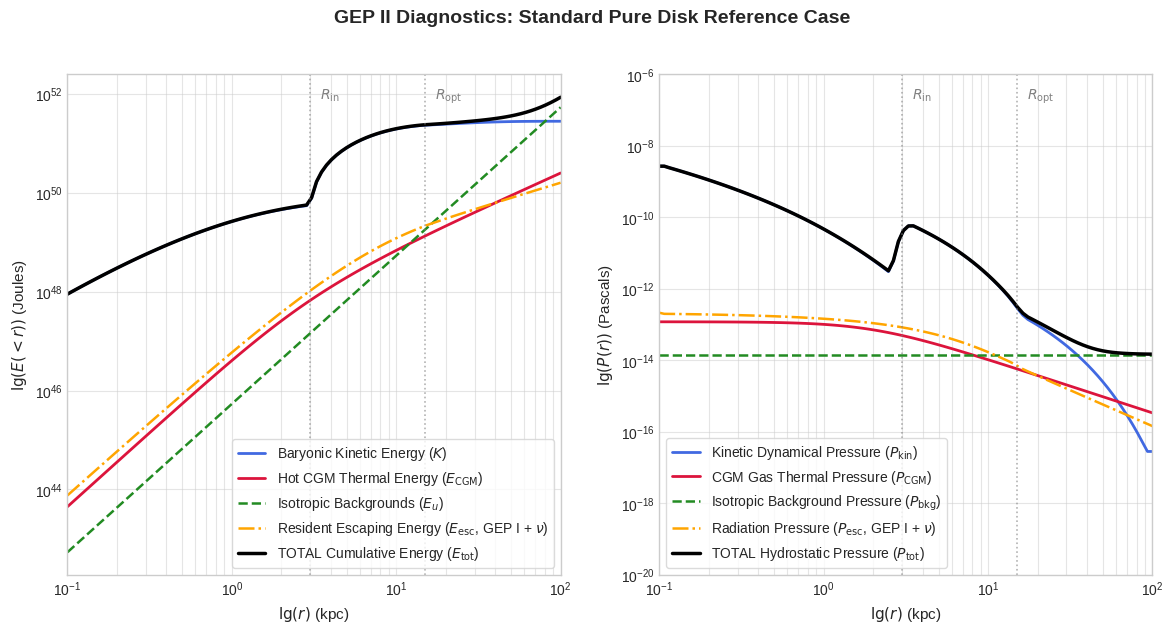
Galactic Energy Profiles: GEP II. In-System and Background Energy Densities

Update: I decided to publish this work, part of the GEP series, on Zenodo without peer review and to use it as a basic tool for building a subsequent dataset (GEP III). Note: This work is version 2.0 of the previous NAGE II work, which has been superseded.


Abstract
Standard galactic energy inventories typically focus on virialized components, namely kinetic and gravitational potential energy derived from baryonic mass distributions, together with energy inferred from bolometric luminosities. In the first paper of the Galactic Energy Profiles (GEP) series, we introduced a reproducible geometric framework for the radiant and relativistic fluxes of galactic origin, accounting for their finite escape time across the Halo. In this second work, we extend the framework toward a volumetric energy inventory, where bolometric luminosity is complemented by energy densities persistently present within the galactic volume. We consider the thermal and kinetic energy of baryonic matter—including bulk motions, turbulence, and rotational degrees of freedom from large-scale dynamics down to the intrinsic angular momentum of bound systems—together with cosmic rays confined by magnetic fields and extragalactic backgrounds (photons, neutrinos, and diffuse fields) permeating the Halo. This approach distinguishes between flux-based contributions and volume-based reservoirs, providing a complementary description of the total galactic energy budget. Crucially, by resolving these volumetric reservoirs into local radial profiles, we characterize the multi-component pressure support (including thermal, magnetic, cosmic ray, and radiant pressures) available to sustain the circumgalactic medium (CGM) in hydrostatic equilibrium. Although these components vary with morphology and evolutionary state, this study is purely theoretical and simplifies the extreme variability of galactic systems to derive reference estimates and ‘standard cases’. The resulting parametrized framework, supported by publicly available Python scripts, is intended as a further methodological baseline for the sample-wide application planned in later work.

Keywords
galactic energy inventory; galactic energy density; galactic Halo energy; energy distribution based on galactic morphology


Here is the Zenodo version of the paper (1.1 MB):

pdf Brussi 2026_GEP II


GEP_II

please, rate this post

Galactic Energy Profiles I

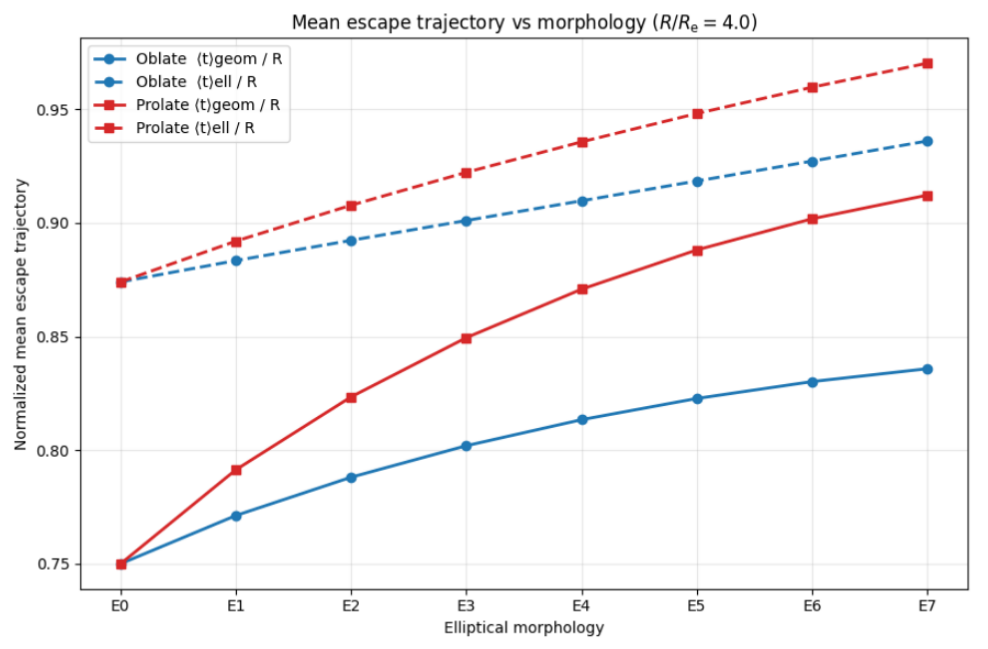
Galactic Energy Profiles: GEP I. Radiant and Relativistic Fluxes

Update: I decided to publish this work, part of the GEP series, on Zenodo without peer review and to use it as a basic tool for building a subsequent dataset (GEP III). Note: This work is version 2.0 of the previous NAGE I work, which has been superseded.


Abstract
Standard galactic energy inventories typically focus on the virialized components of the system, namely the kinetic and gravitational potential energy, derived from baryonic mass distributions and stellar luminosity. This paper, the first in the Galactic Energy Profiles series, introduces a reproducible geometric framework for accounting radiant and relativistic fluxes as a standing energy reservoir. By considering the photon and neutrino escape time τ across the galactic Halo, we quantify the energy density of radiation currently in transit as a component of the total galactic budget, complementary to the standard flux-based description. The resulting closed-form expressions, together with the accompanying open-source Python implementation, are intended as a calibrated methodological baseline for the subsequent application of this framework to observed galactic samples.

Keywords
galactic energy inventory; energy residence time; galactic radiant fluxes; galactic Halo energy; galaxy morphology


Here is the Zenodo version of the paper (1.1 MB):

pdf Brussi 2026 GEP I


GEP I mean escape trajectory length

please, rate this post

Ludwig Boltzmann, an underrated scientist

Many are familiar with Albert Einstein (1879-1955) or Isaac Newton (1643-1727), but few know that the profound architecture of the reality we live in today was designed by Ludwig Boltzmann (1844-1906).
If today we naturally accept that everything around us is made of atoms, we have him to thank. But the price Boltzmann paid for this insight was extremely high: intellectual solitude and, ultimately, his life.

The Bet on Atoms
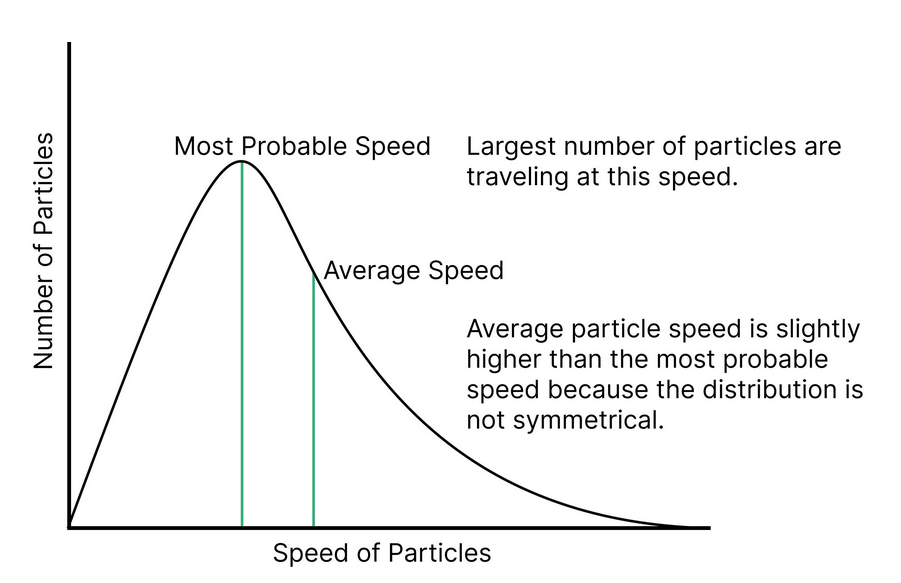
At the end of the 19th century, most scientists (like the influential Ernst Mach, 1838-1916, one of his main detractors) considered atoms merely as “convenient mathematical models,” not as real objects. Boltzmann, on the other hand, was convinced that atoms actually existed. To demonstrate this, he made a logical leap using statistics: he realized that it’s not necessary to know the trajectory of every single molecule to understand how a gas behaves, but rather to calculate the average of their collisions (see Figure 1). From these principles, he developed what later became Statistical Mechanics.


Figure 1 – Diagram of the statistical distribution of particles velocities in a gas (credits: Shutterstock)

particles statistic


Entropy and the ‘arrow of time’
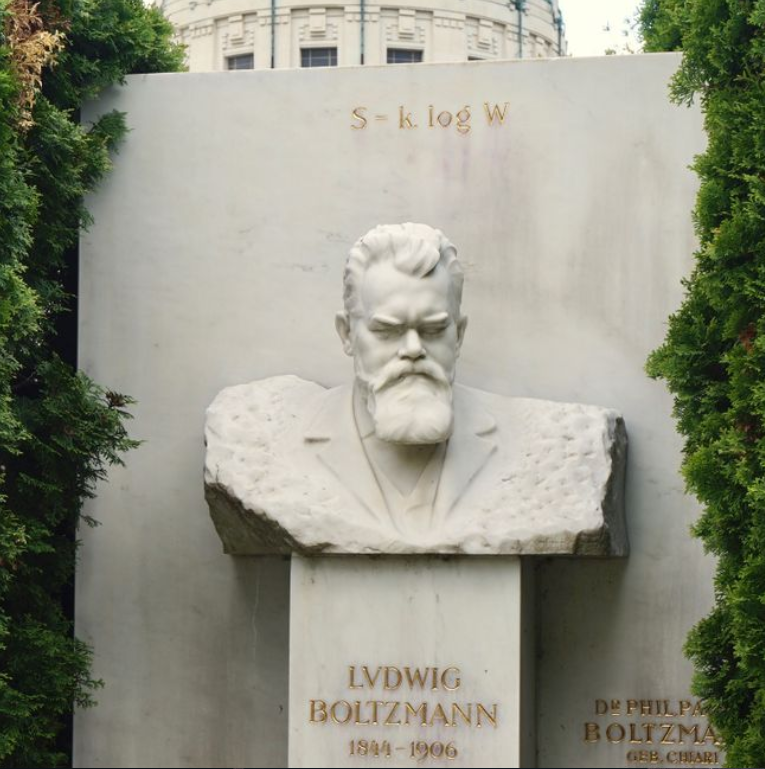
His masterpiece is the famous formula carved on his tomb in Vienna (Figure 2):
S = k log W
This equation connects the visible world (S, entropy) to the invisible world (W, the number of ways atoms can arrange themselves).
One interpretation of entropy is emergent temporal asymmetry: it explains why time only moves forward, not because of a law of mechanics, but because of probability. Heat flows from a hot body to a cold one simply because it is statistically more likely that energy will be dispersed in disorder rather than remain concentrated.
And similarly for the configurational states that hold matter together. Among many, we recall the famous example of the cup falling and breaking into pieces while we don’t observe the pieces spontaneously rejoining to form a whole cup. This happens because the whole cup is a very low-probability state (very ordered); the shattered cup is a very high-probability state (very disordered).
Boltzmann understood that the entire universe is just a gigantic transition to the most probable state.

A misunderstood genius, still underappreciated today
Boltzmann was fiercely attacked by his contemporaries. Scientists of the time, tied to a more continuous view of matter, mocked him. This implacable opposition, combined with a personality prone to depression, led him to commit suicide in 1906, in Duino, near Trieste.
Just a year earlier, in 1905, a young Albert Einstein had published a paper on Brownian motion that proved Boltzmann was right: atoms existed.
He was the first to understand that disorder is the driving force of the universe, and he transformed physics from a science of certainties to a science of probabilities. Without his statistical method and the constant (k) that characterizes it, Max Planck (1858-1947) would never have been able to launch the quantum revolution.
Boltzmann represents the bridge that took physics from the age of steam to the age of the atom and information.


Figure 2 – Ludwig Boltzmann

Ludwig Boltzmann

please, rate this post

References for laymen: What is energy?

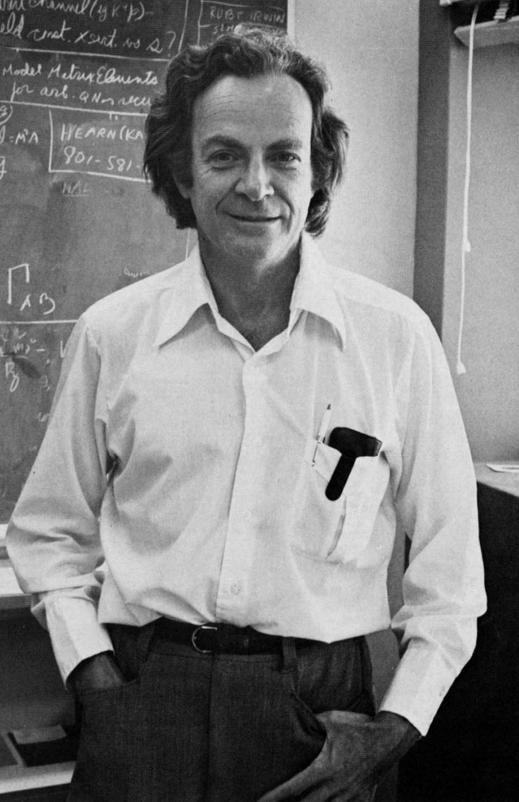
The great physicist Richard Feynman (1918-1988) honestly admitted that in modern physics we have no idea what energy ‘per se’ is. He described it as a kind of magical accounting: in the universe (or rather, in an isolated system), a lot of things happen, but at the end of each day, if we add up certain numbers characteristic of each event, the total is always the same. That number that never changes is energy. It is never created or destroyed, but always transformed.

The scholastic answer, “Energy is the capacity to do work” (given as known the concepts of work, force, etc.), is actually incorrect, because energy naturally tends to ‘spread’; that is, it prefers disorder. And as described by Ludwig Boltzmann (1844-1906), the measure of this disorder, called entropy, always increases in an isolated system. But since entropy also defines energy’s ability to do work, this ability actually always decreases, whereas energy is always conserved.

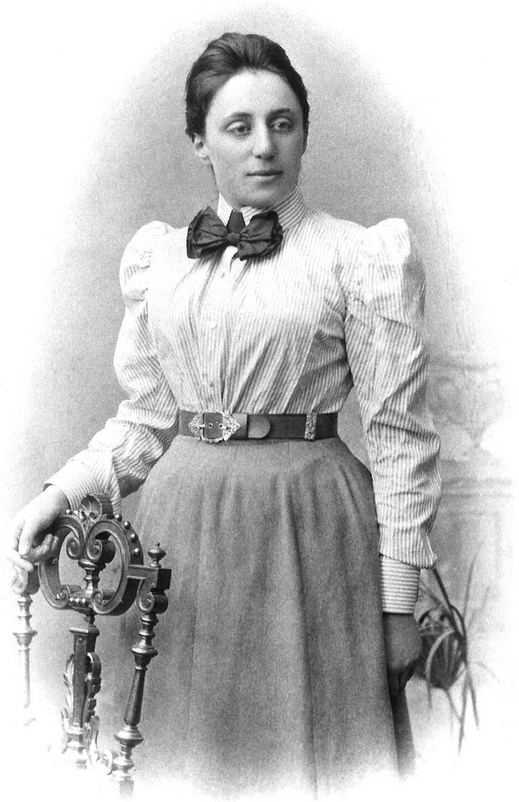
A more technical way to think about energy comes from Emmy Noether (1882-1935), who demonstrated that every conservation law in physics derives from a symmetry: energy is conserved because the Universe has a “translational time symmetry,” meaning the laws of physics remain the same as time passes, and the quantity that mathematically must remain constant is energy. In these terms, one could say that energy is time.

One way to calculate energy is the one defined by Einstein (see Einstein’s formula for energy), even if we don’t know what ‘stuff’ it’s made of. Simply put: even if an object is still and tiny, it hides a monstrous amount of energy within itself thanks to its mass (the constant of proportionality c² is a really huge number). And if it then begins to move due to external action, this energy increases.

Conclusion
We could define energy as the invisible ‘engine’ of reality. We can’t ‘touch’ it, but it ensures that the universe keeps its accounts in order (including the symmetry of time). Every time we do something, or even simply exist, we participate in this immense exchange of ‘tokens’ that has been going on ‘forever’.


Richard Feynman e Emmy Noether

Richard FeynmanEmmy Noether

please, rate this post

Einstein’s formula for energy

The most famous physics formula in the world is probably that of Albert Einstein (1879-1955):
(1) E = mc²
that is, the energy of a body is equal to its mass times the speed of light squared.
Perhaps not many have truly understood it, but certainly almost no one (without university studies) knows the complete formula, which takes into account both moving bodies and the energy of massless particles.

For moving bodies, a multiplication factor must be considered:
(2) E = γ mc²
According to Einstein’s own special relativity (work from 1905), if we consider ‘particles’ moving in four-dimensional spacetime, the change in their momentum (p), is expressed by the relativistic formula of four-momentum. This is a four-vector* in which the time component is represented by energy and the space components by momentum. In particular, in the case of a moving body, its inertia increases, as in (2), according to a factor proportional to the velocity, called the Lorentz factor (after Hendrik Lorentz, 1853-1928):
γ = 1 / √ (1-v²/c²)
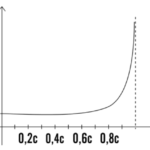
where v is the velocity of the body and c is the speed of light. As can be seen from the formula and from Figure 1 which traces its progression, γ increases as the velocity increases, but remains very close to 1 until the velocities are of the order of magnitude of that of light. For this reason, it is generally omitted, considering γ ≈ 1 . The asymptotic behavior of γ also highlights the difficulty of accelerating material bodies to speeds approaching that of light, whose inertia would have an equally asymptotic behavior.


Figura 1 (credits: youmath.it)
gamm


But the four-momentum also takes into account particles that have no mass, such as photons. From the intuition of Louis de Broglie (1892-1987), the wavelength of a photon is inversely proportional to its momentum:
λ = h / p
where h is Planck’s constant. Recalling that the photon’s energy can be expressed as:
E = hc / λ
it is easy to obtain the relation:
(3) E = pc

Einstein’s complete formula for the energy equation is therefore:
(4) E² = (pc)² + (mc²)²

It is easy to see how, in the case of a massless photon, (4) reduces to (3), the energy of the photon, and in the case of a non-moving particle, (4) reduces to (1), the energy of matter at rest. In the case of a moving body, both the energy due to the movement and the energy at rest must be taken into account, i.e. relation (2).


  • A four-vector is a four-dimensional vector defined in (relativistic) Minkowski (Hermann Minkowski 1864-1909) spacetime. It unifies a temporal quantity and the three corresponding spatial quantities (for example, time and space, or energy and momentum) into a single mathematical object.
    Its fundamental characteristic is that its magnitude (its length) remains unchanged for every observer, ensuring that the laws of physics remain the same even when observed from reference frames in relative motion to each other.
please, rate this post

The Stage of Reality – Why gravity is not a force and the speed of light is not a speed

Introduction
What we are about to explore is what I call ‘the stage of reality’, the place where we, and everything around us, move (a trivial side note: nothing is truly ‘at rest’ in our universe, as there is no absolute reference frame against which to measure motion). This stage is what we call spacetime, composed of the three familiar spatial dimensions plus time, which is simply an additional dimension. We cannot ‘visualize’ it unless we imagine removing one of the spatial dimensions, as seen in the famous Minkowski diagrams (see Figure, Hermann Minkowski, 1864-1909).
It was Albert Einstein (1879-1955), in his brilliant work in the early 1900s, who viewed the universe not as an empty space where time flows separately, but as a single four-dimensional context. These dimensions are inextricably linked by a metric governed by the laws of gravitation. In this scenario, time is not an external clock, but a real direction in which we move, just as we move North or South, to put it in geographic terms.

Gravity
Why is the force of gravity not a force? For centuries, thanks to Isaac Newton (1643-1727), we thought of gravity as a kind of ‘invisible hand’ that ‘pulls’ objects. But if we apply what Einstein called the equivalence principle (which he described as “the happiest thought of my life”), we discover a fundamental concept. He imagined being in an elevator in deep space, far from any gravitation, accelerating upwards (remember that acceleration is the variation of velocity). You would feel pressed to the floor exactly as you do on Earth. If you were to release Newton’s legendary apple, it would ‘fall’ toward the floor. Yet, there is no gravity ‘pulling’ it; there is only acceleration. Einstein realized that gravity is not a force acting in space; rather, the effect we observe and call ‘force’ is the consequence of the curvature of spacetime itself. In fact, the presence of mass —or rather, mass-energy, since they are the same thing except for a conversion factor (the famous E=mc² )— warps the fabric of spacetime like a weight on an elastic sheet. For example, the Earth, with its concentration of mass-energy, creates a geometric deformation: the apple doesn’t fall because a force pushes it, but because it is simply following the straightest possible line (called a geodesic) in a space that has become curved.
According to Newton’s laws of motion, a body with no forces acting upon it moves with uniform rectilinear motion (respecting the principle of inertia). According to Relativity, an apple falling in a gravitational field is, paradoxically, the only object experiencing no force at all (respecting the principle of inertia). To quote Einstein again: “Matter [mass-energy] tells spacetime how to curve, and spacetime tells matter how to move.”

Light
Now let’s consider light. We attribute a ‘speed’ to it (which we define as a change in position), but as physicist Leonard Susskind (1940-) explains, it is not a speed in the common sense of the term (like that of a car). Instead, it is a fundamental property of the geometry of spacetime —a simple ‘conversion factor’ between spatial and temporal coordinates.
In the four-dimensional universe in which we exist, space and time are different directions of the same thing, and  c  is the number that tells us how many meters are equivalent to one second. That is: time=space / c .
The value of the universal constant c is approximately 300,000 km per second, or just over a billion km per hour (approx. 1.08 billion km/h).
Susskind’s profound suggestion is that every object in the universe always and constantly moves at the exact same speed:
– When we are ‘still’ in space—for instance, sitting in our chairs—we are traveling at the speed of light along the axis of time
– If we start moving through space, we must ‘subtract’ speed from time to compensate for the spatial movement (as if paying a toll using the conversion factor, ). From this, the relativistic time dilation is derived (e.g., the twin paradox).
There are no variable speeds; there is only a distribution of the ‘total speed’ among different dimensions. Therefore, light isn’t ‘racing’: we could say that light spends its entire ‘allowance’ on space, leaving zero for time, based on the conversion factor c .
This constant —the speed of light— is the geometric limit of what can happen in the universe.

Conclusions
There is, therefore, no speed limit; there is only a global geometry in which we are all immersed. Gravity is the curvature of the road; the constant holds together the very fabric of the reality surrounding us. Physics does not describe ‘what happens’, but describes the geometric structure in which everything is already contained.
Understanding this means stopping looking at ‘things’ that move and starting to look at the shape of the stage on which they move.


A Minkowsky diagram (credits to medium.com)


MInkowsky diagram

please, rate this post