Parmenides on Being: that which is (τὸ ἐόν)

English summary. A short reflection, written as a study exercise, on a few lines of Parmenides’ poem On Nature (DK fr. 8, vv. 6–11), in which the goddess rules out that what-is (τὸ ἐόν) could ever have come into being. The lines are read both exegetically and, in modern terms, as early uses of principles we now call non-contradiction, excluded middle and sufficient reason, against the background of the Eleatic challenge to earlier cosmogonies. The full text is in Italian.


[1a] [riguardo all’essere, (τὸ ἐόν)] quale sua nascita cercherai?
[1b, c] Come, da dove può essere cresciuto?
[2] Da ciò che non è non te lo lascerò
né dire né pensare, [2a] perché non è dicibile
né pensabile che non sia.
[3] [Inoltre] Quale necessità lo avrebbe indotto
a generarsi dopo piuttosto che prima, avendo inizio da ciò che non è?
[4] [Conclusione] È così necessario che o esista in assoluto oppure non esista del tutto.


La visione di Parmenide si pone in contrasto con le cosmogonie dei pensatori detti presocratici. Questi versi sono parte del poema nel quale egli riporta come racconto di una dea la via alla verità (aletheia). Questa rivelazione è fondata sul logos, la razionalità che spinge agli estremi la logica interpretativa, diversamente dall’esperienza che viene ingannata dai sensi. Il soggetto sottinteso del frammento è ciò che è (τὸ ἐόν), considerato da Parmenide: ingenerato, eterno, immobile, unico e finito; così dalla dea ne sono definiti gli attributi -che chiama indizi (semata)- al kouros/Parmenide, alcuni precisati nel frammento riportato.

Si possono distinguere due possibili tipologie di argomentazioni nel frammento citato: quelle esegetiche legate più strettamente al testo e quelle legate al logos [*] e alla massima coerenza razionale (i primi passi di una nuova disciplina), espresse in termini ‘moderni’.
[1a,b,c] L’indagine sull’essere potrebbe iniziare dalla sua nascita e crescita, così farebbe una cosmogonia.
[2] Ma la dea (ovvero il logos) non consente al kouros di pensare e di dire che ciò che è possa derivare da ciò che non è, perché pensando ciò che non è per poterne parlare lo si tratterebbe come qualcosa che è [2a] quindi per coerenza razionale questo è non dicibile né pensabile.
Viene applicato un principio di non contraddizione [*].
[3] La domanda retorica evidenzia la mancanza della necessità per ciò che è di generarsi, dopo o prima, da ciò che non è, non solo per le ragioni del verso precedente ma anche per il suo non appartenere al tempo (precisato in versi successivi).
Si evidenzia anche la mancanza di una ragione sufficiente [*].
[4] La conclusione ricorda che la possibilità dell’esistenza è considerata binaria, quindi applica il principio del terzo escluso [*] e l’implicazione che ciò che è può solo essere, perchè è “necessario” che sia.
Quindi è una ragione sufficiente [*].

Da un punto di vista storico, tema del frammento è la ‘provocazione del logos‘, la razionalità. La cosiddetta sfida eleatica di Parmenide contro le cosmogonie, rispetto alle quali rappresenta uno ‘spartiacque’ del pensiero antico.
Le cosmogonie infatti non sono logicamente sostenibili perché passano dal ‘prima’ al ‘dopo’ senza una ragione sufficiente.

please, rate this post

Portrait of an epistemological stagnation

We have grown accustomed to being ‘subjected to’ scientific progress as if it were a triumphal and unstoppable march. We live surrounded by a pervasive technology that grants us the illusion of an ever-deepening knowledge of reality. Yet, if we look at the foundations of theoretical physics, the landscape that appears is one of a desolate epistemological stagnation.
For over fifty years, fundamental physics has failed to produce a true ontological revolution. We have confirmed theories born in the last century—such as the Higgs boson from the 1960s or Einstein’s gravitational waves from the beginning of the century, the only two true demonstrations of fundamental theories in recent decades—but we have not given birth to a single new idea that has been proven real (see What’s wrong with scientific research according to Sabine Hossenfelder). On the contrary, we have retreated into a sort of ‘maintenance of paradigms’ (in the Kuhnian sense), adding mathematical patches to models that no longer function (see Kuhn’s “The Structure of Scientific Revolutions” in a nutshell).

The Trap of the ‘Millennium Problem’

A perfect example of this drift is the celebrated Millennium Problem regarding the Navier-Stokes equations (see A pure mathematical version of the Clay Mathematics Institute’s Navier-Stokes Millennium Problem). We are asked to prove whether a ‘smooth’ (continuous) solution can explode into a mathematical singularity. But who does this research truly benefit?
There is a certain arrogance in demanding that the mathematics of the absolute continuum—a tool invented three hundred years ago—must be the faithful mirror of a reality we know to be intrinsically granular. Seeking regularity or singularity in Navier-Stokes is an exercise in the internal consistency of an axiomatic system, a ‘mathematical little game’ that adds nothing to our understanding of matter.
It is a restaging of the late 19th-century ultraviolet catastrophe: classical physics predicted the emission of infinite energy from a black body because it assumed energy was infinitely divisible. Max Planck did not ‘solve’ the calculation problem that diverged; he changed the logic, introducing the quantum of energy—a granular discretization (see Planck’s photon distribution function). Today, persisting in the search for regularity in continuous fluid dynamic models without accepting the logical (and physical) limits of that language is like trying to measure an atom with a ruler: the error is not in the mathematical calculation, but in the model adopted.

The Ptolemaic universe of dark matter

If Navier-Stokes is a dead end for brilliant minds, modern cosmology has become a triumph of epicycles. Kuhn taught us sixty years ago that when a paradigm enters a crisis, the scientific community does not abandon it immediately, but instead begins to ‘save’ it with ‘ad hoc’ hypotheses.
Thus, to make General Relativity equations square with a universe that moves differently than predicted, dark matter and dark energy were invented. We do not see them, we do not know what they are, and we do not understand their nature. They are ‘magical patches’ necessary to prop up models that we are unable to interpret. We are planning trips to Mars using a modernized Ptolemaic system, convinced that adding an invisible epicycle is nobler than admitting we have failed to understand the nature of gravity on a large scale (see Note for laymen – what is the dark matter?).

The Deception of Technological Progress

The common objection is: “How can you speak of stagnation when Artificial Intelligence and silicon dominate the world?”
Here lies the fundamental misunderstanding. Technology is not fundamental science; it is the exploitation of past discoveries. Computers are based on the quantum mechanics of the 1920s and 30s; our rockets on 19th-century thermodynamics. Technology is the engineering that refines the already known, but the theory upon which it is founded remains old—tremendously old. We are utilizing maps that ignore 95% of the territory, or that are incapable of observing it in its true reality.

The Tyranny of the ‘Barons’ and the veto of the paradigm

Why do we not move forward? Because knowledge has become a hostage to a feudal academic structure. The ‘Barons’ of the paradigm are slaves to their own careers and the consensus of the community. Risk is not funded. Anyone proposing a sensible cosmological model that does not include invisible ‘ghosts’ is isolated, denied publication, and stripped of funding.
The system prefers to distract superior minds by challenging them with inessential problems—like Navier-Stokes singularities or calculating the galactic halos of magical components—rather than facing the terrifying uncertainty of a paradigm shift. We are moving backward, not forward, because we have lost the ability to see the problem before calculating the solution.

Conclusion: seeing beyond the fence

Mathematics is indifferent to the survival of the solution, but we should not be. The task of research is not to balance the books of a useless abstraction, but to find the correct language to describe reality.
The result regarding the Navier-Stokes singularity will not change the empirical efficacy of the laws of dynamics. It would perhaps establish (with due respect to Gödel) whether the continuous model is a coherent language or if it is destined to succumb to its own abstraction.
The true challenge is having the courage to admit that our reference models do not describe reality, and that it is necessary to explore new descriptions of nature beyond a “déjà vu that simply ‘does not work’ (by the very admission of those who continue to support it).
While waiting for a visionary genius to find a better description of reality, we could, in the meantime, make room for the visionaries who see beyond the fence…

please, rate this post

Phase and Group Velocity in wave propagation

A harmonic wave is a disturbance that varies in space and time according to a sinusoidal function—a periodic trigonometric function of the form
(1) y(x, t) = A cos(kx – ωt + φ)
that describes a smooth, regular oscillation between a maximum and a minimum value. Phase velocity and group velocity represent two distinct metrics for measuring the propagation of such a wave, depending on whether the focus is on an individual oscillation or on the overall envelope structure of the signal.

When considering an ideal monochromatic wave, the phase velocity (vf = ω / k) quantifies the rate at which a point of constant phase moves through space—that is, the displacement speed of a single crest or trough of the sinusoid. However, physical waves capable of transmitting information are never purely monochromatic; they consist of a superposition of spectral components across a range of frequencies (1), forming what is known as a wave packet. The group velocity (vg = dω / dk) precisely measures the propagation speed of the overall envelope of this wave packet.

The core distinction between these two quantities lies in their underlying physical significance. While the phase velocity describes strictly the motion of the oscillatory state and can, in specialized media such as certain plasmas or metamaterials, exceed the speed of light in vacuum c, the group velocity represents the effective speed at which physical energy and signal information travel.
In non-dispersive media—where all spectral components propagate at the same speed—the two values are identical (vf = vg). Conversely, in dispersive media, the frequency dependence of the medium’s properties causes a dispersion relation where the two velocities diverge, typically resulting in a group velocity that is lower than the phase velocity (vg < vf).


In the image the red dot propagates with phase velocity while the green dots propagate with group velocity, source Wikipedia.

Wave group

please, rate this post

Ludwig Boltzmann, an underrated scientist

Many are familiar with Albert Einstein (1879-1955) or Isaac Newton (1643-1727), but few know that the profound architecture of the reality we live in today was designed by Ludwig Boltzmann (1844-1906).
If today we naturally accept that everything around us is made of atoms, we have him to thank. But the price Boltzmann paid for this insight was extremely high: intellectual solitude and, ultimately, his life.

The Bet on Atoms
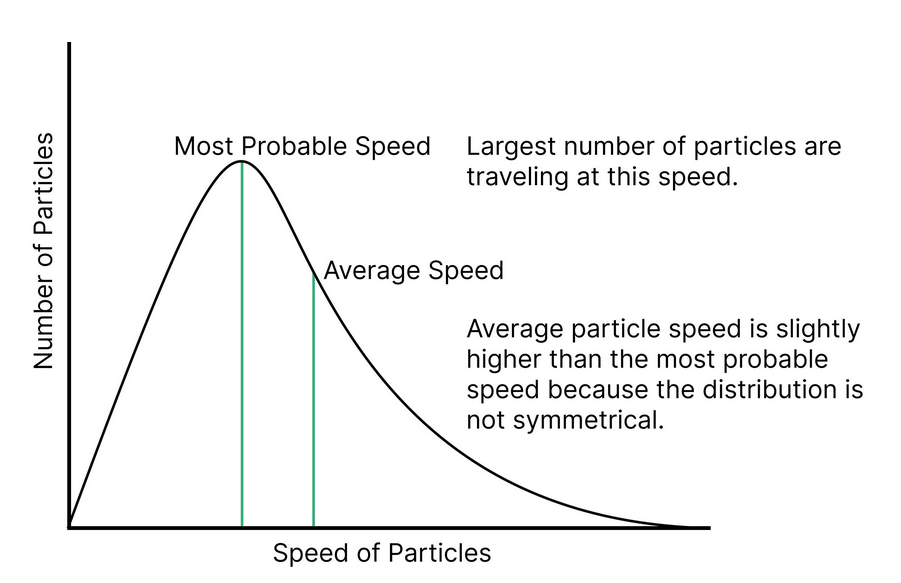
At the end of the 19th century, most scientists (like the influential Ernst Mach, 1838-1916, one of his main detractors) considered atoms merely as “convenient mathematical models,” not as real objects. Boltzmann, on the other hand, was convinced that atoms actually existed. To demonstrate this, he made a logical leap using statistics: he realized that it’s not necessary to know the trajectory of every single molecule to understand how a gas behaves, but rather to calculate the average of their collisions (see Figure 1). From these principles, he developed what later became Statistical Mechanics.


Figure 1 – Diagram of the statistical distribution of particles velocities in a gas (credits: Shutterstock)

particles statistic


Entropy and the ‘arrow of time’
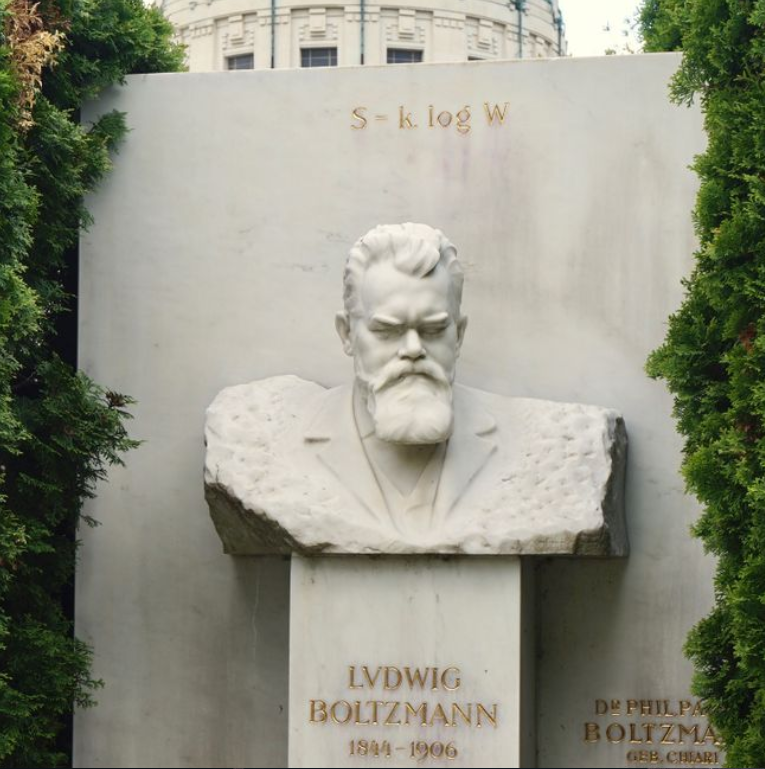
His masterpiece is the famous formula carved on his tomb in Vienna (Figure 2):
S = k log W
This equation connects the visible world (S, entropy) to the invisible world (W, the number of ways atoms can arrange themselves).
One interpretation of entropy is emergent temporal asymmetry: it explains why time only moves forward, not because of a law of mechanics, but because of probability. Heat flows from a hot body to a cold one simply because it is statistically more likely that energy will be dispersed in disorder rather than remain concentrated.
And similarly for the configurational states that hold matter together. Among many, we recall the famous example of the cup falling and breaking into pieces while we don’t observe the pieces spontaneously rejoining to form a whole cup. This happens because the whole cup is a very low-probability state (very ordered); the shattered cup is a very high-probability state (very disordered).
Boltzmann understood that the entire universe is just a gigantic transition to the most probable state.

A misunderstood genius, still underappreciated today
Boltzmann was fiercely attacked by his contemporaries. Scientists of the time, tied to a more continuous view of matter, mocked him. This implacable opposition, combined with a personality prone to depression, led him to commit suicide in 1906, in Duino, near Trieste.
Just a year earlier, in 1905, a young Albert Einstein had published a paper on Brownian motion that proved Boltzmann was right: atoms existed.
He was the first to understand that disorder is the driving force of the universe, and he transformed physics from a science of certainties to a science of probabilities. Without his statistical method and the constant (k) that characterizes it, Max Planck (1858-1947) would never have been able to launch the quantum revolution.
Boltzmann represents the bridge that took physics from the age of steam to the age of the atom and information.


Figure 2 – Ludwig Boltzmann

Ludwig Boltzmann

please, rate this post

On Mars after sunset

The following image shows Venus, Earth, and Jupiter in the sky of Mars. It was published on X, but some users claimed it was fake, saying that the three planets couldn’t be seen aligned because Mars’s orbit was in the middle of theirs.


Mars landscape


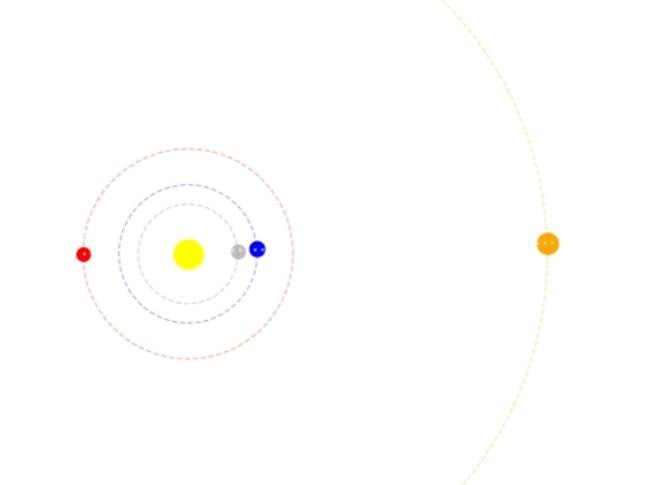
So I created the following diagram to explain that it is absolutely possible to see them like this, after sunset, even if it’s not a frequent configuration. For the planets to be seen, Jupiter, Earth, and Venus must be illuminated by the Sun, so they must be on the other side of the Sun’s orbit, as in my drawing. (Note: the orbits are to scale; the planets and the Sun’s measurements are not!)


Solar System


However, I cannot guarantee that the photo isn’t fake!

please, rate this post

Cute math game

Let us consider the number
[1] x=0.9999…
where the dots … indicate that the numbers continue the same without end.

It seems obvious that we can state that
[2] x<1

However, if we carry out the following steps:

x=0.9999…
10x=9.9999…
10x−x=9.000…
9x=9
[3] x=1

Does [3] contradict [2]?

Where is the ‘problem’?

Write your opinion in the comments
let’s see if someone wins a little doll… ; )

please, rate this post

How much does air weigh?

Let us first consider the air we breathe on Earth.
It is a mixture of gases, as well as water vapour (from 0% to 4%) and dust.
The main gases are:
– Nitrogen (N₂): 78.08%, a molecule made of two nitrogen atoms
– Oxygen (O₂): 20.95%, a molecule made of two oxygen atoms
– Argon (Ar): 0.93%, a noble gas—so called because it does not bind into molecules (its outer electron shell is complete, with the 8 electrons allowed)
– Carbon dioxide (CO₂): about 0.04%, made of one carbon atom and two oxygen atoms.
With rounding, the total comes to 100%, but there are also traces of other gases, such as neon (Ne), helium (He), methane (CH₄), ozone (O₃). From everyday experience we know its elastic properties, which make it compressible and give concrete meaning to the concept of pressure (force applied on a surface), but we rarely think about its weight.

One litre, i.e., one cubic decimetre, of dry air at sea level and at the standard temperature of 15°C weighs about 1.2 grams. Stated like that it sounds like little, but it means that 1 cubic metre weighs 1.2 kg. That is why the kilometres of air above our heads ‘weigh’: as you go up the gases become increasingly rarefied and the air weighs less, but we are talking about tens of kilometres, if not more (to give a more precise estimate one would have to set a limit in pressure or in specific weight). This weight, obviously determined by gravitational attraction, is substantial: the standard pressure of 1 atmosphere corresponds to about 1 kg of weight per square centimetre. In other words, for every square centimetre of our body (a little less than an average fingernail) the acting force is equivalent to 1 kg of weight.
We are not crushed by it and we scarcely notice it because from the inside our body exerts an equal and opposite pressure: we are essentially like balloons that do not burst because the pressures balance. In addition, pressure acts in all directions, not only vertically, so we are not ‘pushed’ one way, we receive the push from every side.

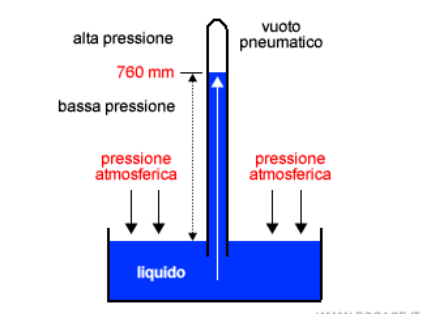
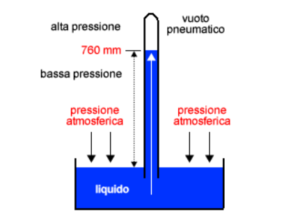
The instrument for measuring atmospheric pressure was invented in 1643 by Evangelista Torricelli (1608–1647), a student of Galileo Galilei (1564–1642). He observed that a transparent tube closed at one end and filled with mercury, when inverted into a basin also containing mercury, maintained a height of about 76 cm, as in Figure 1. Therefore, the weight of the mercury column in the tube had to be equivalent to the weight of the air. The standard unit of measurement for atmospheric pressure is the Pascal (or the hectoPascal, hPa, equal to 100 Pascals, called millibar in meteorology as a submultiple of the bar). One atmosphere, defined as the average pressure at sea level, corresponds to 1,013 hPa, and is the simplest measure for quick explanations. For example, as you gain altitude the trend is not linear because, as mentioned, the air becomes lighter; but at first the pressure halves roughly every 5,500 metres. To give easily testable figures, at 1,500 metres above sea level the pressure is about 84%, at 3,000 metres it is about 69%. That is to say: at 1,500 metres altitude the pressure difference (negative) is comparable to that of a couple of metres of water depth—this is why, even when going into the mountains, it is often necessary to equalize the pressure on our eardrums.


Figure 1 – Torricelli’s barometer (source: ecoage.it, under CC  Creative Commons licence)
Barometro di Torricelli


In this post I will not go into meteorological questions, but it is clear that depending on humidity content and temperature this weight changes, determining differences between locations that generate weather phenomena: wind, clouds, rain, air-mass fronts, etc.

Returning to weight, by analogy with the measure of one atmosphere, note that it corresponds to a column of water about 10 metres high (because of the large difference in density between the two fluids: mercury is almost 14 times as dense as water). Thus, the pressure of the kilometres of air above us is equivalent to 10 metres of water; that is, when we dive, at 10 metres depth we experience a pressure about double what it was before we entered the water. Okay, this is not something people normally do, but anyone who has dived even just a few metres has clearly felt the external pressure (and the need to equalize the internal pressure in the ears). With simple multiplication, this means that at 50 metres depth the “weight” is 5 kg per cm², and at 1,000 metres it is 100 kg per cm².

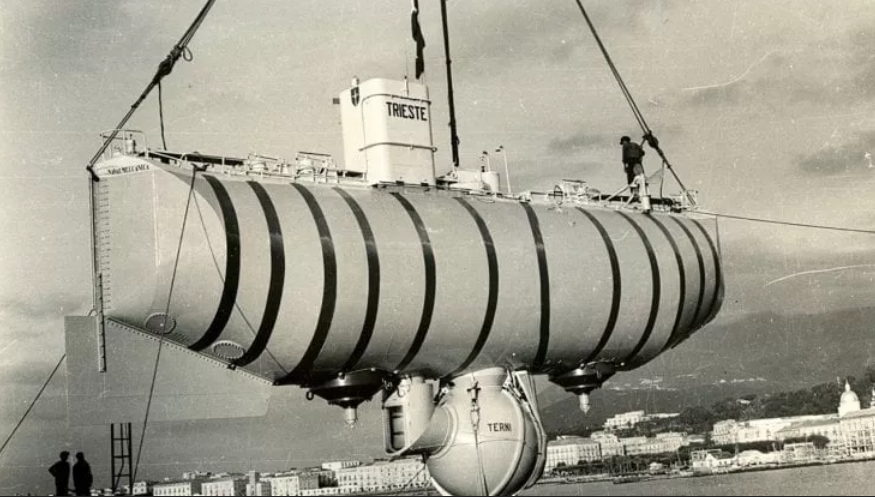
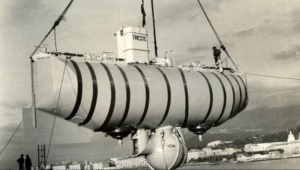
In the Mariana Trench, where the bathyscaphe Trieste (built in Italy, Figure 2) first arrived with the exploration pioneers Jacques Piccard and Don Walsh in 1960, at nearly 11,000 metres depth, the pressure was over one tonne per cm². To withstand it, the steel hull was about 13 cm thick!


Figure 2 – Bathyscaphe Trieste (source: repubblica.it)
Batiscafo Trieste


And how much does the air weigh on Mars?
The Martian atmosphere is composed of about 95% carbon dioxide (CO₂) (oxygen is only about 0.13%). The pressure is very low, about 1% of Earth’s, around 6 hPa compared with our 1013 hPa. It might seem like a paradise for plants that ‘breathe’ CO₂, but aside from the fact that at night plants also breathe oxygen (so they would suffocate), the very low pressure and extremely low temperature (−60°C) would not allow water to be liquid, so the plant’s biochemistry would come to a halt as well.

A significant problem with very low pressure for the human body is the so-called Armstrong limit (about 63 hPa), below which water and blood (at body temperature) would begin to ‘boil’ spontaneously because the external pressure is too low to keep them in the liquid state. A walk on Mars without a pressurized suit is strongly discouraged, regardless of the temperature and the lack of oxygen! On Earth this limit is reached at around 18 km of altitude.

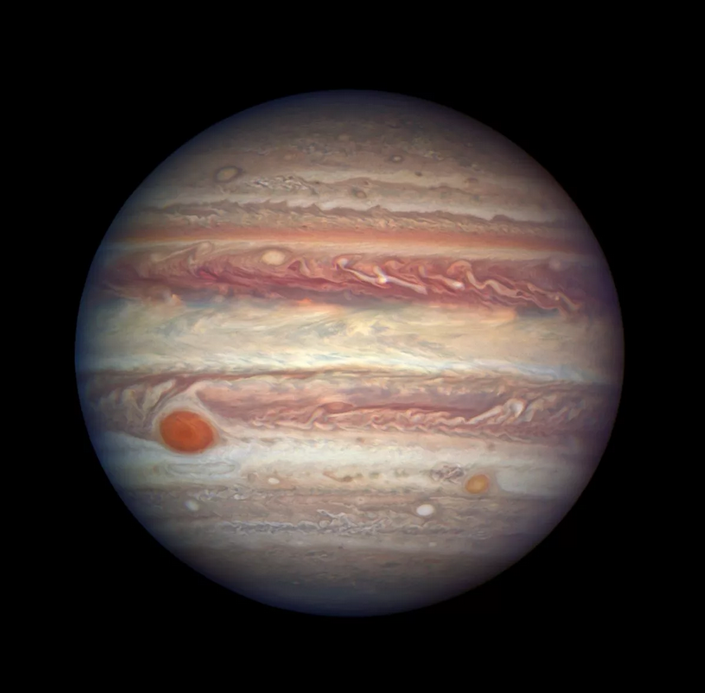
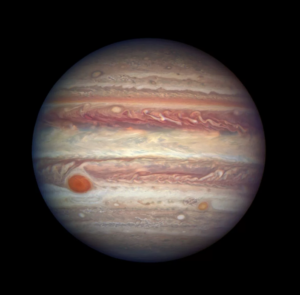
On Jupiter things ‘get worse’ considerably: first of all there is no solid surface; the planet is entirely gaseous, made of about 90% hydrogen (H₂) and 10% helium (He), plus traces of other gases (which are what determine the coloured bands and spots we observe, see Figure 3). Moving inward from the outer layers, because of pressure these gases become liquids and temperatures become extremely high, perhaps 30,000°C near the core, consisting of molten metallic hydrogen (i.e., behaving like a molten metal, for example mercury), which produces its intense magnetic field (20 to 50 times Earth’s and more than twice the Sun’s, except in sunspots, where it is about 300 times stronger). The pressure, which on the outside is of the same order of magnitude as ours, likely reaches 100 million times that toward the centre.
Jupiter is basically a failed star, a terrible place.


Figure 3 – Jupiter (source: NASA / Space Telescope Science Institute, 2017)
Giove


please, rate this post

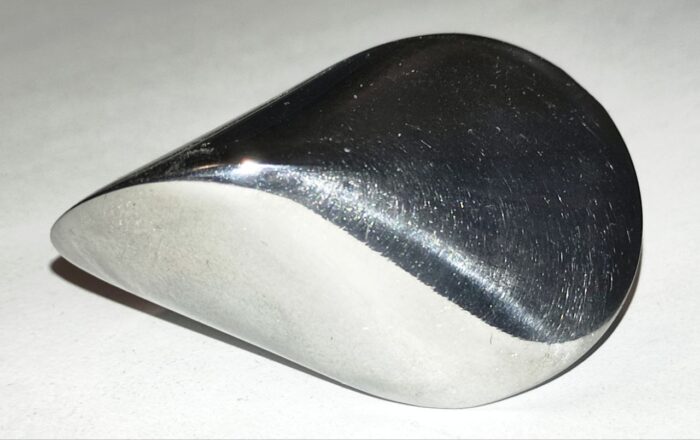
Strange Mathematical Objects: oloid

Figure 1 – A steel oloid

Oloid


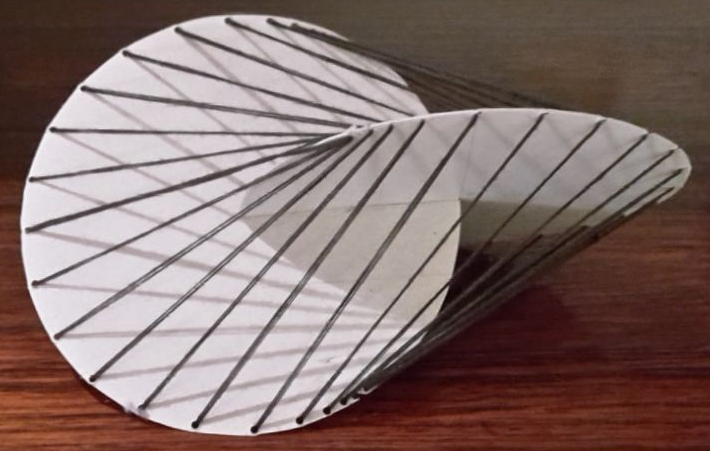
The oloid is a solid discovered by Paul Schatz (1898–1979). It is defined as “the convex hull of two identical circles placed in perpendicular planes, such that the center of each circle lies on the circumference of the other.” Figure 2 clearly shows how it is constructed.


Figure 2 – Oloid model showing the construction of the solid figure (source: Dr. S. Wetzel, licensed under CC BY-SA 3.0 de)

Oloid


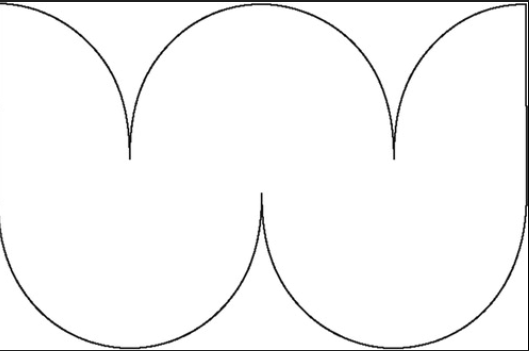
One characteristic that is immediately noticeable is that, if it rolls on a plane, it develops its entire surface on that plane; that is, every point on its surface touches the plane. Moreover, despite its rocking motion, its rolling direction is perfectly straight.

During rotation, the distance of its center of mass from the plane does not vary linearly but ‘undulates’, with two minima and two maxima for each full rotation.

The surface area is easily determined by considering this development, highlighted in Figure 3 for a semi-rotation (half a turn), equal to four semicircles, so its double for a full rotation is:
Aₒ=4πr²
where r is the radius of the generating circle.


Figure 3 – Development of the oloid’s rolling on the surface

Oloid surface


Calculating the volume is very complex; it involves elliptic integrals of the first and second kind, and I will not even report the formula. A numerical computation gives the approximate value:
Vₒ=3.052 r³
where r is the radius of the generating circle. For comparison, recall that the volume of a sphere gives the approximate value:
Vₛ=4.189 r³

In addition to being a very aesthetically pleasing object and a nice presence as a ‘desk toy’, oloids are used industrially for gentle mixing of fluids, thanks to their characteristic of not generating vortices and of preventing foam formation and oxygenation.

please, rate this post

17 February 1600 – the burning of Giordano Bruno

In Rome, in Campo de’ Fiori, one of the countless murders perpetrated throughout history for conquest and, as in this case, for maintaining imperial power over free thought and ultimately over peoples.
That the killing of the enemy has always been an anthropic standard is evident. Borrowed, as a degeneration, from the animal struggle for survival, to the point of turning it into a ‘moral rule’. Yet the physical violence of domination by the stronger is still understandable in a confrontation ‘on equal terms’. In ancient wars soldiers faced each other directly. Then, perhaps, the victors also abused civilian populations, but in some way they had demonstrated a physical superiority, at least in violence.

The qualitative leap to the suppression of ideas, ideas that differ from the theoretical framework of those in command, is typical of religions, which have often provided a moral and identity-based framework of legitimation for the violence of political and economic powers.

Starting from the common celebratory dating of an event of a religious nature (sun worship later becoming the birth of the ‘son of a god’), one underestimates the conditioning power of religions, namely of those responsible for managing religious sects, founded on the human weakness of the need for a superior being and for its interpreters. Each one claiming to be the bearer of the only truth, incidentally different from that of the others. All fine, if it ended there. But when a different idea is not confronted with better ideas, but by suppressing the bearer of the idea, what is at stake is not truth: what is at stake is power.

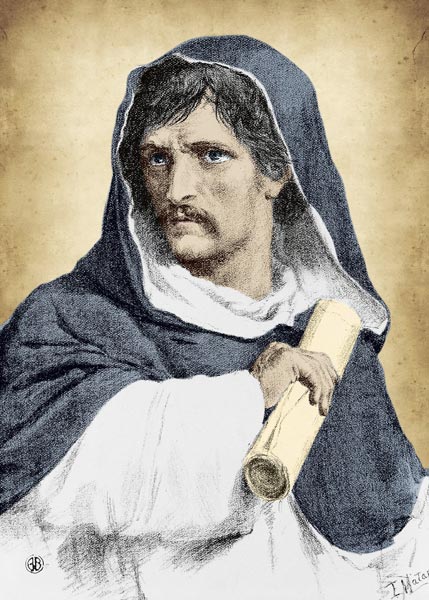
Nature is incredibly violent in its evolution, just think of a volcano or an earthquake on our small planet, or, with infinitely greater power, the explosion of a supernova or a black hole, or the gravitational merger of galaxies. We cannot apply criteria of morality or justice to Nature in events that vaporize entire planets in a few instants. But we can to the bipedal mammals of this mild and quiet planet. Endowed with the faculty of rational thought, we should respect this potential in others in order to respect it in ourselves. Yet the ambition for the power of domination has always won by a landslide. And so the bearers of opposing ideas, of a freedom of thought that could weaken one’s own positions as monopolists of ‘truth’, are killed, if possible amid atrocious suffering. Thus small, petty little men of a sect which, in the name of a revealed truth, resorted to coercion and to the killing, after years of imprisonment, of a visionary genius such as Giordano Bruno. Fortunately, however, he managed to pass on to us his thoughts, his visions, still relevant after more than four centuries.

And religious sects are still active today in many parts of the world and, by merging with political power, they become coercive apparatuses that often translate into systematic persecutions and violence—now industrialized in modern ways, but always with the same aim: the suppression of people’s freedom and of ideas, to impose their own dominion through violence and not comparing better ideas on a rational level.

For a more in-depth look at the life and thought of Giordano Bruno, the Wikipedia page is comprehensive.


Giordano Bruno
Giordano Bruno (source copia-di-arte.com)

please, rate this post

Mie scattering and white clouds

Why are clouds white?
We need to examine a type of scattering that involves photons of solar radiation when they interact with the molecules that make up the tiny droplets (or water droplets) forming clouds or fog. Unlike Rayleigh scattering (which involves nitrogen and oxygen molecules in the air, see my post The Rayleigh scattering and the blue sky, whose sizes are smaller than the wavelength of the incoming radiation), in this case the droplets are of the same order of magnitude as the radiation wavelength (or slightly larger). This phenomenon is called Mie scattering, named after the German physicist Gustav Adolf Fedor Wilhelm Ludwig Mie (1869–1957), who provided a rigorous mathematical demonstration of it.

Because these microdroplets are ‘large’, they scatter nearly all wavelengths with approximately the same intensity, so the light appears white (or whitish). There is no wavelength-selection effect as in the case of the blue sky.
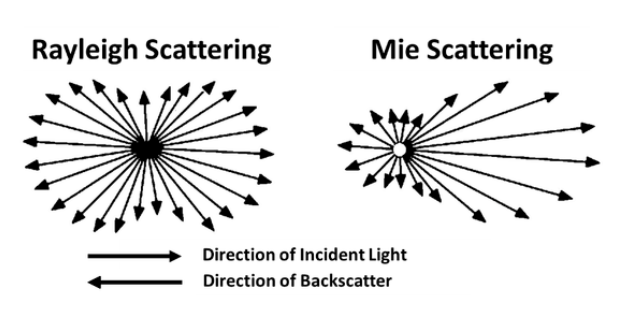
Another characteristic is that the scattering does not occur uniformly in all directions but mainly forward (in the same direction as the incoming light), creating strong glare, while a smaller fraction is scattered backward. See Figure 2.


Figure 1 – White clouds !

White clouds


Figure 2 – Rayleigh scattering and Mie scattering

Mie scattering


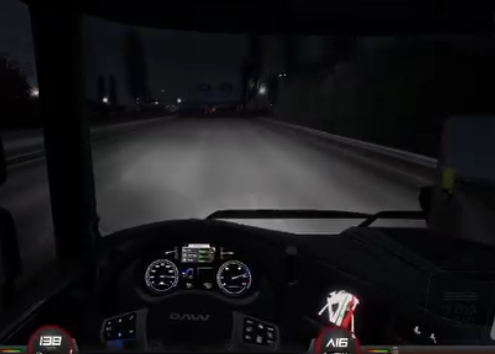
This explains why clouds tend to be white and why, when you shine car headlights into fog, a blinding glow is produced (due mainly to the backscattered component), see Figure 3. It also explains why truck drivers -whose driving position is at least a couple of meters higher than the level of their headlights (rather than about half a meter or less, as in cars)- experience this backscattering effect to a lesser extent and therefore can actually see the road in fog better than a car driver. See Figure 4 (clearly rather banal examples, only ‘evocative’ to suggest points of view).
This is also the reason why fog lights are always mounted very low, both on cars and on commercial vehicles: to maximize the angle relative to the backscattered glare produced by Mie scattering.


Figure 3 – Blinding glow while driving a car in the fog

Car driving in the fog


Figure 4 – Driving a truck at night

Truck driving


Technically,
Mie theory provides an exact solution to Maxwell’s equations for the interaction of a plane electromagnetic wave with a homogeneous sphere of dielectric material. It has no limits beyond the size of the interacting material (as in the case of Rayleigh scattering).
In Mie theory, the total extinction of light (absorption + scattering) is defined by the coefficient Qₑₓₜ.
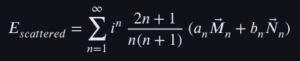
Mathematically, the diffuse electric field is expressed as an infinite series of coefficients (called aₙ and bₙ), which represent the contributions of the electric and magnetic multipoles:
Mie scattering maths
where Mₙ and Nₙ are spherical vector wave functions. The larger the particle (i.e. the fog), the more terms in the series are needed to calculate the correct scattering.

please, rate this post