Figure 1 – A steel oloid
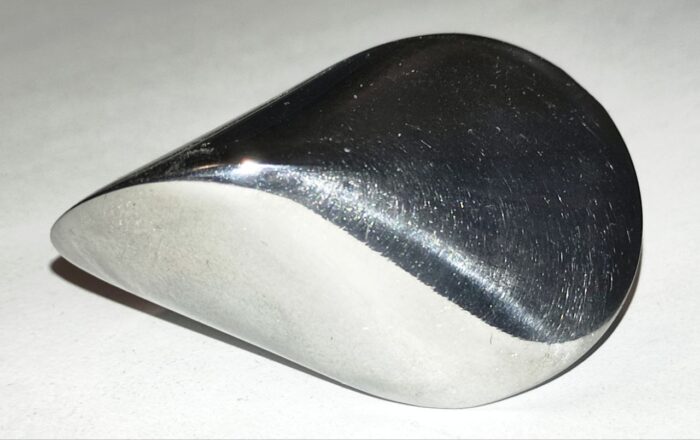
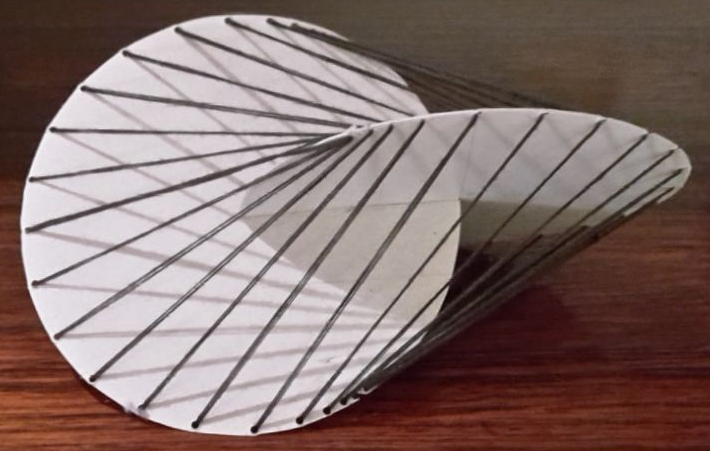
The oloid is a solid discovered by Paul Schatz (1898–1979). It is defined as “the convex hull of two identical circles placed in perpendicular planes, such that the center of each circle lies on the circumference of the other.” Figure 2 clearly shows how it is constructed.
Figure 2 – Oloid model showing the construction of the solid figure (source: Dr. S. Wetzel, licensed under CC BY-SA 3.0 de)
One characteristic that is immediately noticeable is that, if it rolls on a plane, it develops its entire surface on that plane; that is, every point on its surface touches the plane. Moreover, despite its rocking motion, its rolling direction is perfectly straight.
During rotation, the distance of its center of mass from the plane does not vary linearly but ‘undulates’, with two minima and two maxima for each full rotation.
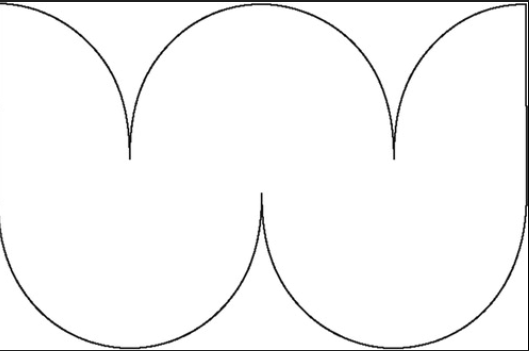
The surface area is easily determined by considering this development, highlighted in Figure 3 for a semi-rotation (half a turn), equal to four semicircles, so its double for a full rotation is:
Aₒ=4πr²
where r is the radius of the generating circle.
Figure 3 – Development of the oloid’s rolling on the surface
Calculating the volume is very complex; it involves elliptic integrals of the first and second kind, and I will not even report the formula. A numerical computation gives the approximate value:
Vₒ=3.052 r³
where r is the radius of the generating circle. For comparison, recall that the volume of a sphere gives the approximate value:
Vₛ=4.189 r³
In addition to being a very aesthetically pleasing object and a nice presence as a ‘desk toy’, oloids are used industrially for gentle mixing of fluids, thanks to their characteristic of not generating vortices and of preventing foam formation and oxygenation.


Molto interessante!
thanks 🙂