Why are clouds white?
We need to examine a type of scattering that involves photons of solar radiation when they interact with the molecules that make up the tiny droplets (or water droplets) forming clouds or fog. Unlike Rayleigh scattering (which involves nitrogen and oxygen molecules in the air, see my post The Rayleigh scattering and the blue sky, whose sizes are smaller than the wavelength of the incoming radiation), in this case the droplets are of the same order of magnitude as the radiation wavelength (or slightly larger). This phenomenon is called Mie scattering, named after the German physicist Gustav Adolf Fedor Wilhelm Ludwig Mie (1869–1957), who provided a rigorous mathematical demonstration of it.
Because these microdroplets are ‘large’, they scatter nearly all wavelengths with approximately the same intensity, so the light appears white (or whitish). There is no wavelength-selection effect as in the case of the blue sky.
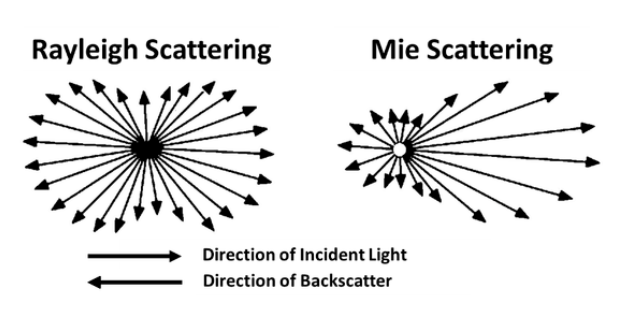
Another characteristic is that the scattering does not occur uniformly in all directions but mainly forward (in the same direction as the incoming light), creating strong glare, while a smaller fraction is scattered backward. See Figure 2.
Figure 1 – White clouds !

Figure 2 – Rayleigh scattering and Mie scattering
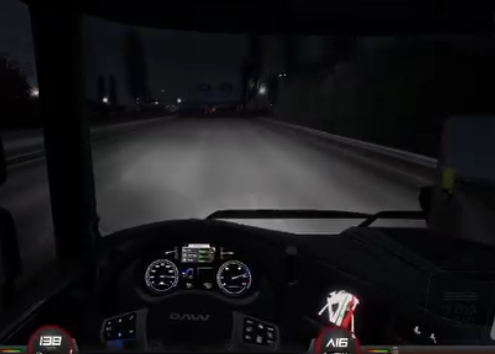
This explains why clouds tend to be white and why, when you shine car headlights into fog, a blinding glow is produced (due mainly to the backscattered component), see Figure 3. It also explains why truck drivers -whose driving position is at least a couple of meters higher than the level of their headlights (rather than about half a meter or less, as in cars)- experience this backscattering effect to a lesser extent and therefore can actually see the road in fog better than a car driver. See Figure 4 (clearly rather banal examples, only ‘evocative’ to suggest points of view).
This is also the reason why fog lights are always mounted very low, both on cars and on commercial vehicles: to maximize the angle relative to the backscattered glare produced by Mie scattering.
Figure 3 – Blinding glow while driving a car in the fog
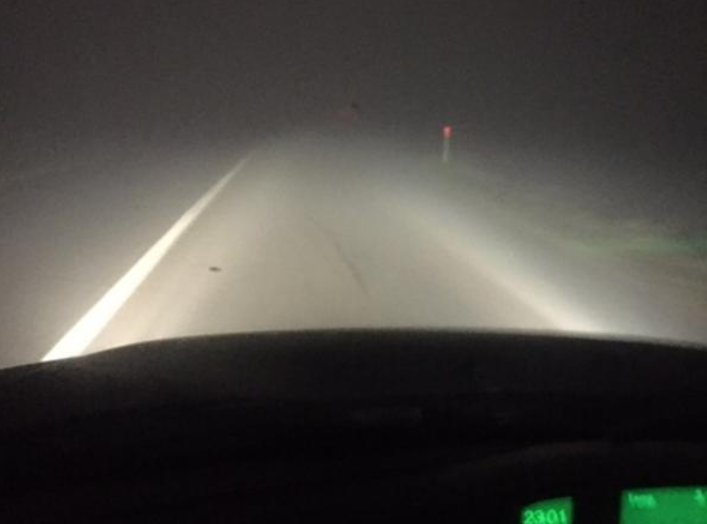
Figure 4 – Driving a truck at night
Technically,
Mie theory provides an exact solution to Maxwell’s equations for the interaction of a plane electromagnetic wave with a homogeneous sphere of dielectric material. It has no limits beyond the size of the interacting material (as in the case of Rayleigh scattering).
In Mie theory, the total extinction of light (absorption + scattering) is defined by the coefficient Qₑₓₜ.
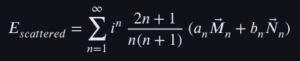
Mathematically, the diffuse electric field is expressed as an infinite series of coefficients (called aₙ and bₙ), which represent the contributions of the electric and magnetic multipoles:
where Mₙ and Nₙ are spherical vector wave functions. The larger the particle (i.e. the fog), the more terms in the series are needed to calculate the correct scattering.


Interessante!
Grazie …. Hai risposto a una delle domande che mi facevo spesso da bimba guardando il cielo
ε>