Post

A wearable math problem

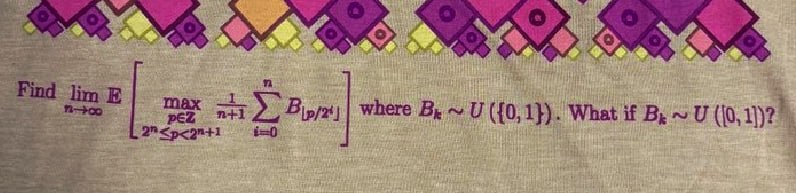
I was given this problem, printed on a T-shirt handed out at a math conference.
Below is my answer to the first part, which I believe is correct.
Does anyone know the answer to the second question as well?


math shirt


The defined structure is a ‘binary’ fractal because it divides into two parts each time.
The first question is to find the maximum expected value for the average of the values encountered when traversing the entire structure, as the number of subdivisions approaches infinity, if the values 0 or 1 are randomly assigned to each small square. That is, the maximum average value obtainable by following one of the paths.
[One path could be, for example, 1+0+1+0+1+0+0+1+1+1+…, another 1+1+1+1+1+1+1+1+1…]
Since the subdivision is binary, the chance of getting a 1 each time is 1/2 (one in two). But the number of paths grows at the same rate at which the probability decreases (doubling at each step), so it should always be possible to find a path where all the squares contain 1s; therefore, I would say the answer for the maximum of this expected value is “1”.
The following “what if” question, however, asks for the same expected value not for two discrete values, {0, 1}, but for the continuous values of the interval [0, 1] …
Not trivial… the chances of obtaining a number are no longer as simple as the 1 in 2 from before…


please, rate this post

On Mars after sunset

The following image shows Venus, Earth, and Jupiter in the sky of Mars. It was published on X, but some users claimed it was fake, saying that the three planets couldn’t be seen aligned because Mars’s orbit was in the middle of theirs.


Mars landscape


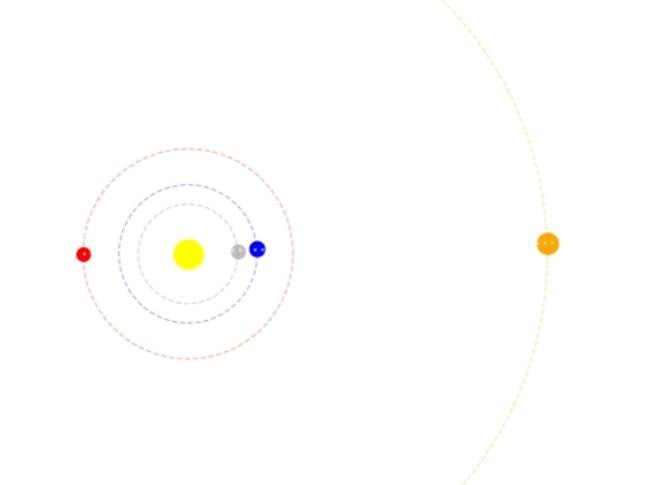
So I created the following diagram to explain that it is absolutely possible to see them like this, after sunset, even if it’s not a frequent configuration. For the planets to be seen, Jupiter, Earth, and Venus must be illuminated by the Sun, so they must be on the other side of the Sun’s orbit, as in my drawing. (Note: the orbits are to scale; the planets and the Sun’s measurements are not!)


Solar System


However, I cannot guarantee that the photo isn’t fake!

please, rate this post

Cute math game

Let us consider the number
[1] x=0.9999…
where the dots … indicate that the numbers continue the same without end.

It seems obvious that we can state that
[2] x<1

However, if we carry out the following steps:

x=0.9999…
10x=9.9999…
10x−x=9.000…
9x=9
[3] x=1

Does [3] contradict [2]?

Where is the ‘problem’?

Write your opinion in the comments
let’s see if someone wins a little doll… ; )

please, rate this post

How much does air weigh?

Let us first consider the air we breathe on Earth.
It is a mixture of gases, as well as water vapour (from 0% to 4%) and dust.
The main gases are:
– Nitrogen (N₂): 78.08%, a molecule made of two nitrogen atoms
– Oxygen (O₂): 20.95%, a molecule made of two oxygen atoms
– Argon (Ar): 0.93%, a noble gas—so called because it does not bind into molecules (its outer electron shell is complete, with the 8 electrons allowed)
– Carbon dioxide (CO₂): about 0.04%, made of one carbon atom and two oxygen atoms.
With rounding, the total comes to 100%, but there are also traces of other gases, such as neon (Ne), helium (He), methane (CH₄), ozone (O₃). From everyday experience we know its elastic properties, which make it compressible and give concrete meaning to the concept of pressure (force applied on a surface), but we rarely think about its weight.

One litre, i.e., one cubic decimetre, of dry air at sea level and at the standard temperature of 15°C weighs about 1.2 grams. Stated like that it sounds like little, but it means that 1 cubic metre weighs 1.2 kg. That is why the kilometres of air above our heads ‘weigh’: as you go up the gases become increasingly rarefied and the air weighs less, but we are talking about tens of kilometres, if not more (to give a more precise estimate one would have to set a limit in pressure or in specific weight). This weight, obviously determined by gravitational attraction, is substantial: the standard pressure of 1 atmosphere corresponds to about 1 kg of weight per square centimetre. In other words, for every square centimetre of our body (a little less than an average fingernail) the acting force is equivalent to 1 kg of weight.
We are not crushed by it and we scarcely notice it because from the inside our body exerts an equal and opposite pressure: we are essentially like balloons that do not burst because the pressures balance. In addition, pressure acts in all directions, not only vertically, so we are not ‘pushed’ one way, we receive the push from every side.

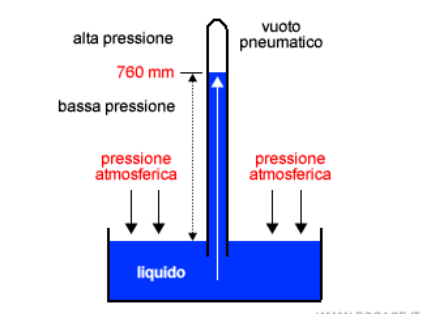
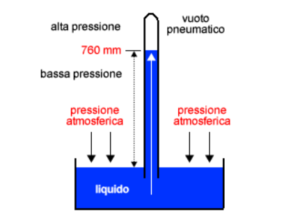
The instrument for measuring atmospheric pressure was invented in 1643 by Evangelista Torricelli (1608–1647), a student of Galileo Galilei (1564–1642). He observed that a transparent tube closed at one end and filled with mercury, when inverted into a basin also containing mercury, maintained a height of about 76 cm, as in Figure 1. Therefore, the weight of the mercury column in the tube had to be equivalent to the weight of the air. The standard unit of measurement for atmospheric pressure is the Pascal (or the hectoPascal, hPa, equal to 100 Pascals, called millibar in meteorology as a submultiple of the bar). One atmosphere, defined as the average pressure at sea level, corresponds to 1,013 hPa, and is the simplest measure for quick explanations. For example, as you gain altitude the trend is not linear because, as mentioned, the air becomes lighter; but at first the pressure halves roughly every 5,500 metres. To give easily testable figures, at 1,500 metres above sea level the pressure is about 84%, at 3,000 metres it is about 69%. That is to say: at 1,500 metres altitude the pressure difference (negative) is comparable to that of a couple of metres of water depth—this is why, even when going into the mountains, it is often necessary to equalize the pressure on our eardrums.


Figure 1 – Torricelli’s barometer (source: ecoage.it, under CC  Creative Commons licence)
Barometro di Torricelli


In this post I will not go into meteorological questions, but it is clear that depending on humidity content and temperature this weight changes, determining differences between locations that generate weather phenomena: wind, clouds, rain, air-mass fronts, etc.

Returning to weight, by analogy with the measure of one atmosphere, note that it corresponds to a column of water about 10 metres high (because of the large difference in density between the two fluids: mercury is almost 14 times as dense as water). Thus, the pressure of the kilometres of air above us is equivalent to 10 metres of water; that is, when we dive, at 10 metres depth we experience a pressure about double what it was before we entered the water. Okay, this is not something people normally do, but anyone who has dived even just a few metres has clearly felt the external pressure (and the need to equalize the internal pressure in the ears). With simple multiplication, this means that at 50 metres depth the “weight” is 5 kg per cm², and at 1,000 metres it is 100 kg per cm².

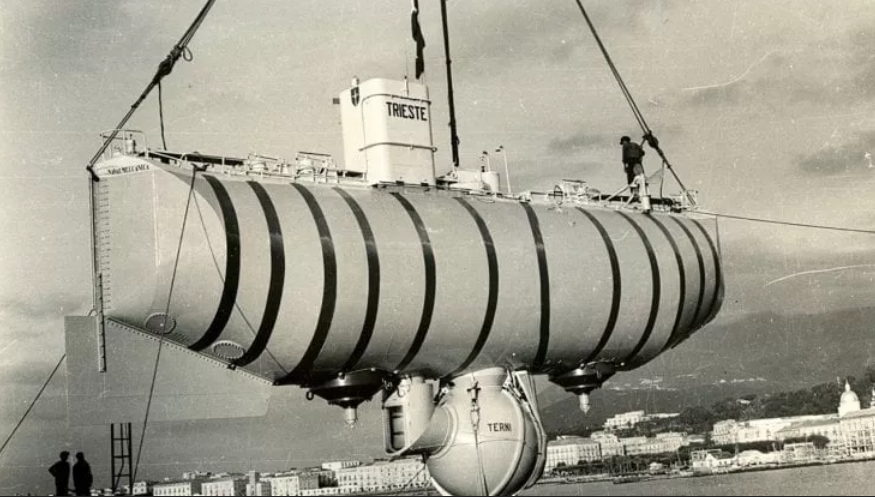
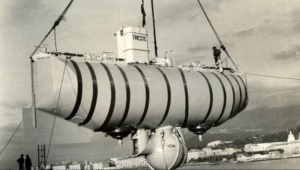
In the Mariana Trench, where the bathyscaphe Trieste (built in Italy, Figure 2) first arrived with the exploration pioneers Jacques Piccard and Don Walsh in 1960, at nearly 11,000 metres depth, the pressure was over one tonne per cm². To withstand it, the steel hull was about 13 cm thick!


Figure 2 – Bathyscaphe Trieste (source: repubblica.it)
Batiscafo Trieste


And how much does the air weigh on Mars?
The Martian atmosphere is composed of about 95% carbon dioxide (CO₂) (oxygen is only about 0.13%). The pressure is very low, about 1% of Earth’s, around 6 hPa compared with our 1013 hPa. It might seem like a paradise for plants that ‘breathe’ CO₂, but aside from the fact that at night plants also breathe oxygen (so they would suffocate), the very low pressure and extremely low temperature (−60°C) would not allow water to be liquid, so the plant’s biochemistry would come to a halt as well.

A significant problem with very low pressure for the human body is the so-called Armstrong limit (about 63 hPa), below which water and blood (at body temperature) would begin to ‘boil’ spontaneously because the external pressure is too low to keep them in the liquid state. A walk on Mars without a pressurized suit is strongly discouraged, regardless of the temperature and the lack of oxygen! On Earth this limit is reached at around 18 km of altitude.

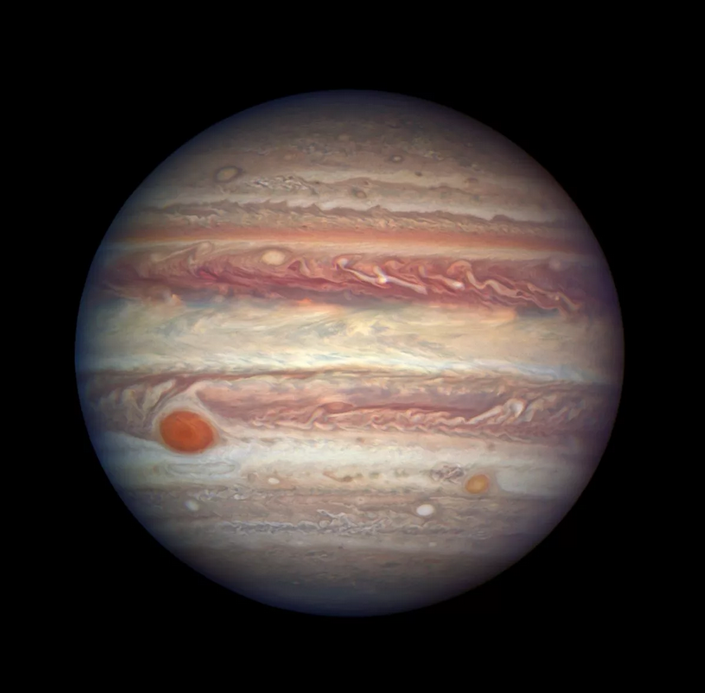
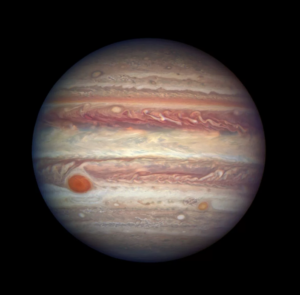
On Jupiter things ‘get worse’ considerably: first of all there is no solid surface; the planet is entirely gaseous, made of about 90% hydrogen (H₂) and 10% helium (He), plus traces of other gases (which are what determine the coloured bands and spots we observe, see Figure 3). Moving inward from the outer layers, because of pressure these gases become liquids and temperatures become extremely high, perhaps 30,000°C near the core, consisting of molten metallic hydrogen (i.e., behaving like a molten metal, for example mercury), which produces its intense magnetic field (20 to 50 times Earth’s and more than twice the Sun’s, except in sunspots, where it is about 300 times stronger). The pressure, which on the outside is of the same order of magnitude as ours, likely reaches 100 million times that toward the centre.
Jupiter is basically a failed star, a terrible place.


Figure 3 – Jupiter (source: NASA / Space Telescope Science Institute, 2017)
Giove


please, rate this post

Strange mathematical objects: Klein bottle

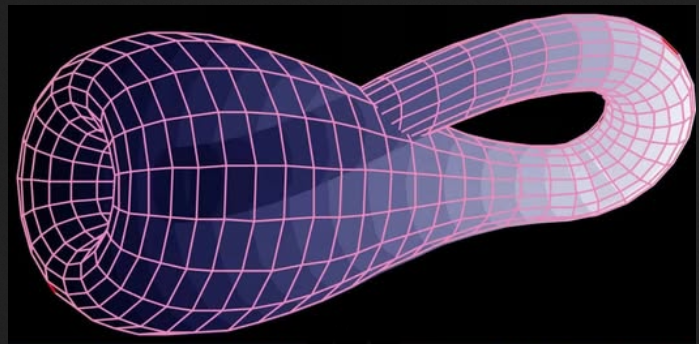
Figure 1 – Klein bottle

Klein bottle


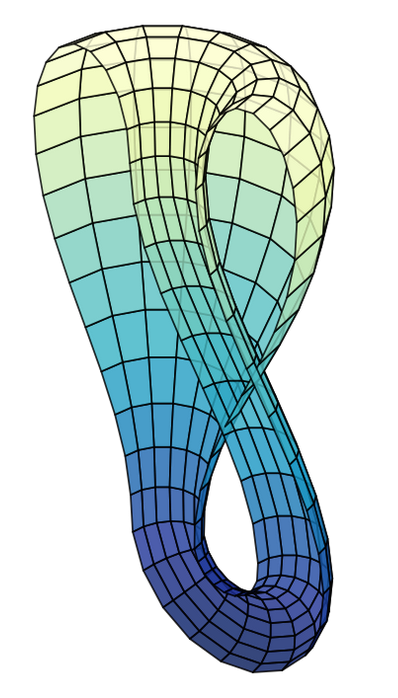
The Klein bottle, or Klein surface, named after the German mathematician Felix Christian Klein (1849–1925), who described it at the end of the 19th century during the development of topology*, it’s an example of one sided surface, with no distinct inside or outside. It is a so-called non-orientable two-dimensional manifold, like the previously seen the Möbius strip, with the important difference that it has no edges.
It is a kind of bottle in which the neck connects to the bottom, having to pass through the wall of the same bottle, as in Figure 1. This is how it appears in a three-dimensional visualization, but like other topological spaces (which we always consider Euclidean), it is not easily visualized in ℝ³. When analyzed in ℝ⁴ there are no overlaps (self-intersections); one understands that the neck does not touch the surface.

Proceeding to higher dimensions, one can imagine a non-orientable three-dimensional manifold that cannot be embedded in ℝ⁴ but can be embedded in ℝ⁵. For example connecting two ends of a Spherinder to each other in the same manner as the two ends of a cylinder for a Klein bottle.

If cut in half, the Klein bottle creates two Möbius strips as in Figure 2, remembering that in reality the intersection does not exist in ℝ⁴.


Figure 2 – A Klein bottle cut in half results in two Möbius strips (source: wikimedia licensed under the Creative Commons Attribution 4.0 Int license)

Klein bottle cut in half


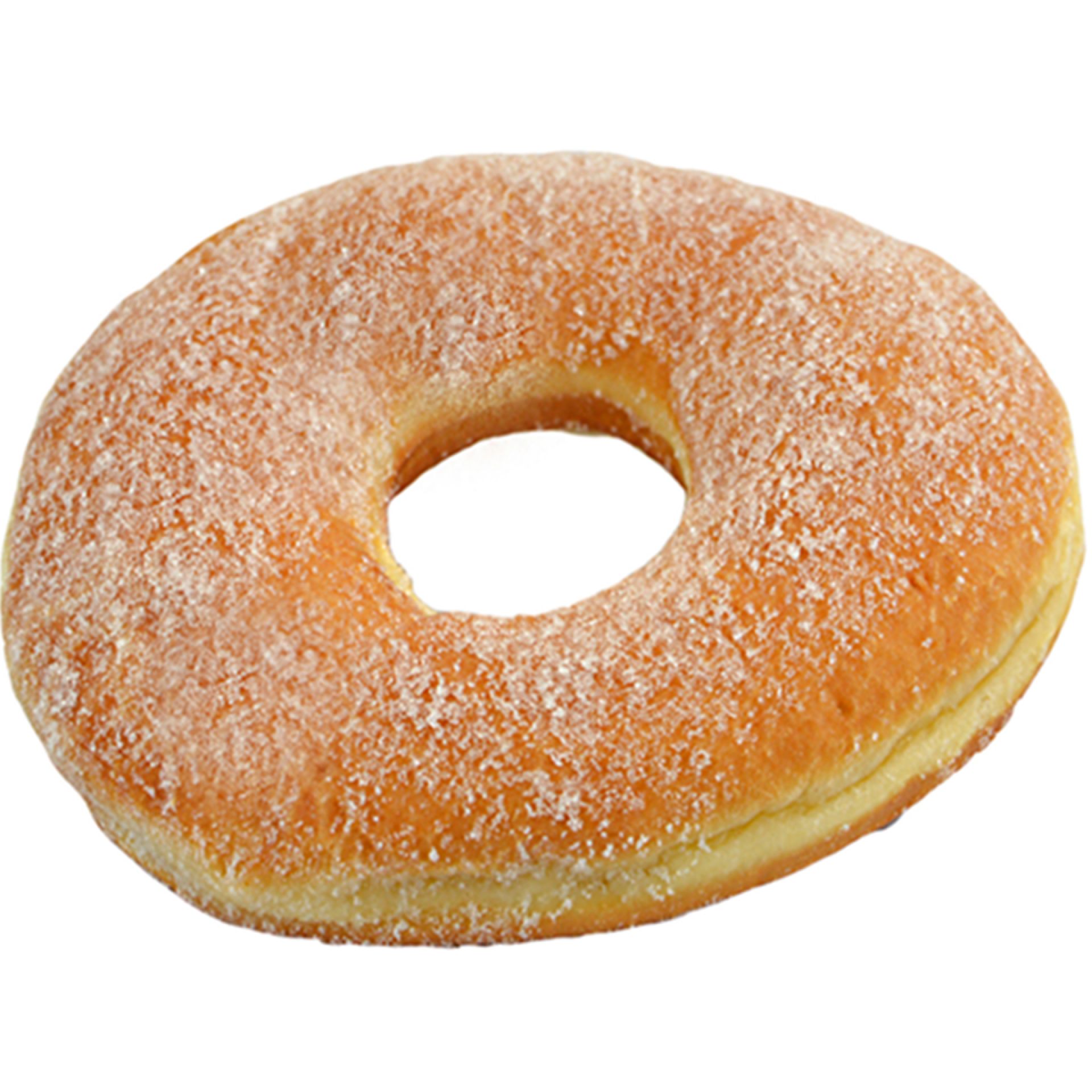
Figure 3 – A tasty solid torus

A tasty solid torus


The traditional (immersed) representation of the Klein bottle is achiral (that is, its mirror image cannot be distinguished from the object). The solid Klein bottle is considered the non-orientable version of the solid torus (such as the one in Figure 3).


Topology*
Topology is an area of mathematics that studies the properties of mathematical objects (shapes) that do not change when a deformation is performed without ‘holes’, ‘overlaps’, or ‘gluing’. For example, a cube is topologically equivalent to a sphere, whereas a torus (a doughnut) is not, because it has a hole that cannot be removed by deformation.
For further reading, the Wikipedia page is comprehensive.

please, rate this post

The virial theorem and stellar equilibrium

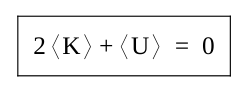
The virial theorem is a fundamental analytical result in the mechanics of particle systems, as it establishes a rigorous connection between the time averages of kinetic and potential energies. Its validity extends to systems in dynamic equilibrium, where internal forces are governed by potentials that depend on distance according to a power law, as in the case of universal gravitation or electrostatics.
The work is written in italian.

pdf_ita Brussi 2026_Il teorema del viriale e l’equilibrio stellare

Teorema del viriale

please, rate this post

Strange Mathematical Objects: oloid

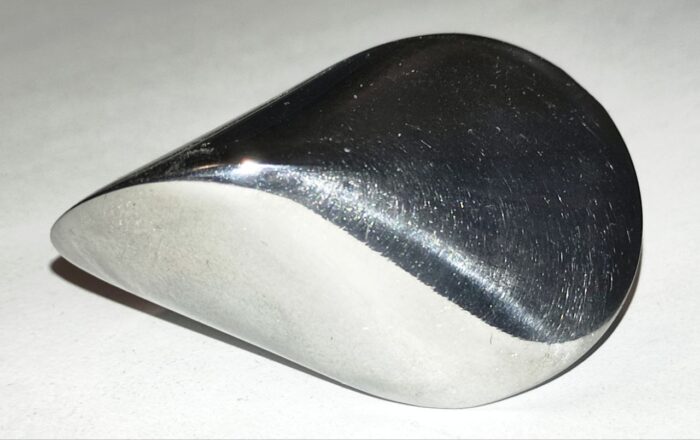
Figure 1 – A steel oloid

Oloid


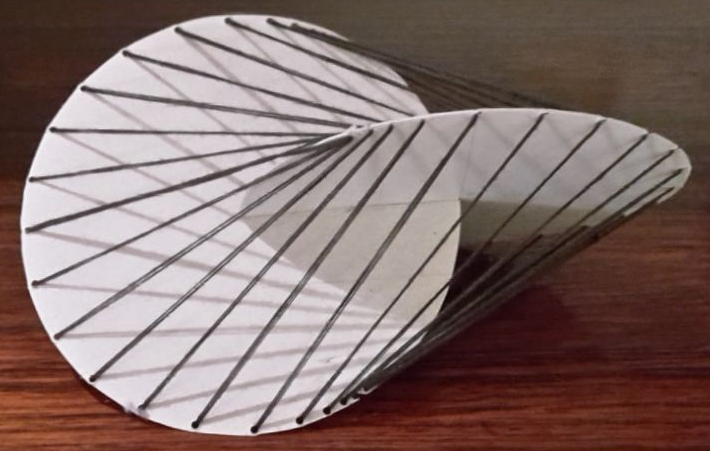
The oloid is a solid discovered by Paul Schatz (1898–1979). It is defined as “the convex hull of two identical circles placed in perpendicular planes, such that the center of each circle lies on the circumference of the other.” Figure 2 clearly shows how it is constructed.


Figure 2 – Oloid model showing the construction of the solid figure (source: Dr. S. Wetzel, licensed under CC BY-SA 3.0 de)

Oloid


One characteristic that is immediately noticeable is that, if it rolls on a plane, it develops its entire surface on that plane; that is, every point on its surface touches the plane. Moreover, despite its rocking motion, its rolling direction is perfectly straight.

During rotation, the distance of its center of mass from the plane does not vary linearly but ‘undulates’, with two minima and two maxima for each full rotation.

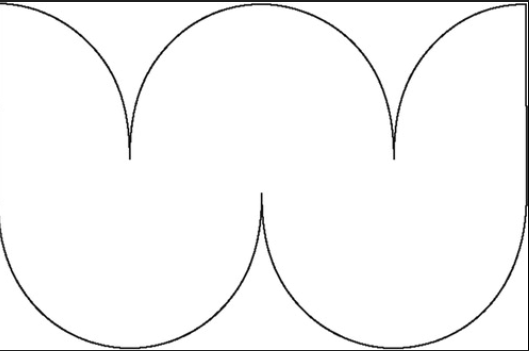
The surface area is easily determined by considering this development, highlighted in Figure 3 for a semi-rotation (half a turn), equal to four semicircles, so its double for a full rotation is:
Aₒ=4πr²
where r is the radius of the generating circle.


Figure 3 – Development of the oloid’s rolling on the surface

Oloid surface


Calculating the volume is very complex; it involves elliptic integrals of the first and second kind, and I will not even report the formula. A numerical computation gives the approximate value:
Vₒ=3.052 r³
where r is the radius of the generating circle. For comparison, recall that the volume of a sphere gives the approximate value:
Vₛ=4.189 r³

In addition to being a very aesthetically pleasing object and a nice presence as a ‘desk toy’, oloids are used industrially for gentle mixing of fluids, thanks to their characteristic of not generating vortices and of preventing foam formation and oxygenation.

please, rate this post

Logic pills: the Boolean basics

The mathematician and philosopher George Boole (1815–1864) developed the association between logic and mathematics by analyzing the laws of mental operations underlying reasoning, and expressing them in a symbolic language that would allow logical operators to act like algebraic operators, by means of computable statements. He created what is known as Boolean algebra.

Boolean logic is the foundation of computer science and digital electronics, and it is based on the manipulation of variables that can take only two values: True (1) and False (0). The Boolean logical operators, detailed below, are applied as ‘logic gates’ in electronic devices, making it possible to build the basic operations, then replicated billions of times in modern devices, to create the computers and smartphones we know. More precisely, these include both physical gates, transistors* in hardware, and non-physical gates, in the instructions of operating system and application code.

The fundamental operators are:
AND: returns true (1) only if all inputs are true.
OR: returns true (1) if at least one input is true.
NOT (negation): an operator that inverts the input value: 1 becomes 0, and vice versa.

ABAND (A*B)OR (A+B)
0000
0101
1001
1111

Using the fundamental operators one can build the logic gates:
NAND (Not-AND): output is false only if all inputs are true.
NOR (Not-OR): output is true only if all inputs are false.
XOR (Exclusive OR): true if the inputs are different, false if they are the same.

Combinations of these gates and the fundamental operators, together with an algebra that makes them workable, make it possible to build digital circuits and instruction structures that process and store data.


Transistor*

Transistors are devices made of semiconductor materials (e.g., modified silicon) that behave like a ‘switch’, regulating current flow on the basis of a control signal (in the sense that its value determines whether the flow can pass or not).
OFF state: if there is no signal on the control (value 0), the transistor blocks the flow (open circuit).
ON state: if there is a signal on the control (value 1), the transistor allows the flow (closed circuit).

Logic gates can thus be built:
AND gate: two transistors in series; current flows only if both are ON (1 AND 1 = 1)
OR gate: two transistors in parallel; current flows if at least one of the two is ON (1 OR 0 = 1)
NOT gate: called an inverter; a single transistor configured so as to disconnect the output (open circuit) if it receives the signal (value 1).

please, rate this post

Odifreddi’s Lucretius

Perhaps I will not add anything about an author who has demonstrated not only competence but also genuine originality in many of his works, but I want to write this review, trying not to slip into apologetics.
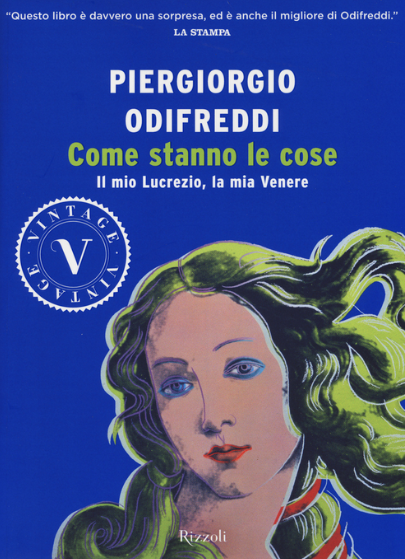
I am referring to Come stanno le cose. Il mio Lucrezio, la mia Venere, an essay (published by Rizzoli, 2014) by Piergiorgio Odifreddi (1950–), who, in a new complete translation of the poem De rerum natura by Titus Lucretius Carus (98/94–50/55), provides a version in modern words and meanings—not only to make it easier to understand ideas conceived two millennia ago, but above all to highlight their incredible modernity. An excellent conception of the work and an excellent execution, in which the translation on the right-hand pages and the interpretation on the facing pages make it possible to appreciate both the ideas that today we would call scientific and the philosophical visions of a great author.

In high school (a scientific high school) De rerum natura was the subject of a (mild) in-depth study (though we were required to buy a book about the poem, which I still keep). But our teacher was not able to convey its greatness and meanings, surely because he had not understood them himself, with the partial excuse that the ‘literal’ translation by someone who, perhaps like him, being wholly incompetent in scientific matters, was not even able to sense how, in recent centuries, science has confirmed some old intuitions, obviously at the level of general principles.

Odifreddi’s work, therefore, not only restores Lucretius to his full stature, but also tries to fill a gap that is perhaps typically Italian, where scientific culture has always been little widespread and little valued. This has not prevented excellence, of course, but Italians’ general lack of competence on scientific and technical topics is limiting in a modern world founded above all on technology. I realize I do not know the situation well in other countries, but my thought was also tied to the ‘historical responsibility’ of being part of a land that is a ‘cradle of civilization’ and of thought, now reduced to a third-rate caricature in geo-economic and political balances, unworthy of a cultural heritage that has no comparable equal in the world. A heritage that must be rediscovered, overcoming the obscurantist inertia of a ruling class inadequate to its role. And I am not referring only to the current one, except in the sense that, being in office, they are the only ones who could do more than a little to change things.

Perhaps it is a small gesture, Odifreddi’s, but it is an excellent achievement that deserves to be known.


Odifreddi Lucrezio

please, rate this post

Strange Mathematical Objects: Möbius strip

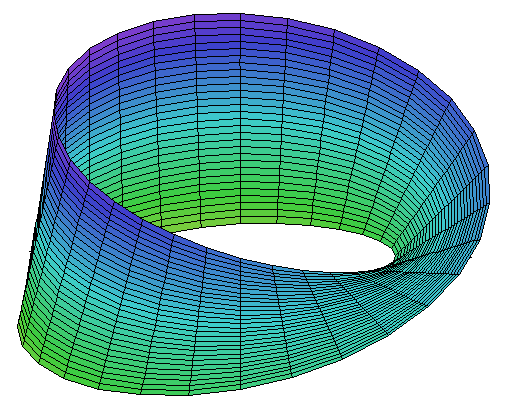
Figure 1 – Möbius strip

Möbius strip


The Möbius strip is a three-dimensional object studied in topology* with unusual characteristics: it has only one side and only one boundary (see Figure 1). It can be easily made from an elongated rectangular strip of paper by joining the short ends after first giving one end a half-twist. With the object in hand, one can immediately verify—also by tracing it with a finger—that it has a single side and a single boundary.

Its name comes from August Ferdinand Möbius (1790–1868), who was the first to study non-orientable surfaces (surfaces on which it is not possible to distinguish positive and negative configurations, an “inside” and an “outside”) and ruled surfaces (which can be obtained as a union of straight lines, such as the plane, the cylinder, and the cone), like this one.

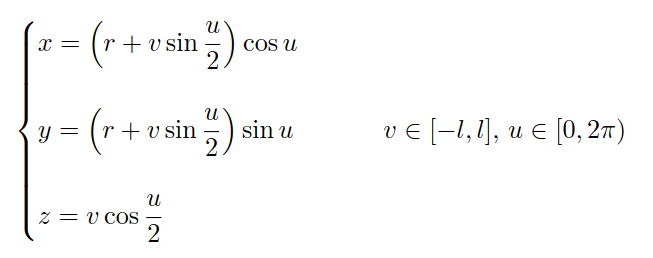
In ℝ³ the strip is described by the following parametric equations in Cartesian coordinates:

 Möbius strip equationswhere r and l are fixed positive numbers with r>l (a necessary condition for the strip to have the possibility of twisting).

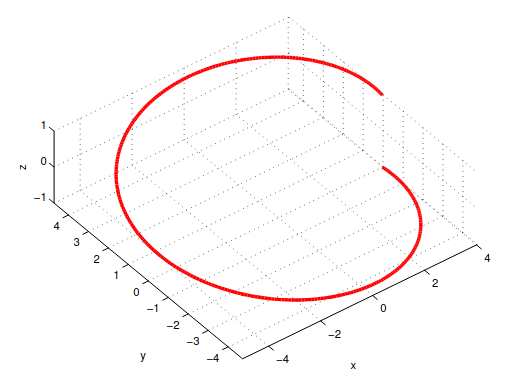
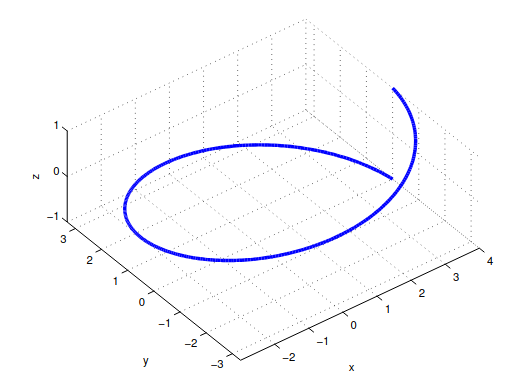
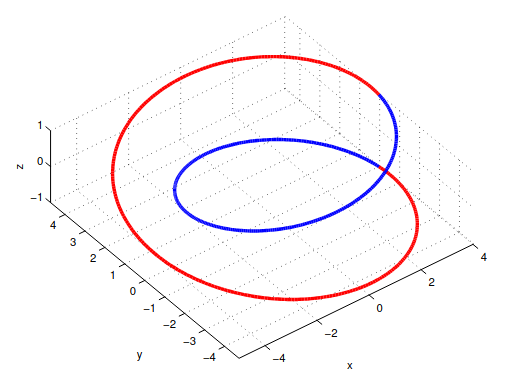
Informally, one can say that the parameter u is an angle that “goes around” the strip counterclockwise, while the parameter v “moves from one side to the other” across the strip. Fixing two values of v, for example v=−1,1, one obtains the curves in Figures 2 and 3, which, taken together, outline the boundary of the strip in Figure 4. As is easy to guess, for v=0 one obtains a circle, i.e., a closed curve halfway along the strip. Interestingly, cutting the strip along this midline does not produce two strips, but a new single strip twisted twice.


Figure 2 – Curve obtained with v=1 (source: Riccardo Dossena, UniPV)

Mobius curve v 1

Figure 3 – Curve obtained with v=−1 (source: Riccardo Dossena, UniPV)

Mobius curve -1

Figure 4 – Curve obtained by combining the previous two, the boundary of the strip (source: Riccardo Dossena, UniPV)

Mobius curve v1 and v -1


Once the boundary is defined, it is easy to understand how the set of all the curves described by the two parameters u,v, over the intervals considered, can define the entire surface of the strip.

Topological considerations are omitted, and the reader is invited to do some experiments by constructing strips with two or more twists of the ends before joining them, and by cutting the strip along its middle in the various cases to see the results… surprising!


Topology*
Topology is an area of mathematics that studies the properties of mathematical objects (shapes) that do not change when a deformation is performed without ‘holes’, ‘overlaps’, or ‘gluing’. For example, a cube is topologically equivalent to a sphere, whereas a torus (a doughnut) is not, because it has a hole that cannot be removed by deformation.
For further reading, the Wikipedia page is comprehensive.

please, rate this post