Figure 1 – Klein bottle
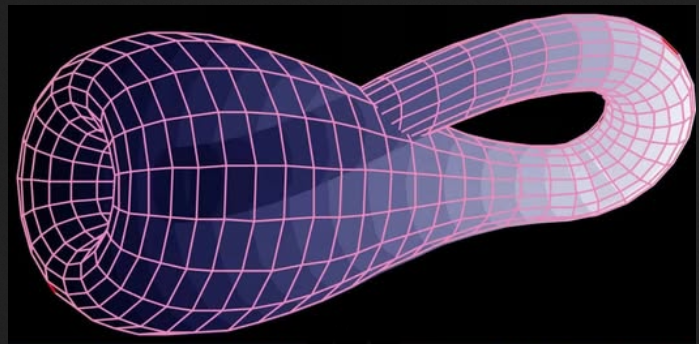
The Klein bottle, or Klein surface, named after the German mathematician Felix Christian Klein (1849–1925), who described it at the end of the 19th century during the development of topology*, it’s an example of one sided surface, with no distinct inside or outside. It is a so-called non-orientable two-dimensional manifold, like the previously seen the Möbius strip, with the important difference that it has no edges.
It is a kind of bottle in which the neck connects to the bottom, having to pass through the wall of the same bottle, as in Figure 1. This is how it appears in a three-dimensional visualization, but like other topological spaces (which we always consider Euclidean), it is not easily visualized in ℝ³. When analyzed in ℝ⁴ there are no overlaps (self-intersections); one understands that the neck does not touch the surface.
Proceeding to higher dimensions, one can imagine a non-orientable three-dimensional manifold that cannot be embedded in ℝ⁴ but can be embedded in ℝ⁵. For example connecting two ends of a Spherinder to each other in the same manner as the two ends of a cylinder for a Klein bottle.
If cut in half, the Klein bottle creates two Möbius strips as in Figure 2, remembering that in reality the intersection does not exist in ℝ⁴.
Figure 2 – A Klein bottle cut in half results in two Möbius strips (source: wikimedia licensed under the Creative Commons Attribution 4.0 Int license)
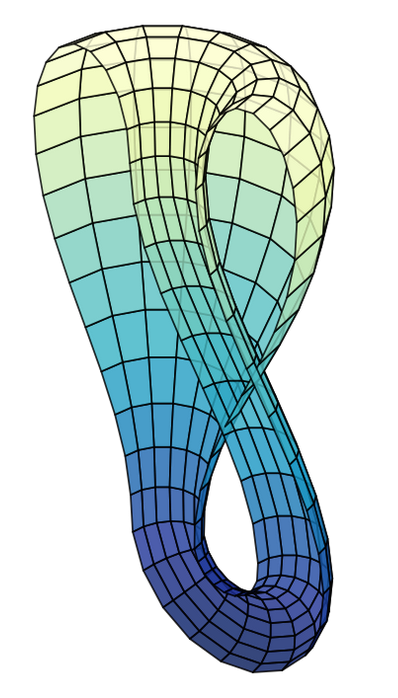
Figure 3 – A tasty solid torus
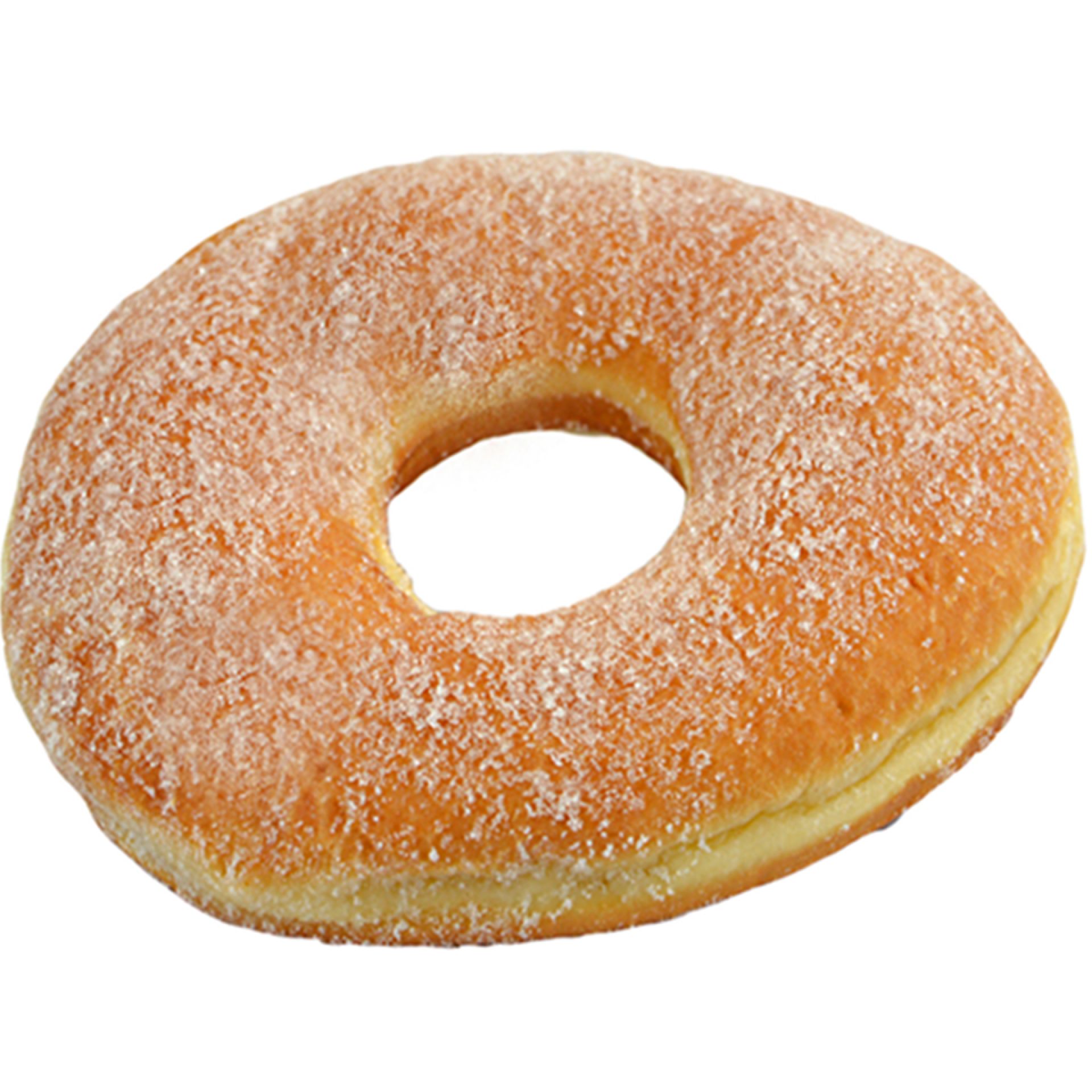
The traditional (immersed) representation of the Klein bottle is achiral (that is, its mirror image cannot be distinguished from the object). The solid Klein bottle is considered the non-orientable version of the solid torus (such as the one in Figure 3).
Topology*
Topology is an area of mathematics that studies the properties of mathematical objects (shapes) that do not change when a deformation is performed without ‘holes’, ‘overlaps’, or ‘gluing’. For example, a cube is topologically equivalent to a sphere, whereas a torus (a doughnut) is not, because it has a hole that cannot be removed by deformation.
For further reading, the Wikipedia page is comprehensive.

