Perhaps I will not add anything about an author who has demonstrated not only competence but also genuine originality in many of his works, but I want to write this review, trying not to slip into apologetics.
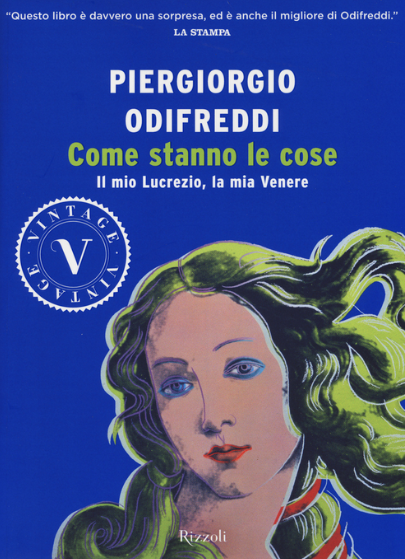
I am referring to Come stanno le cose. Il mio Lucrezio, la mia Venere, an essay (published by Rizzoli, 2014) by Piergiorgio Odifreddi (1950–), who, in a new complete translation of the poem De rerum natura by Titus Lucretius Carus (98/94–50/55), provides a version in modern words and meanings—not only to make it easier to understand ideas conceived two millennia ago, but above all to highlight their incredible modernity. An excellent conception of the work and an excellent execution, in which the translation on the right-hand pages and the interpretation on the facing pages make it possible to appreciate both the ideas that today we would call scientific and the philosophical visions of a great author.
In high school (a scientific high school) De rerum natura was the subject of a (mild) in-depth study (though we were required to buy a book about the poem, which I still keep). But our teacher was not able to convey its greatness and meanings, surely because he had not understood them himself, with the partial excuse that the ‘literal’ translation by someone who, perhaps like him, being wholly incompetent in scientific matters, was not even able to sense how, in recent centuries, science has confirmed some old intuitions, obviously at the level of general principles.
Odifreddi’s work, therefore, not only restores Lucretius to his full stature, but also tries to fill a gap that is perhaps typically Italian, where scientific culture has always been little widespread and little valued. This has not prevented excellence, of course, but Italians’ general lack of competence on scientific and technical topics is limiting in a modern world founded above all on technology. I realize I do not know the situation well in other countries, but my thought was also tied to the ‘historical responsibility’ of being part of a land that is a ‘cradle of civilization’ and of thought, now reduced to a third-rate caricature in geo-economic and political balances, unworthy of a cultural heritage that has no comparable equal in the world. A heritage that must be rediscovered, overcoming the obscurantist inertia of a ruling class inadequate to its role. And I am not referring only to the current one, except in the sense that, being in office, they are the only ones who could do more than a little to change things.
Perhaps it is a small gesture, Odifreddi’s, but it is an excellent achievement that deserves to be known.


La ringrazio dell’apprezzamento! Anche se il merito maggiore va ovviamente a Lucrezio, per aver scritto un libro tanto moderno duemila anni fa. E per aver aperto le porte al dialogo tra umanesimo e scienza, che purtroppo stenta a crescere, come lei giustamente fa notare. Ma che sicuramente trarrebbe vantaggio dalla lettura del “De rerum natura”: soprattutto nei licei, in particolare classici, dove appunto troppo spesso si lavora per erigere la barriera, più che per per abbatterla.
un onore la sua risposta !
sono un suo lettore appassionato ma questo su Lucrezio è davvero un piccolo capolavoro.
nel mio piccolissimo cerco di divulgare un po’ di cultura scientifica e di critica epistemologica, ombre di un grande maestro che riconosco in lei…
🙂
andrea
piacere mio! io stesso considero quel libro il mio più riuscito.
ho provato a ripetere l’operazione con tre lavori collegati: “la faccia della luna” di plutarco, il “sogno” di keplero e il “messaggero cosmico” di huygens, in un volume intitolato “dalla terra alle lune” (sempre per rizzoli), ma è venuto un po’ più impegnativo da leggere, perché c’era molta astronomia, anche complessa, nonostante gli intenti divulgativi dei tre autori.
ora sto riprovandoci con il “timeo” di platone. ma anche questo non raggiunge la completezza e la bellezza del poema di lucrezio, che rimane un unicum per bellezza letteraria e intuizione scientifica.
confermo, da lettore, “dalla Terra alle lune” non ha l’immediatezza ed efficacia del Lucrezio. d’altra parte non poteva avere lo stesso sviluppo lineare.
a volte mi ha ricordato gli scambi tra Simplicio e Salviati nel “Dialogo sopra i due massimi sistemi”…
però l’Astronomia la apprezzo, da laureato in Astronomia
attendo il “Timeo” allora…
buon lavoro