Figure 1 – Torricelli trumpet

The Torricelli trumpet is a solid obtained by revolving the curve with equation y=1/x around the x-axis over the interval [1,+∞), see Figure 2. It takes its name from Evangelista Torricelli (1608–1647), who studied it in the 17th century.
The peculiarity of this solid is that it has finite volume but infinite surface area.
Figure 2 – Torricelli trumpet 2D equation (source: maeckes.nl)
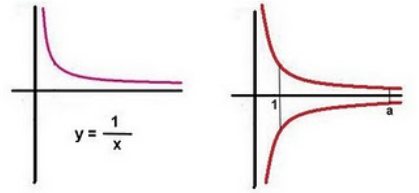
To verify this today we can easily use integral calculus, which did not exist in Torricelli’s time.
In a coordinate system (x,y,z) the horn is described by the parametric equations:
x(ξ,θ)=ξ
y(ξ,θ)=acosθ/ξ
z(ξ,θ)=asinθ/ξ
The volume and the surface area are computed as follows, where a > 1 is a value of x:

It is therefore clear that as a → ∞ the volume approaches the finite quantity π , while the surface area diverges.
This apparent paradox, finite and infinite values associated with the same object, can be explained easily mathematically, as follows. If we consider a can of paint, it certainly has a finite volume. If we spread it over a surface, mathematically the thickness could be infinitesimal, so it could indeed cover an infinite area.

