Why is the daytime sky blue?
We need to examine a type of scattering that affects photons from solar radiation when they interact with the molecules that make up the atmosphere, namely nitrogen and oxygen (99% of the components).
This is Rayleigh scattering (named after Nobel Prize winner John William Strutt Rayleigh, 1842-1919), which affects particles smaller than the wavelength of the incident radiation. It is an elastic scattering, so the wavelength of the same radiation is not changed.
We are dealing with photons, but the formula was developed on the basis of classical electromagnetic theory, not quantum theory (which was created after Rayleigh’s death).
Figure 1 – Angular dependence of Rayleigh Scattering
(copyright MLisandra, CC BY-SA 4.0, via Wikimedia Commons, here without the formula inscription)
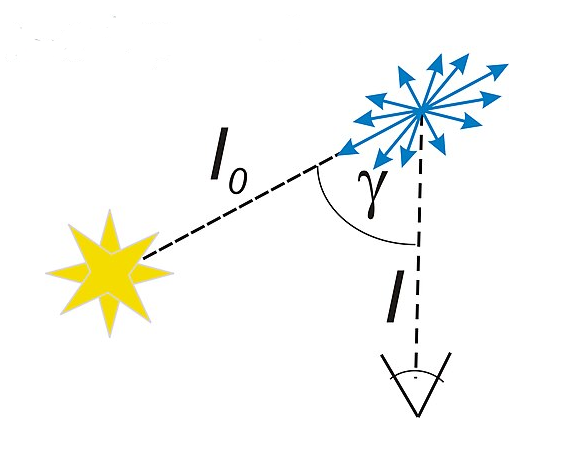
For the explanation we are looking for, the Rayleigh scattering formula can be simplified as follows (see also Figure 1):
[1] I ~ I₀ (1+cos²γ) / λ⁴
where I is the intensity of the scattered radiation, I₀ is the intensity of the incident radiation with wavelength λ , γ is the scattering angle of the incident radiation.
We can immediately see that the angle where the intensity [1] is lowest is the right angle ( π/2 ), where the cosine is zero (see Figure 2), meaning that the sky is darkest (the blue is most intense) at an angle of 90° to the direction of the Sun.
Furthermore, the dependence on the inverse of the fourth power of λ suggests that the effects for different wavelengths are significantly different. In fact, blue light is scattered much more than red light, which has a longer wavelength (see Figure 3), making the sky blue. Even shorter wavelengths, such as those of violet, are less intense at source and do not contribute significantly.
At dawn and dusk, blue light is highly scattered by the greater layer of atmosphere it passes through, together with yellow and green light, so red/orange light dominates.
In the case of smaller particles, the cross section and refractive index of the particle are considered, but even if atmospheric gas molecules are treated as point sources, in this case the effects depend on their polarizability due to incident radiation. Those who take photographs using a polarizing filter are familiar with this phenomenon: in fact, by adjusting the filter effect and therefore the polarization, the sky can even become completely black at 90° to the Sun, which can be creative but not very realistic!
Figure 2 – cosine function behaviour
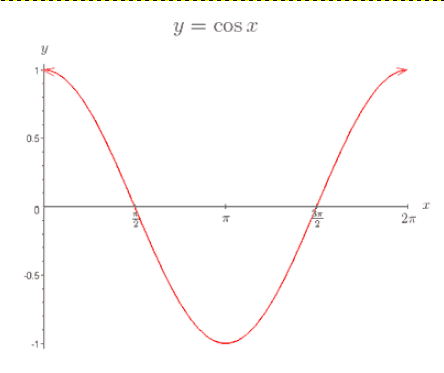
Figure 3 – visible band of radiation

See also Mie scattering and white clouds.