Why is the night sky dark?
If universe were infinite, eternal, and static, as Giordano Bruno (1548-1600) claimed, as did cosmology until the early 20th century, adding that it is also populated by stars in a homogeneous manner, the night sky should be bright and not dark. This contradiction was already noted by Johannes Kepler (1571-1630) in 1610 in Dissertatio cum Nuncio Sidereo.
However, the principle was clearly formulated in 1826 by Einrich Wilhelm Olbers (1758-1840), who mathematically demonstrated (see below, optional reasoning which can be skipped) why the night sky should shine according to the cosmology of the time, highlighting a paradox with respect to observation.
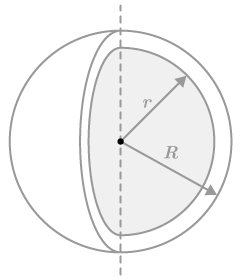
Imagining the universe as consisting of spherical shells concentric with respect to our point of observation (see Figure 1), the intensity of radiation received (flux f ) from a source ( L ) at a distance ( r ) is inversely proportional to the square of the distance:
[1] f = L / 4 π r²
The number of sources contained in the shell is proportional to the volume, which increases with the square of the distance (by infinitesimal increments
dr = R – r with reference to Figure 1):
[2] dn ∝ dV ≈ 4 π r² dr
Therefore, the effects of [1] and [2] compensate each other and each shell contributes with the same intensity, regardless of distance.
The infinitesimal intensity ( dI ) coming from the infinitesimal shell, multiplying [1] and [2], is:
[3] dI = f dn = n L dr
Integrating [3] gives the total intensity:
[4] I =∫₀ᴿ n L dr = n L R
Therefore, for R → ∞, the intensity [4] should become infinite. So something is wrong with the reasoning (hence the paradox).
Figure 1 – sketch of a spherical shell
The observation of the dark night sky is explained in modern terms (based on cosmological standard model) because the universe has existed for a finite time (Big Bang hypothesis) and is expanding (interpretation of the redshift of radiation from remote sources).
In the first case, it is considered that the light from remote sources, which has a finite speed, simply has not reached us yet.
In the second case, redshift, or the shift of light towards longer wavelengths (for example, in the infrared band, beyond the range visible to the eye), prevents the observation of remote sources.
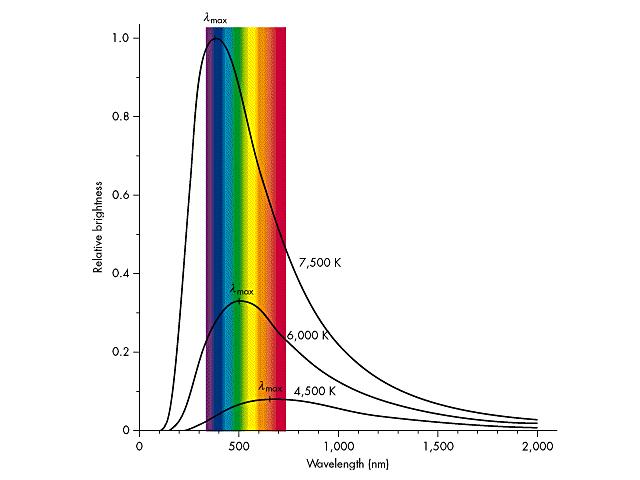
It should also be remembered that the distribution of the intensity of radiation from stellar sources follows a Planckian curve (see Figure 3), which has its maximum in the visible light band. In other words, there are no significant intensities of radiation in a typical stellar source that, moving due to the effect of redshift, could affect this visible band.
In fact, we emphasize that the range of radiation visible to our eyes is very small compared to the entire spectrum of radiation, as shown in Figure 2.
In reality, redshift alone would explain the dark night sky, even if the universe were infinite and without assuming a Big Bang. And even without expansion, if the observed redshift had a different cause.
Figure 2 – full spectrum of radiation with visible band
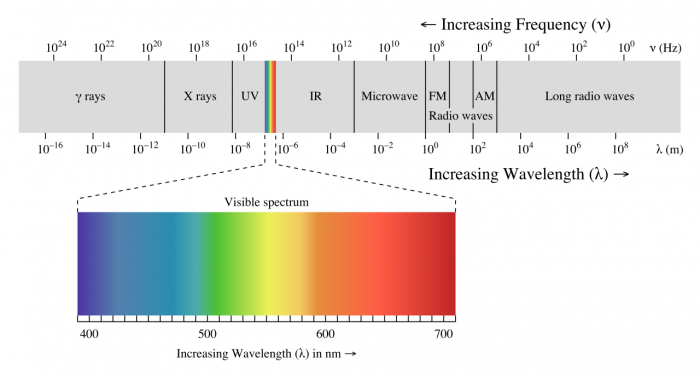
Figure 3 – A sketch of a Planckian functions of brightness (intensity of radiation emitted per unit solid angle) for stellar sources with different surface temperatures. That of the Sun is approximately 5700 K.