The URD Framework – under development

The URD Framework: Cosmological Distances from Redshift in a Non-Standard Context

While I am still developing the project —including through parallel studies on the Tolman test and the quality of indirect data obtained from recent galaxy surveys— I am making my work public as a preprint. I always hope that someone might be interested in my conjectures or perhaps even willing to collaborate with me to address the critical issues of the URD Framework.


Abstract
A phenomenological framework for determining cosmological distances is proposed, based on a non-expanding spacetime interpretation consistent with current observational datasets. The model introduces a redshift mechanism associated with cumulative photon energy attenuation along the line of sight, formulated in a way that is not equivalent to standard tired light scenarios. The approach is constructed to remain compatible with established relativistic principles whereas adopting boundary conditions distinct from the metric expansion paradigm. Distance estimation is achieved through the URD equation (U energy density, Redshift, Distance), which incorporates two phenomenological parameters that describe conformal geometric dissipation in extended gravity and an effective relativistic path-length correction. Within this formulation, the model addresses the primary shortcomings traditionally associated with energy dissipation effects, specifically reconciling time dilation in supernova light curves and the Tolman surface brightness relation. The model is calibrated using the Pantheon+ supernova sample by comparing and cross-validating distances inferred from the proposed redshift mapping with redshift-independent indicators, with additional comparison performed against baryon acoustic oscillations, radio galaxy samples, and high-energy quasars. Across these datasets, the framework reproduces observational constraints over a wide redshift range within a phenomenological, non-standard cosmological setting. The results indicate that alternative, non-expansion-based mappings between redshift and distance can be constructed that remain consistent within the observational range considered, suggesting a phenomenological alternative worth further study.
Keywords
cosmological distance ladder; redshift-distance relation; non-expanding spacetime; cosmic microwave background; extended gravity; Pantheon+ sample; baryon acoustic oscillations; Tolman test; time dilation; geodetic correction


Here is the last version of the preprint (5.1 MB):

pdf Brussi 2026_URD Framework Preprint

Version uploaded to Zenodo:

link DOI – zenodo.20763682


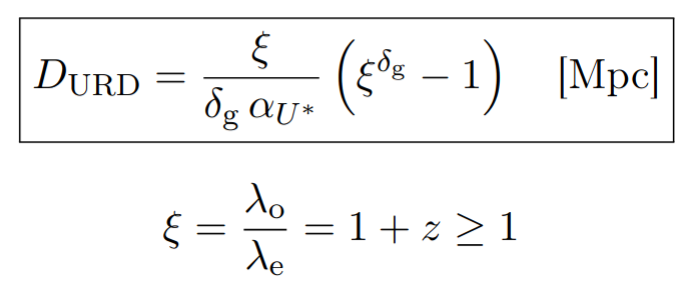
URD distance formula

please, rate this post

Leonard Susskind about the c constant

An in-depth analysis by Leonard Susskind of the constant c, commonly referred to as the “speed of light.” It is essentially a collection of familiar concepts, but reinterpreted in an illuminating way, that are well worth considering.


please, rate this post

How much does air weigh?

Let us first consider the air we breathe on Earth.
It is a mixture of gases, as well as water vapour (from 0% to 4%) and dust.
The main gases are:
– Nitrogen (N₂): 78.08%, a molecule made of two nitrogen atoms
– Oxygen (O₂): 20.95%, a molecule made of two oxygen atoms
– Argon (Ar): 0.93%, a noble gas—so called because it does not bind into molecules (its outer electron shell is complete, with the 8 electrons allowed)
– Carbon dioxide (CO₂): about 0.04%, made of one carbon atom and two oxygen atoms.
With rounding, the total comes to 100%, but there are also traces of other gases, such as neon (Ne), helium (He), methane (CH₄), ozone (O₃). From everyday experience we know its elastic properties, which make it compressible and give concrete meaning to the concept of pressure (force applied on a surface), but we rarely think about its weight.

One litre, i.e., one cubic decimetre, of dry air at sea level and at the standard temperature of 15°C weighs about 1.2 grams. Stated like that it sounds like little, but it means that 1 cubic metre weighs 1.2 kg. That is why the kilometres of air above our heads ‘weigh’: as you go up the gases become increasingly rarefied and the air weighs less, but we are talking about tens of kilometres, if not more (to give a more precise estimate one would have to set a limit in pressure or in specific weight). This weight, obviously determined by gravitational attraction, is substantial: the standard pressure of 1 atmosphere corresponds to about 1 kg of weight per square centimetre. In other words, for every square centimetre of our body (a little less than an average fingernail) the acting force is equivalent to 1 kg of weight.
We are not crushed by it and we scarcely notice it because from the inside our body exerts an equal and opposite pressure: we are essentially like balloons that do not burst because the pressures balance. In addition, pressure acts in all directions, not only vertically, so we are not ‘pushed’ one way, we receive the push from every side.

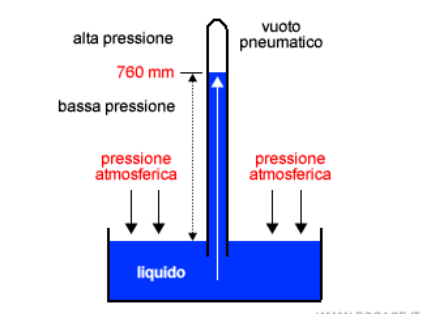
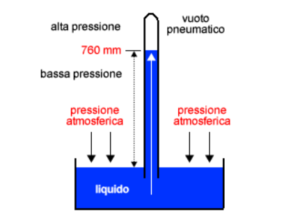
The instrument for measuring atmospheric pressure was invented in 1643 by Evangelista Torricelli (1608–1647), a student of Galileo Galilei (1564–1642). He observed that a transparent tube closed at one end and filled with mercury, when inverted into a basin also containing mercury, maintained a height of about 76 cm, as in Figure 1. Therefore, the weight of the mercury column in the tube had to be equivalent to the weight of the air. The standard unit of measurement for atmospheric pressure is the Pascal (or the hectoPascal, hPa, equal to 100 Pascals, called millibar in meteorology as a submultiple of the bar). One atmosphere, defined as the average pressure at sea level, corresponds to 1,013 hPa, and is the simplest measure for quick explanations. For example, as you gain altitude the trend is not linear because, as mentioned, the air becomes lighter; but at first the pressure halves roughly every 5,500 metres. To give easily testable figures, at 1,500 metres above sea level the pressure is about 84%, at 3,000 metres it is about 69%. That is to say: at 1,500 metres altitude the pressure difference (negative) is comparable to that of a couple of metres of water depth—this is why, even when going into the mountains, it is often necessary to equalize the pressure on our eardrums.


Figure 1 – Torricelli’s barometer (source: ecoage.it, under CC  Creative Commons licence)
Barometro di Torricelli


In this post I will not go into meteorological questions, but it is clear that depending on humidity content and temperature this weight changes, determining differences between locations that generate weather phenomena: wind, clouds, rain, air-mass fronts, etc.

Returning to weight, by analogy with the measure of one atmosphere, note that it corresponds to a column of water about 10 metres high (because of the large difference in density between the two fluids: mercury is almost 14 times as dense as water). Thus, the pressure of the kilometres of air above us is equivalent to 10 metres of water; that is, when we dive, at 10 metres depth we experience a pressure about double what it was before we entered the water. Okay, this is not something people normally do, but anyone who has dived even just a few metres has clearly felt the external pressure (and the need to equalize the internal pressure in the ears). With simple multiplication, this means that at 50 metres depth the “weight” is 5 kg per cm², and at 1,000 metres it is 100 kg per cm².

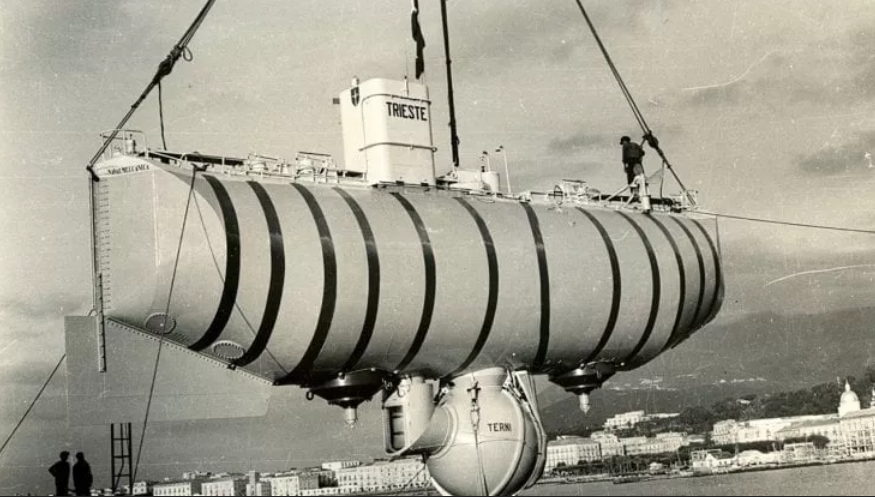
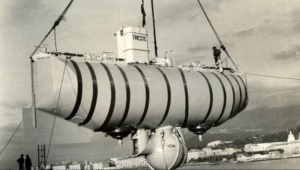
In the Mariana Trench, where the bathyscaphe Trieste (built in Italy, Figure 2) first arrived with the exploration pioneers Jacques Piccard and Don Walsh in 1960, at nearly 11,000 metres depth, the pressure was over one tonne per cm². To withstand it, the steel hull was about 13 cm thick!


Figure 2 – Bathyscaphe Trieste (source: repubblica.it)
Batiscafo Trieste


And how much does the air weigh on Mars?
The Martian atmosphere is composed of about 95% carbon dioxide (CO₂) (oxygen is only about 0.13%). The pressure is very low, about 1% of Earth’s, around 6 hPa compared with our 1013 hPa. It might seem like a paradise for plants that ‘breathe’ CO₂, but aside from the fact that at night plants also breathe oxygen (so they would suffocate), the very low pressure and extremely low temperature (−60°C) would not allow water to be liquid, so the plant’s biochemistry would come to a halt as well.

A significant problem with very low pressure for the human body is the so-called Armstrong limit (about 63 hPa), below which water and blood (at body temperature) would begin to ‘boil’ spontaneously because the external pressure is too low to keep them in the liquid state. A walk on Mars without a pressurized suit is strongly discouraged, regardless of the temperature and the lack of oxygen! On Earth this limit is reached at around 18 km of altitude.

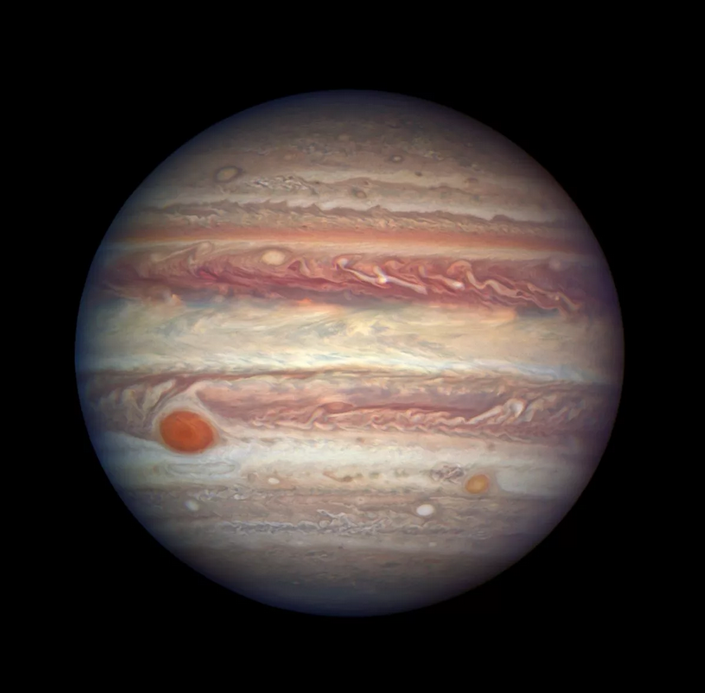
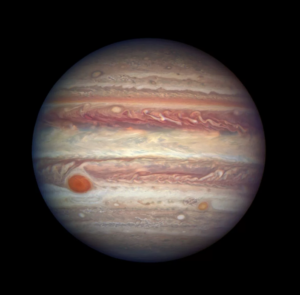
On Jupiter things ‘get worse’ considerably: first of all there is no solid surface; the planet is entirely gaseous, made of about 90% hydrogen (H₂) and 10% helium (He), plus traces of other gases (which are what determine the coloured bands and spots we observe, see Figure 3). Moving inward from the outer layers, because of pressure these gases become liquids and temperatures become extremely high, perhaps 30,000°C near the core, consisting of molten metallic hydrogen (i.e., behaving like a molten metal, for example mercury), which produces its intense magnetic field (20 to 50 times Earth’s and more than twice the Sun’s, except in sunspots, where it is about 300 times stronger). The pressure, which on the outside is of the same order of magnitude as ours, likely reaches 100 million times that toward the centre.
Jupiter is basically a failed star, a terrible place.


Figure 3 – Jupiter (source: NASA / Space Telescope Science Institute, 2017)
Giove


please, rate this post

The virial theorem and stellar equilibrium

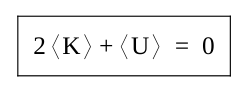
The virial theorem is a fundamental analytical result in the mechanics of particle systems, as it establishes a rigorous connection between the time averages of kinetic and potential energies. Its validity extends to systems in dynamic equilibrium, where internal forces are governed by potentials that depend on distance according to a power law, as in the case of universal gravitation or electrostatics.
The work is written in italian.

pdf_ita Brussi 2026_Il teorema del viriale e l’equilibrio stellare

Teorema del viriale

please, rate this post

How empty is matter?

Very empty.
Extremely empty.

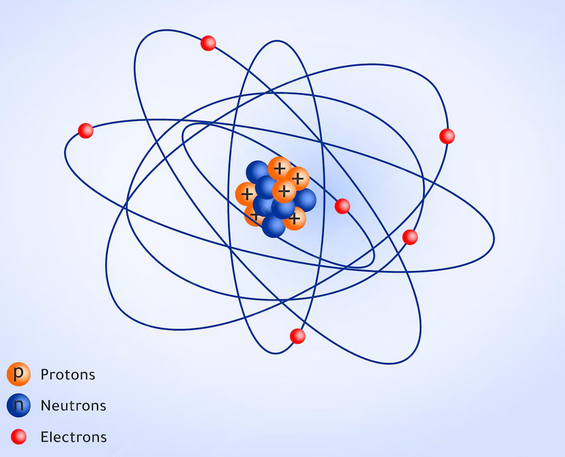
Let’s consider the elementary constituents, atoms, which then aggregate into molecules to form the matter we know. They consist of a nucleus that represents almost the entire mass, in the form of positively charged protons and neutrons with almost equal mass to protons but without charge, and very light (1/2000 the mass of the proton) negatively charged electrons that ‘orbit’ around the nucleus. Under normal conditions, the electric charges of the protons and electrons of the ‘neutral’ atom balance each other out. All aggregations between atoms occur thanks to the forces of attraction between different charges, whereas, as we know, equal charges repel each other, as is the case with magnetic forces. In the nucleus, protons, although they have the same positive charge and repel each other, are held together by an extremely strong force called the strong nuclear force.


Figure 1 – example of a very imprecise diagram of an atom (source: freepic.com)

false atom


Figure 1 is a typical example of a misrepresentation of an atom, for many reasons, but two are primary: the particles are not ‘balls’ but probability densities, that is, ‘elongated clouds’ rather than ‘balls’; the proportions are monstrously misleading.
This brings us to the topic of this post.
Let’s consider the smallest and simplest atom, the neutral hydrogen atom H (consisting of 1 proton and 1 electron), and the neutral iron atom Fe (the most common isotope is composed of 26 protons, 30 neutrons and 26 electrons). The mass of Fe is therefore about 56 times that of H.
For atomic measurements, we use angstroms (Å, named after the Swedish physicist Anders Jonas Ångström, 1814-1874), equal to one-tenth of a billionth of a meter (10¯¹º m).
We also consider only the nuclei and the minimum distance of the electrons from the nucleus, that is, the radius of their innermost orbit (so the ‘size’ of the entire atom is much larger).
Some actual measurements of these particles are approximately as follows:

AtomNucleusMin distance electronsΔ
H1,7 · 10-5 Å (0,000017 Å)0,5 Å~2.9 · 104
Fe5 · 10-5 Å (0,00005 Å) 1,25 Å~2.5 · 104

So between the nucleus and the innermost orbit of the electrons there are about four orders of magnitude! This is empty space. Obviously, there are electric fields holding everything together, but there are no massive particles, bound or not, in that space, and there can’t be any in any atom, under normal conditions of matter.

Four orders of magnitude means that if the Fe nucleus were the size of a plum (5 cm), there would be empty space up to 1250 meters away. For H, if the nucleus were the size of a grape (17 mm), there would be empty space up to 500 meters away.

What allows matter to be bound in the solid state are the electrical binding forces between atoms, due to the presence/absence of electrons in outermost atomic shells, but that’s another story.
These empty spaces compress only under extreme conditions, for example when matter degenerates in stars that transform into white dwarfs or neutron stars (when the outward force of radiation ceases and gravity compresses the star), reaching unimaginable densities (a grape would have a mass of billions of tons). But that’s another story, too.

please, rate this post

A sharp presentation of a quantum mechanics course

Not all professors are so explicit in presenting a quantum mechanics course, which is objectively very challenging. A medal for intellectual honesty to this professor!
(yes, it’s an old video, but it’s still worth watching ; )

link  Presentation of a quantum mechanics course

please, rate this post

Snell’s law and the causes of refraction

Let us recall Snell’s well-known law, which describes the phenomenon of refraction:
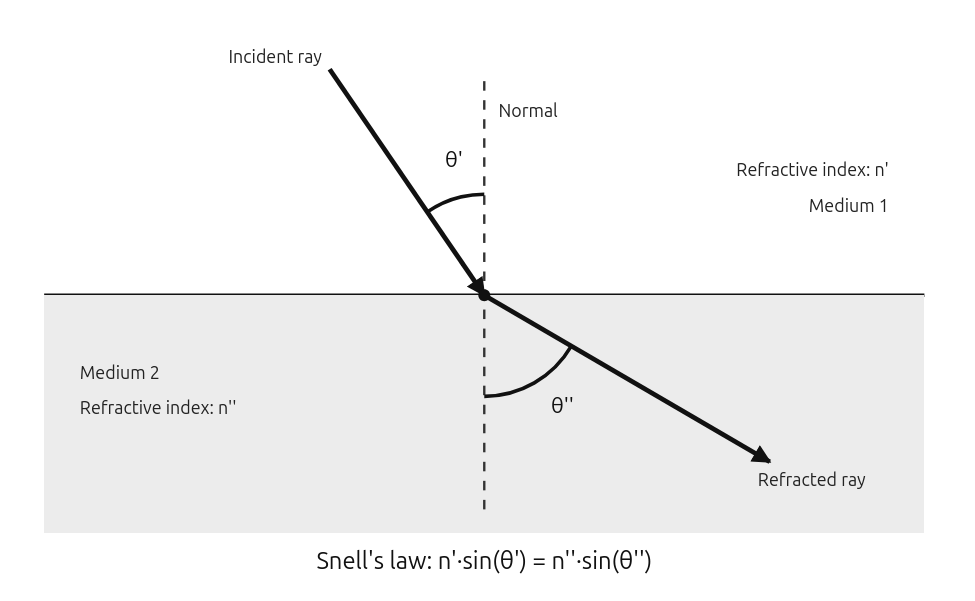
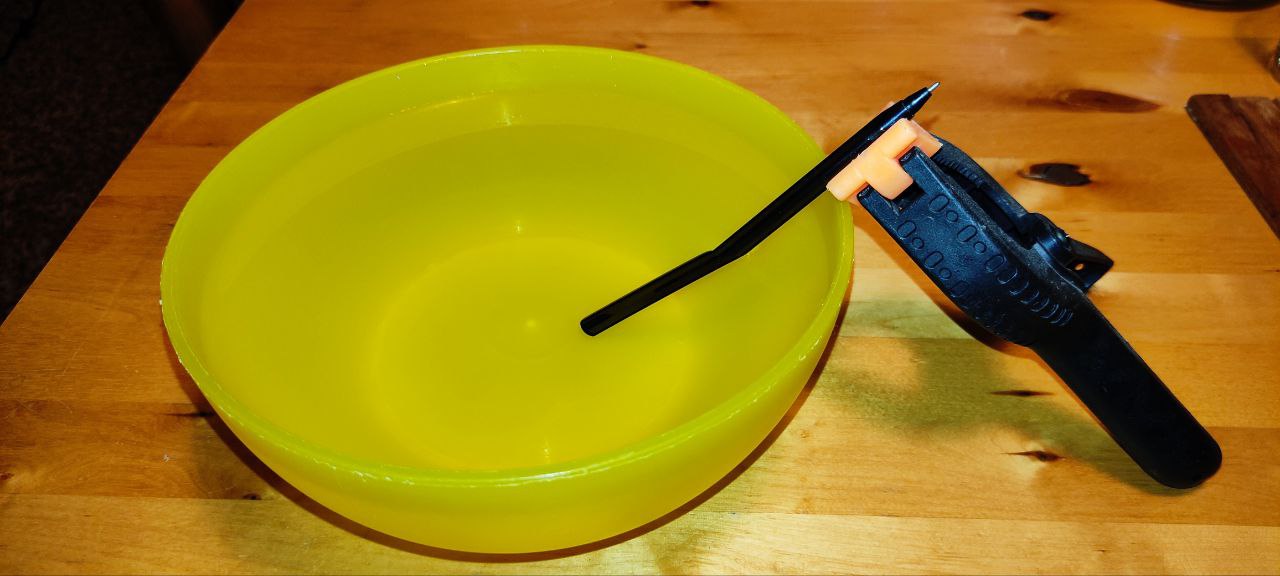
– a ray of light undergoes a deviation when it passes from one transparent medium to another with a different refractive index (see Figure 2).


Figure 1 – Snell law


Figure 2 – Refraction example


Mathematically (see Figure 1):
[1]    n’ sin(θ’) = n” sin(θ”)
where  n’ ,  n”  are the refractive indices of the two transparent media,  θ’ ,  θ”  are the angles of incidence and refraction (measured relative to normal at the interface between the media).
In other words, given two media, the ratio between the respective sines of the angles of incidence and refraction is constant.
A first proof can be obtained by applying Pierre de Fermat’s (1601-1665) principle of least time, namely that light follows the path that requires the least time to travel from one point to another. Attached below is the simple geometric-analytical proof (in italian):

pdf  Fermat_Snell_geometric-analytical demonstration

Okay, this relationship (perhaps already studied in the 10th century by the Persian mathematician Ibn Sahl) is certainly interesting, but what is the physical motivation for this constant quantity? It is necessary to identify where this regularity lies.
The reasons derive directly from Maxwell’s equations, the fundamental laws describing the interaction between electric and magnetic fields.
From these, it follows that the boundary conditions require that the tangential components of the electric field and magnetic field be continuous across the separation surface. Therefore, the phase of the incident, (reflected,) and transmitted wave must be the same along this boundary.

The assumption that the frequency ( ν ) of the incident light remains constant (i.e., that it is independent of the medium in which it propagates) can also be understood by considering that if this were not the case, it would lose coherence as it crossed the surface between the two media, probably transforming the image observed through the separation surface into a uniform grey color, which is not observed.
Furthermore, since the energy associated with incident photons is  E = h ν , where  h  is the Planck constant, the same conservation of energy tells us that the frequency cannot change.
Quantistic note: this consideration refers to a single photon, which would change color (towards red) if it lost energy (phenomenon that does not occur for all observed refracted photons). Considering a beam of photons, however, it may be that the second medium causes absorption of the incident light, thus a decrease in total energy, but this concerns the entire beam that absorbs some photons completely and not the individual photons.

Considering the wave vectors  k’  (incident) and  k”  (refracted) associated with their respective phases, and equating their projections on the separation interface, we obtain:
[2]     k’ sin(θ’) = k” sin(θ”)
but  k = ω / v  , where  ω  is the angular frequency of the electromagnetic wave of the incident light,  v  is the velocity in the medium, and defining the refractive index  n = c / v  (derived from the constants  ε₀  and  μ₀  of the medium using Maxwell’s equations, where  c =  1/√(ε₀ μ₀)  ), from  [2]  we finally obtain  [1] .

please, rate this post

The three-body problem and the five Lagrangian points

Joseph-Louis Lagrange (1736-1813) was a great mathematician of the 18th century. His main studies on mechanics led him to tackle the gravitational three-body problem, which, however, remains unsolved to this day because the system is inherently chaotic and unpredictable in the long term, as small initial variations cause drastically different results.
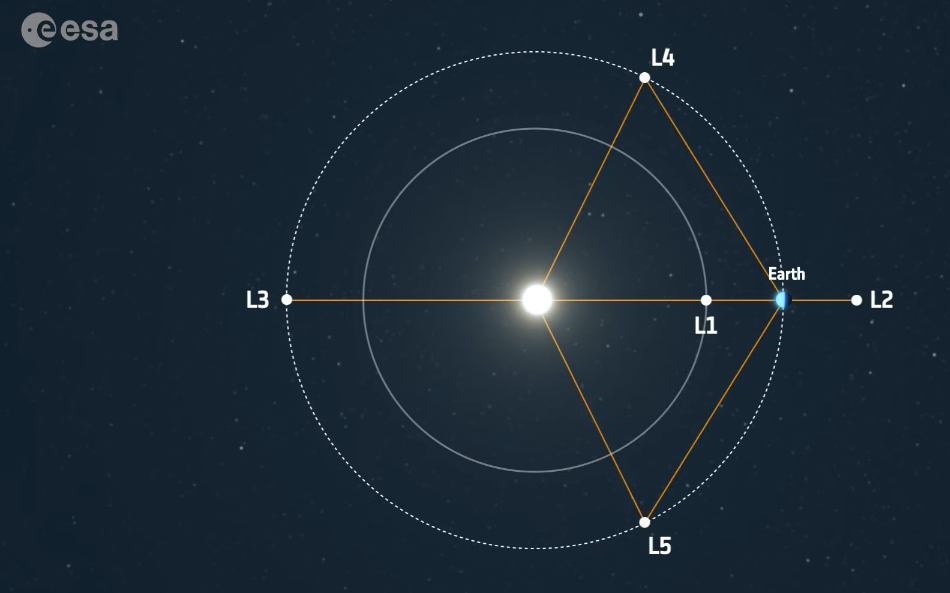
Lagrange found the equilibrium solutions (the five Lagrangian points, see figure taken from the ESA website) for the system in the simplified yet highly interesting case where the third body has negligible mass compared to the other two (e.g., the Sun, a planet, and an asteroid or an artificial satellite). The first three points (L1, L2, L3) had already been found by Leonhard Euler (1707-1783), another huge mathematician of the 18th century, while Lagrange found the so-called ‘triangular’ points (L4, L5), because they form perfect equilateral triangles with the two main bodies.
For details about these points, please refer to the easy explanations on the
link  ESA (European Space Agency) website.

Obviously, Lagrange could never have known about the evidence supporting his conjecture (it was only in 1906 that astronomers confirmed his theory by discovering Trojan asteroids captured at points L4 and L5 of Jupiter’s orbit) or its current usefulness in positioning our space exploration vehicles.
Thanks to their ‘gravitational stability’, which saves positioning energy (and in the case of L2 also provides partial shielding from the Sun), it is conceivable that, in the future of space exploration, advanced bases for deep space exploration will be located at Lagrangian points.


The 5 Lagrangian points, from the link  ESA (European Space Agency) website; the orbits of points L1 and L2 are not to scale, the distance from Earth is about 1/100 of the radius of Earth’s orbit.

Lagrangian points

please, rate this post

References for laymen: Archimedes’ hydrostatic principle

Archimedes of Syracuse (287-212) was perhaps one of humanity’s greatest mathematical geniuses. He is remembered for the principle of hydrostatic thrust, the screw pump, and war machines, but his most advanced studies were on conics and mathematical methods for calculating surfaces and volumes (e.g., of sphere). These are considered among the highest achievements of ancient science and, although they lack modern formal rigor, they represent the direct precursors of the concept of limits and integral calculus (independently developed by Sir Isaac Newton and Gottfried Wilhelm Leibniz in the late 17th century). See, for example, Lucio Russo, Archimedes: A Great Ancient Scientist (Carocci Editore, 2019).

One day, my young son asked me, “Why do ships that are heavy and made of iron float?” I couldn’t explain the density of water to him, but I found a good answer for a child: “Because they weigh less than the water they displace.”
This is exactly Archimedes’ principle of hydrostatic thrust, which in more complicated terms is expressed as: “A body immersed in a fluid experiences an upward thrust equal to the weight of the volume of fluid displaced.” So if this is greater than the weight of the body, it floats.

We can express Archimedes’ principle of hydrostatic thrust (force) F(A) using the following formula:
[1]    F(A) = m * g = ρ(fluid) * V(displaced) * g
where  m =  ρ *  V  is the mass,  g  is the acceleration due to gravity,  ρ  represents the density, and  V  represents the volume of fluid displaced by the body.
For this reason, any body also ‘weighs’ according to the density of the fluid in which it is immersed. The greater the density, the greater the hydrostatic thrust and the lower the weight of the body.

As an example, if an iron nail (which, due to its shape, does not seem to be able to float like a ship by displacing a lot of fluid) were placed in a container with liquid mercury, which has a density almost double that of iron, the nail would float at the level of the weight of mercury displaced. Calculations show that it would be immersed just over half its volume (about 58%).


In this video, we can see how an iron anvil floats in mercury because the density of iron (7.87 g/cm³) is almost half that of mercury (13.55 g/cm³) (source: Wonder of science on X channel).


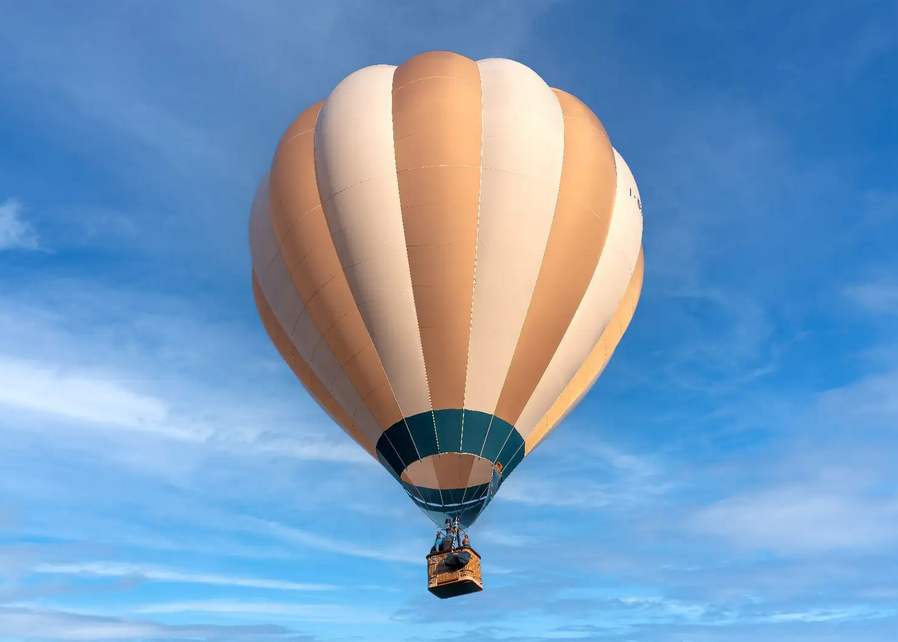
Another famous example of buoyancy is that of hot air balloons: they float exactly like a ship because the volume of fluid (atmospheric air) they displace weighs more (is denser) than that contained in the balloon, which is heated with a burner (and is therefore less dense).


An hot air balloon (source: freedome.it)

mongolfiera

please, rate this post