Let us recall Snell’s well-known law, which describes the phenomenon of refraction:
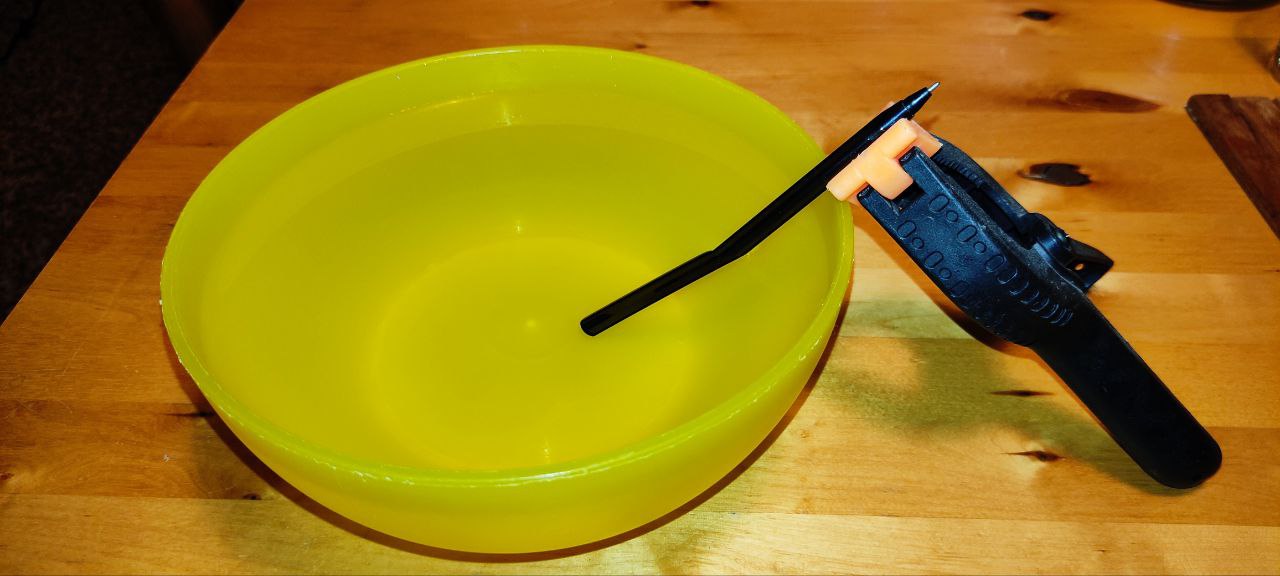
– a ray of light undergoes a deviation when it passes from one transparent medium to another with a different refractive index (see Figure 2).
Figure 1 – Snell law
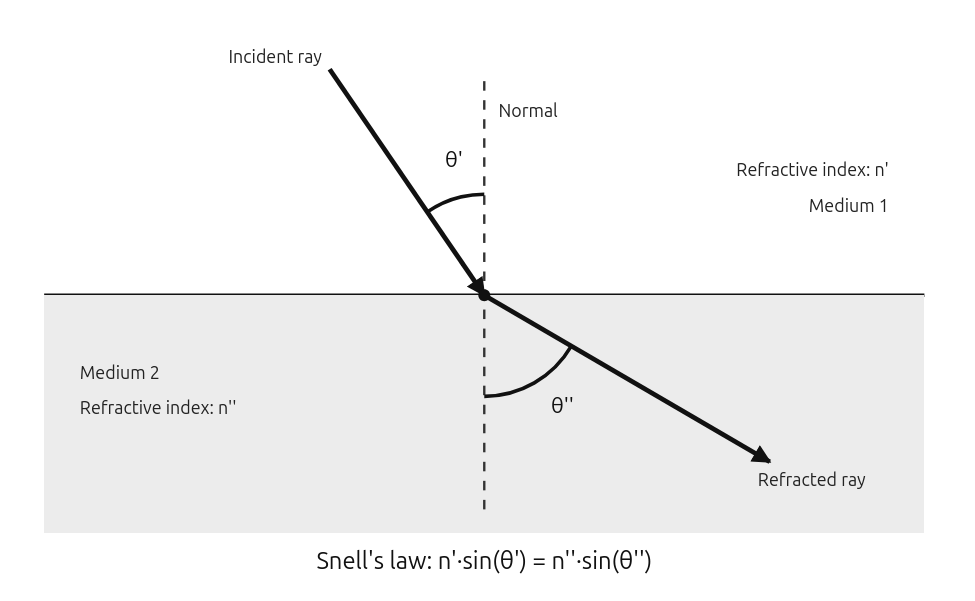
Figure 2 – Refraction example
Mathematically (see Figure 1):
[1] n’ sin(θ’) = n” sin(θ”)
where n’ , n” are the refractive indices of the two transparent media, θ’ , θ” are the angles of incidence and refraction (measured relative to normal at the interface between the media).
In other words, given two media, the ratio between the respective sines of the angles of incidence and refraction is constant.
A first proof can be obtained by applying Pierre de Fermat’s (1601-1665) principle of least time, namely that light follows the path that requires the least time to travel from one point to another. Attached below is the simple geometric-analytical proof (in italian):
 Fermat_Snell_geometric-analytical demonstration
Okay, this relationship (perhaps already studied in the 10th century by the Persian mathematician Ibn Sahl) is certainly interesting, but what is the physical motivation for this constant quantity? It is necessary to identify where this regularity lies.
The reasons derive directly from Maxwell’s equations, the fundamental laws describing the interaction between electric and magnetic fields.
From these, it follows that the boundary conditions require that the tangential components of the electric field and magnetic field be continuous across the separation surface. Therefore, the phase of the incident, (reflected,) and transmitted wave must be the same along this boundary.
The assumption that the frequency ( ν ) of the incident light remains constant (i.e., that it is independent of the medium in which it propagates) can also be understood by considering that if this were not the case, it would lose coherence as it crossed the surface between the two media, probably transforming the image observed through the separation surface into a uniform grey color, which is not observed.
Furthermore, since the energy associated with incident photons is E = h ν , where h is the Planck constant, the same conservation of energy tells us that the frequency cannot change.
Quantistic note: this consideration refers to a single photon, which would change color (towards red) if it lost energy (phenomenon that does not occur for all observed refracted photons). Considering a beam of photons, however, it may be that the second medium causes absorption of the incident light, thus a decrease in total energy, but this concerns the entire beam that absorbs some photons completely and not the individual photons.
Considering the wave vectors k’ (incident) and k” (refracted) associated with their respective phases, and equating their projections on the separation interface, we obtain:
[2] k’ sin(θ’) = k” sin(θ”)
but k = ω / v , where ω is the angular frequency of the electromagnetic wave of the incident light, v is the velocity in the medium, and defining the refractive index n = c / v (derived from the constants ε₀ and μ₀ of the medium using Maxwell’s equations, where c = 1/√(ε₀ μ₀) ), from [2] we finally obtain [1] .

