Very empty.
Extremely empty.
Let’s consider the elementary constituents, atoms, which then aggregate into molecules to form the matter we know. They consist of a nucleus that represents almost the entire mass, in the form of positively charged protons and neutrons with almost equal mass to protons but without charge, and very light (1/2000 the mass of the proton) negatively charged electrons that ‘orbit’ around the nucleus. Under normal conditions, the electric charges of the protons and electrons of the ‘neutral’ atom balance each other out. All aggregations between atoms occur thanks to the forces of attraction between different charges, whereas, as we know, equal charges repel each other, as is the case with magnetic forces. In the nucleus, protons, although they have the same positive charge and repel each other, are held together by an extremely strong force called the strong nuclear force.
Figure 1 – example of a very imprecise diagram of an atom (source: freepic.com)
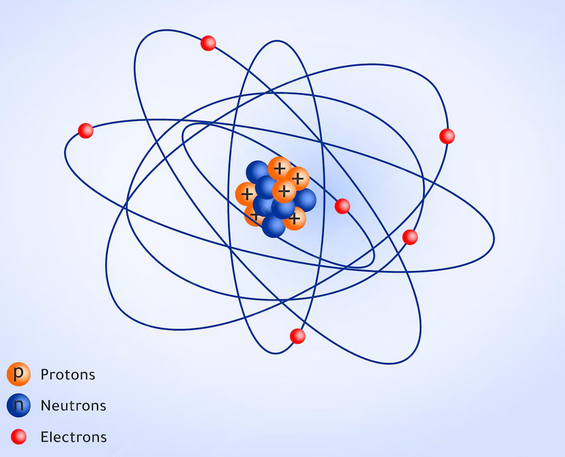
Figure 1 is a typical example of a misrepresentation of an atom, for many reasons, but two are primary: the particles are not ‘balls’ but probability densities, that is, ‘elongated clouds’ rather than ‘balls’; the proportions are monstrously misleading.
This brings us to the topic of this post.
Let’s consider the smallest and simplest atom, the neutral hydrogen atom H (consisting of 1 proton and 1 electron), and the neutral iron atom Fe (the most common isotope is composed of 26 protons, 30 neutrons and 26 electrons). The mass of Fe is therefore about 56 times that of H.
For atomic measurements, we use angstroms (Å, named after the Swedish physicist Anders Jonas Ångström, 1814-1874), equal to one-tenth of a billionth of a meter (10¯¹º m).
We also consider only the nuclei and the minimum distance of the electrons from the nucleus, that is, the radius of their innermost orbit (so the ‘size’ of the entire atom is much larger).
Some actual measurements of these particles are approximately as follows:
| Atom | Nucleus | Min distance electrons | Δ |
|---|---|---|---|
| H | 1,7 · 10-5 Å (0,000017 Å) | 0,5 Å | ~2.9 · 104 |
| Fe | 5 · 10-5 Å (0,00005 Å) | 1,25 Å | ~2.5 · 104 |
So between the nucleus and the innermost orbit of the electrons there are about four orders of magnitude! This is empty space. Obviously, there are electric fields holding everything together, but there are no massive particles, bound or not, in that space, and there can’t be any in any atom, under normal conditions of matter.
Four orders of magnitude means that if the Fe nucleus were the size of a plum (5 cm), there would be empty space up to 1250 meters away. For H, if the nucleus were the size of a grape (17 mm), there would be empty space up to 500 meters away.
What allows matter to be bound in the solid state are the electrical binding forces between atoms, due to the presence/absence of electrons in outermost atomic shells, but that’s another story.
These empty spaces compress only under extreme conditions, for example when matter degenerates in stars that transform into white dwarfs or neutron stars (when the outward force of radiation ceases and gravity compresses the star), reaching unimaginable densities (a grape would have a mass of billions of tons). But that’s another story, too.


Well… in spite of my huge ignorance in this argument I proudly understood the 70% …approximately indeed.
Good stuff Andrea!
Thank you, dear.
Long live the antelopes!