Strange Mathematical Objects: Torricelli’s Trumpet

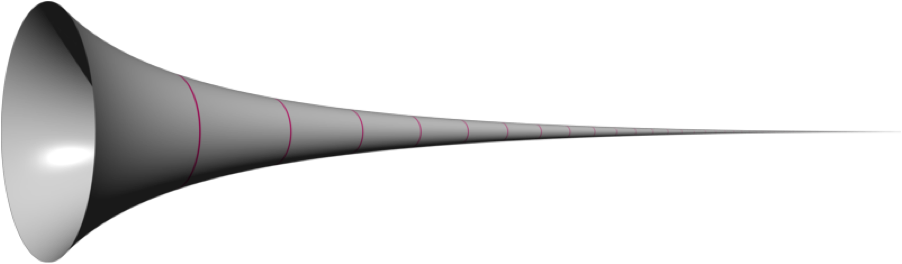
Figure 1 – Torricelli trumpet

Torricelli trumpet

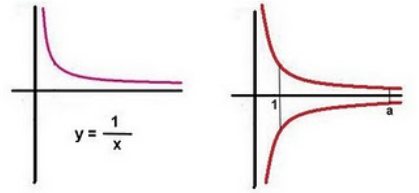
The Torricelli trumpet is a solid obtained by revolving the curve with equation y=1/x around the x-axis over the interval [1,+∞), see Figure 2. It takes its name from Evangelista Torricelli (1608–1647), who studied it in the 17th century.
The peculiarity of this solid is that it has finite volume but infinite surface area.


Figure 2 – Torricelli trumpet 2D equation (source: maeckes.nl)

Torricelli trumpet equation


To verify this today we can easily use integral calculus, which did not exist in Torricelli’s time.

In a coordinate system (x,y,z) the horn is described by the parametric equations:
x(ξ,θ)=ξ
y(ξ,θ)=acos⁡θ/ξ
z(ξ,θ)=asin⁡θ/ξ

The volume and the surface area are computed as follows, where  a > 1  is a value of  x:

Volume and area trumpet

It is therefore clear that as  a → ∞  the volume approaches the finite quantity π , while the surface area diverges.

This apparent paradox, finite and infinite values associated with the same object, can be explained easily mathematically, as follows. If we consider a can of paint, it certainly has a finite volume. If we spread it over a surface, mathematically the thickness could be infinitesimal, so it could indeed cover an infinite area.

please, rate this post

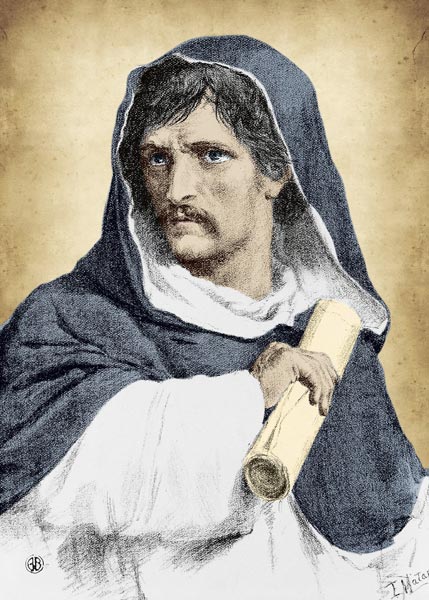
17 February 1600 – the burning of Giordano Bruno

In Rome, in Campo de’ Fiori, one of the countless murders perpetrated throughout history for conquest and, as in this case, for maintaining imperial power over free thought and ultimately over peoples.
That the killing of the enemy has always been an anthropic standard is evident. Borrowed, as a degeneration, from the animal struggle for survival, to the point of turning it into a ‘moral rule’. Yet the physical violence of domination by the stronger is still understandable in a confrontation ‘on equal terms’. In ancient wars soldiers faced each other directly. Then, perhaps, the victors also abused civilian populations, but in some way they had demonstrated a physical superiority, at least in violence.

The qualitative leap to the suppression of ideas, ideas that differ from the theoretical framework of those in command, is typical of religions, which have often provided a moral and identity-based framework of legitimation for the violence of political and economic powers.

Starting from the common celebratory dating of an event of a religious nature (sun worship later becoming the birth of the ‘son of a god’), one underestimates the conditioning power of religions, namely of those responsible for managing religious sects, founded on the human weakness of the need for a superior being and for its interpreters. Each one claiming to be the bearer of the only truth, incidentally different from that of the others. All fine, if it ended there. But when a different idea is not confronted with better ideas, but by suppressing the bearer of the idea, what is at stake is not truth: what is at stake is power.

Nature is incredibly violent in its evolution, just think of a volcano or an earthquake on our small planet, or, with infinitely greater power, the explosion of a supernova or a black hole, or the gravitational merger of galaxies. We cannot apply criteria of morality or justice to Nature in events that vaporize entire planets in a few instants. But we can to the bipedal mammals of this mild and quiet planet. Endowed with the faculty of rational thought, we should respect this potential in others in order to respect it in ourselves. Yet the ambition for the power of domination has always won by a landslide. And so the bearers of opposing ideas, of a freedom of thought that could weaken one’s own positions as monopolists of ‘truth’, are killed, if possible amid atrocious suffering. Thus small, petty little men of a sect which, in the name of a revealed truth, resorted to coercion and to the killing, after years of imprisonment, of a visionary genius such as Giordano Bruno. Fortunately, however, he managed to pass on to us his thoughts, his visions, still relevant after more than four centuries.

And religious sects are still active today in many parts of the world and, by merging with political power, they become coercive apparatuses that often translate into systematic persecutions and violence—now industrialized in modern ways, but always with the same aim: the suppression of people’s freedom and of ideas, to impose their own dominion through violence and not comparing better ideas on a rational level.

For a more in-depth look at the life and thought of Giordano Bruno, the Wikipedia page is comprehensive.


Giordano Bruno
Giordano Bruno (source copia-di-arte.com)

please, rate this post

Logic pills: Implies (→) is not follows (⇒)

In classical logic* it is easy to confuse them, but they are different things.
Given two declarative statements to which a truth value can be assigned, an antecedent P (premise) and a consequent C (conclusion), we consider:

P → C (if P then C) a statement with a truth value
P ⇒ C (from P follows C) an inference: C is derivable by assuming P.

The crucial difference lies precisely in this deducibility obtainable in the inference. Instead, the implication P → C is true even when P is false. Therefore it can happen that P is false, C is false, and yet P → C is true. In particular, if P is false, P → C is true whatever C is. For this reason, the implication by itself does not establish (nor prove) the truth of C.
Instead, from P follows C is legitimate only when P is available as a hypothesis in the reasoning: and it is the typical case in which, if P and P → C, then one can conclude C. But if P is false (or is not assumed), the implication is said to be ‘vacuously true’ and it does not authorize any conclusion about C.

If and only if: equivalence as a double inference
The properties of inference make it very useful: a large part of mathematical proofs is based on if and only if, which expresses an equivalence between two statements A and B.
To say:
A if and only if B
means precisely to prove both directions:
A ⇒ B (A is sufficient for B)
B ⇒ A (B is sufficient for A)
When both inferences are valid, A and B are logically equivalent, therefore they have the same truth value.


Classical logic *

This is how one refers to those logical systems (the most used in basic mathematics) in which laws and rules considered traditional hold, such as:

Law of excluded middle: every statement is either true or false (P or not-P)
Non-contradiction: P and not-P cannot both be true
Double negation: negating twice brings one back to the original statement
Explosion (in the presence of contradiction): from a contradiction one can derive any conclusion.

‘Non-classical’ logics arise from wanting to give up or modify some of these features. By way of example:

intuitionistic logic: does not accept the law of excluded middle as a general rule
paraconsistent logics: do not accept explosion (they tolerate contradictions without making everything ‘collapse’)
modal logics: add operators such as necessarily / possibly.

please, rate this post

Mie scattering and white clouds

Why are clouds white?
We need to examine a type of scattering that involves photons of solar radiation when they interact with the molecules that make up the tiny droplets (or water droplets) forming clouds or fog. Unlike Rayleigh scattering (which involves nitrogen and oxygen molecules in the air, see my post The Rayleigh scattering and the blue sky, whose sizes are smaller than the wavelength of the incoming radiation), in this case the droplets are of the same order of magnitude as the radiation wavelength (or slightly larger). This phenomenon is called Mie scattering, named after the German physicist Gustav Adolf Fedor Wilhelm Ludwig Mie (1869–1957), who provided a rigorous mathematical demonstration of it.

Because these microdroplets are ‘large’, they scatter nearly all wavelengths with approximately the same intensity, so the light appears white (or whitish). There is no wavelength-selection effect as in the case of the blue sky.
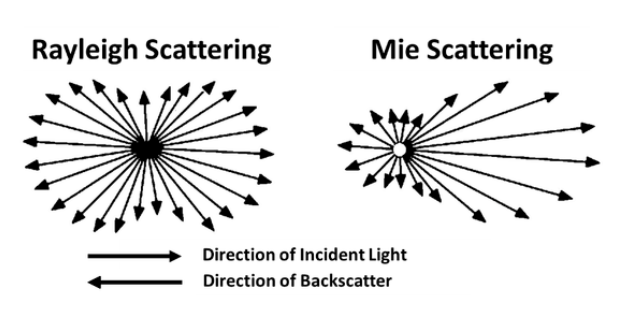
Another characteristic is that the scattering does not occur uniformly in all directions but mainly forward (in the same direction as the incoming light), creating strong glare, while a smaller fraction is scattered backward. See Figure 2.


Figure 1 – White clouds !

White clouds


Figure 2 – Rayleigh scattering and Mie scattering

Mie scattering


This explains why clouds tend to be white and why, when you shine car headlights into fog, a blinding glow is produced (due mainly to the backscattered component), see Figure 3. It also explains why truck drivers -whose driving position is at least a couple of meters higher than the level of their headlights (rather than about half a meter or less, as in cars)- experience this backscattering effect to a lesser extent and therefore can actually see the road in fog better than a car driver. See Figure 4 (clearly rather banal examples, only ‘evocative’ to suggest points of view).
This is also the reason why fog lights are always mounted very low, both on cars and on commercial vehicles: to maximize the angle relative to the backscattered glare produced by Mie scattering.


Figure 3 – Blinding glow while driving a car in the fog

Car driving in the fog


Figure 4 – Driving a truck at night

Truck driving


Technically,
Mie theory provides an exact solution to Maxwell’s equations for the interaction of a plane electromagnetic wave with a homogeneous sphere of dielectric material. It has no limits beyond the size of the interacting material (as in the case of Rayleigh scattering).
In Mie theory, the total extinction of light (absorption + scattering) is defined by the coefficient Qₑₓₜ.
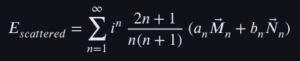
Mathematically, the diffuse electric field is expressed as an infinite series of coefficients (called aₙ and bₙ), which represent the contributions of the electric and magnetic multipoles:
Mie scattering maths
where Mₙ and Nₙ are spherical vector wave functions. The larger the particle (i.e. the fog), the more terms in the series are needed to calculate the correct scattering.

please, rate this post

The error function as an integration trick

The error function, erf(x), represents a statistical function, but it can also be used as an integration trick in the case of complex exponentials, which occur fairly frequently in the study of physics, for example, in differential equations describing heat propagation. It is also used in quantum mechanics to describe particles represented by a wave function, and in astrophysics for the spectroscopic analysis of spectral lines, as in the examples discussed in detail (in english and italian translation).

pdf  Brussi 2026_The error function as an integration trick

pdf_ita  Brussi 2026_La funzione di errore come trucco di integrazione


error function

please, rate this post

Changing perspective: Einstein between Kant’s certainties and Hume’s doubts

We can imagine the context in which Albert Einstein’s Gedankenexperimente (thought experiments) were born: the study of philosophy. To dismantle the idea that space and time were the same for everyone, the young physicist had to engage in an intellectual duel with two giants of thought: Immanuel Kant and David Hume.

Kant’s legacy: space as an objective necessity
From an early age, Einstein had studied Kant in depth, and from him he learned a fundamental concept: we are not passive spectators of the world; our mind does not simply record reality, but actively processes it. Kant argued that space and time are internal structures of the mind, the necessary conditions for having any experience at all. See also my post Kant and Space.
This idea was crucial for Einstein because it helped him understand that science is not merely a collection of data, but a construction of reason. However, the limit of Kant’s thought lay in the claim that these structures must be rigid and identical for every rational being. For Kant, space was only the one described in Euclid’s geometry books, and time was a universal flow, the same for everyone.

Hume’s inspiration: the courage to doubt
When Einstein began working on his thought experiments about light, he realized that Kant’s ‘fixed rules’ no longer worked. To move beyond them, David Hume’s philosophy was certainly of help.
Hume was a radical philosopher who urged people to take nothing for granted. His motto was simple: if a concept cannot be verified by the senses or through a concrete measurement, then it is suspicious. Hume taught Einstein to have the courage to doubt concepts that seem obvious to ‘common sense’. Einstein was aware that no one had ever measured ‘absolute time’, flowing identically for all; it was only a belief grounded in habit, not in physical evidence.

The synthesis: Relativity is born
Without the support of Hume’s skepticism, Einstein might not have had the audacity to question time. He understood that if the speed of light must remain constant, then time and space must be able to change depending on the speed of the observer (the principles of Special Relativity).
In this way, Einstein went beyond Kant using Hume’s method: he retained the Kantian idea that the mind must create categories to read the world, but he showed that these categories are not immutable. Space and time are not unchanging a priori forms, but physical quantities that can contract or stretch.

Einstein was thus a philosopher among physicists. He learned from Kant that the mind must anticipate reality (that is, describe it even before physical observations) with a coherent theoretical model, but he learned from Hume that no idea is untouchable. In this way, he found the courage to understand that if old theories had become full of gaps or incapable of describing the universe in a unified (that is, invariant) way, one had to have the audacity to redesign the very structure of thought itself, even before the facts forced it.


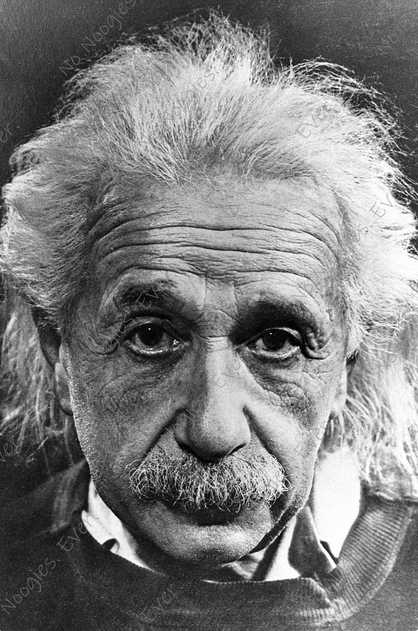
Albert Einstein

please, rate this post

Kant and Space

The redefinition of the concept of space is one of the revolutionary foundations thought of Immanuel Kant (1724-1804): the abandonment of the common, Newtonian-derived idea of space as an absolute entity or an objective ‘container’ of reality. Kant addresses the problem within the Transcendental Aesthetic, the section of the Critique of Pure Reason devoted to sensibility. He distinguishes a metaphysical exposition, which establishes the a priori nature of space, and a transcendental exposition, which derives from it space’s role as a condition of the possibility of experience and of geometry.

Space as Pure Intuition
In contrast to empiricists, Kant argues that space cannot be derived from experience. In order to perceive an object as located in a place different from that occupied by another object, or simply as ‘external’ to us, we must already presuppose the representation of space. Therefore, space is not a general concept constructed by abstraction, but a pure a priori intuition:
– intuition: because it is not a logical construction, but an immediate and singular representation within which we place sensory data
– a priori: because it precedes every sensation and is its necessary condition.

Transcendental Subjectivity
This is the core of Kant’s ‘Copernican Revolution’. Kant claims that space does not belong to things in themselves (noumena), but is the form of outer sense. In other words, it is the way in which the human subject is structured to receive information from the world. This leads to a fundamental epistemological distinction:
– transcendental ideality: if we abstract from the knowing subject, space is nothing as a thing in itself; it has no autonomous existence outside our faculties and is not a determination of noumena
– empirical reality: at the same time, space has objective validity for all phenomena (for every possible experience), for every object that could ever present itself to our senses.

The Foundation of Geometry
Kant uses this view to explain, in a scientific context, the nature of geometry’s synthetic a priori judgments. He is, of course, considering only Euclidean geometry as a description of the space of experience, having lived half a century before Bernhard Riemann (1826-1866) and the development of elliptic geometry. If geometry is the science that studies the properties of space, and if space is the a priori form of our mind, then geometrical theorems will be universally and necessarily valid for all objects of experience. In short, geometry applies to the physical world not because the world is ‘geometrical by nature’, but because we can perceive the world only through a spatial structure that we ourselves project onto phenomenal reality.

In conclusion, for Kant space is not an object of physical investigation like others, but the condition of possibility of our experience. Without this subjective structure, the perception of the external world would be impossible.
Clearly, this Kantian interpretation should be reconsidered in light of the implications of elliptic geometry and of General Relativity, and of the consequences of Special Relativity. In General Relativity, Einstein showed that space is not merely a passive state of possibility, but a dynamic physical entity that bends under the influence of mass: space acts on matter, and matter acts on space. Special Relativity undermines the objectivity of spatial extensions: lengths are measures of objects, but ultimately they are measures of the spatial coordinate component parallel to the relative velocity between reference frames, which is not invariant. The requirement, as noted above, that this structure (space) be objective stands in sharp contradiction with the physical reality described by General and Special Relativity.

Quite simply, while Kant wanted to base science on philosophy, Einstein demonstrated that it is philosophy that must bow (and bend with General Relativity!) before the physical evidence of reality.

see also the post:
link  Changing perspective: Einstein between Kant’s certainties and Hume’s doubts


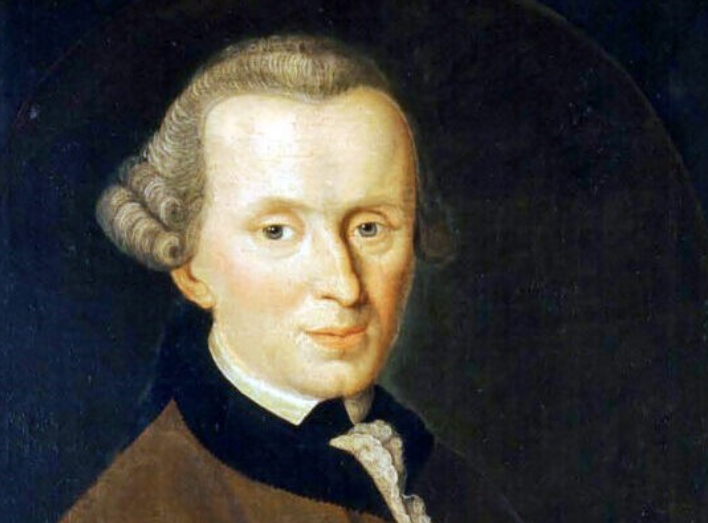
Immanuel Kant

please, rate this post

How lightning works

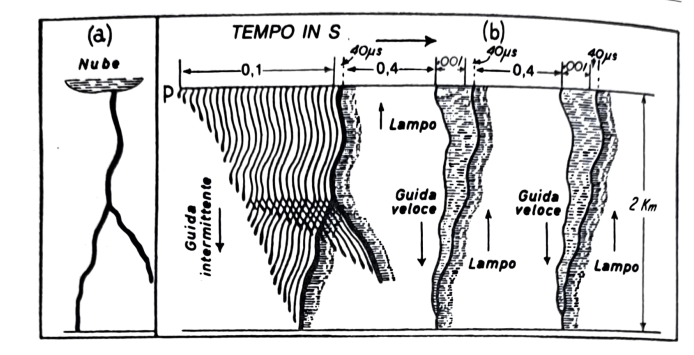
An interesting explanation is given in Ottavio Vittori’s excellent book L’atmosfera del pianeta Terra (Zanichelli, 1992), from which the introductory chapter on this powerful electrical phenomenon is attached with the best intentions.
It’s written in italian.

pdf  Vittori 1992_L’atmosfera del pianeta Terra


Lightnings

please, rate this post

Understanding the Sizes : 4 – galaxy clusters and beyond

Exploring beyond our galaxy, to be able to reach the edges of the known universe with measurements that can be perceived, it is necessary to change scale again compared with the previous post on the Milky Way. Over there, the distances involved become almost impossible to truly understand, they are so mindblowing!

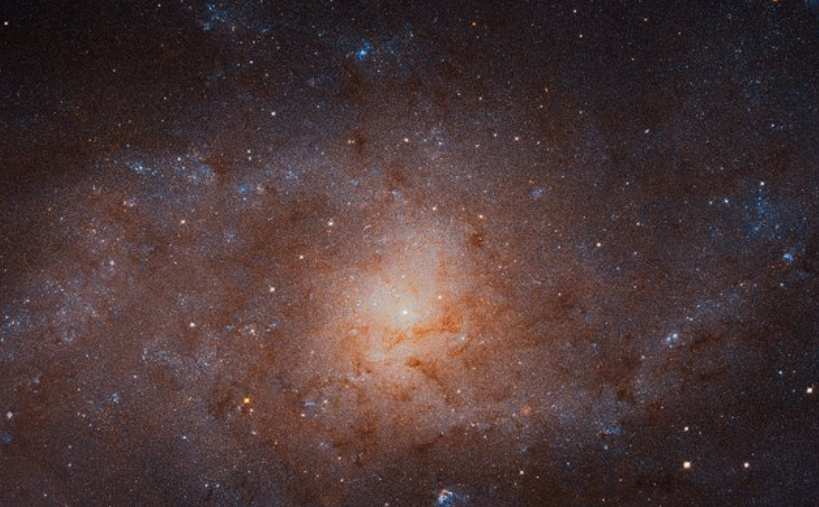
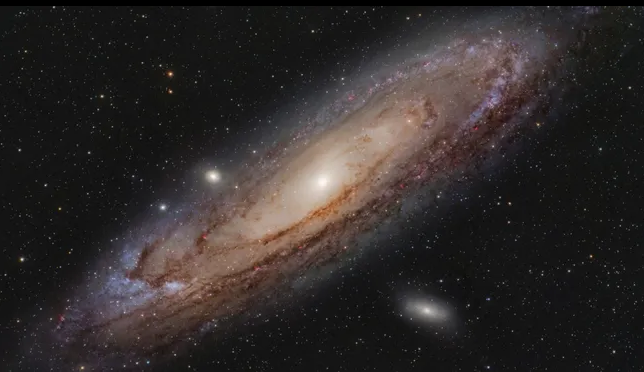
Let us now consider our galaxy to be 1 millimeter across. We are part of a ‘local’ group of galaxies made up of more than a hundred smaller galaxies (of which only one is of significant size, the Triangulum Galaxy, known as M33, see Figure 1), and a large spiral galaxy broadly similar to ours, Andromeda (Figure 2), which is about 2.5 cm away. Andromeda is the most distant cosmological object that can be seen with the naked eye (see also my post References for laymen: angles in the sky).


Figure 1 – triangle galaxy M33 (credits: Nasa, Esa e M. Durbin, J. Dalcanton e B. F. Williams, University of Washington)
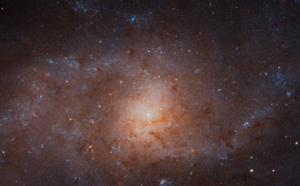
Triangle galaxy M33


Figure 2 – Andromeda galaxy (image credit: Westend61 via Getty Images)
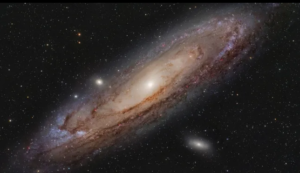

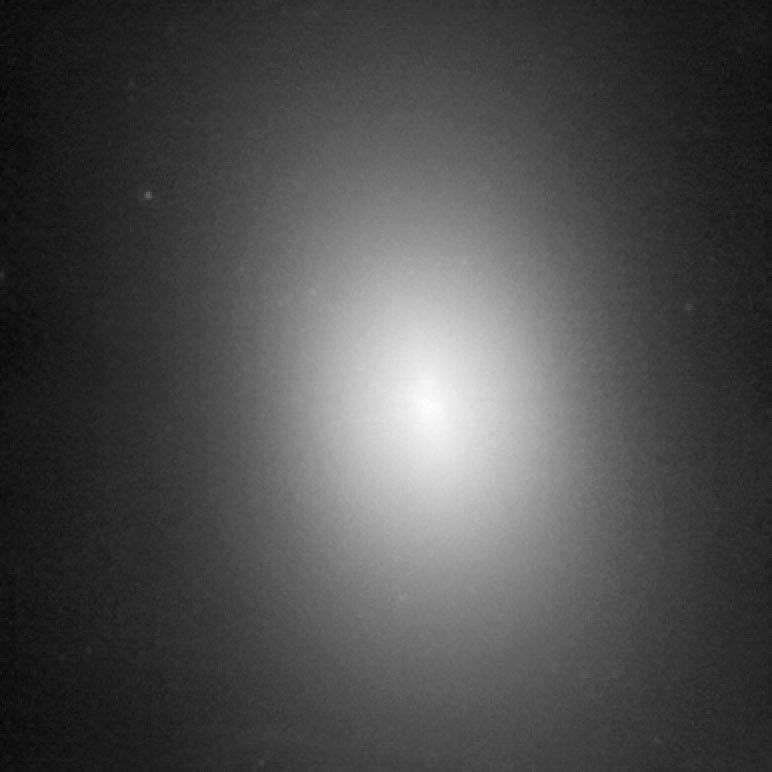
Andromeda is more extended but less massive than our galaxy. It’s getting closer to us (or rather we’re getting closer to each other) at about 400,000 km/h, on our new scale, less than four thousandths of a millimeter (about one hundredth the thickness of a hair) in a million years. In other words, in 4–5 billion years the two galaxies will merge, still in a collisionless way (we demonstrated this here, §1, not for newbies), and will probably turn into a giant elliptical galaxy (like NGC 1600 in Figure 3) after a few more billion years. However, recent measurements from the Gaia* satellite reduce the probability of this merger happening on such ‘short’ timescales, even though it is inevitable that it will occur.

* The Gaia satellite is an astrometric mission of the European Space Agency (ESA), launched in 2013 to map the Milky Way in 3D. It orbits around the Lagrange point L2 (see my post The three-body problem and the five Lagrangian points), and has created the most precise stellar catalog of more than 2 billion stars around us, measuring their positions, motions, brightness, and chemical composition.


Figure 3 – NGC 1600 by HST, it has a diameter of about 120.000 light -years, or about 1.2 mm on our scale (credits: A. Quillen, University of Rochester, G. Bower, CSC/STScI, and G. Rieke, Steward Observatory/University of Arizona)
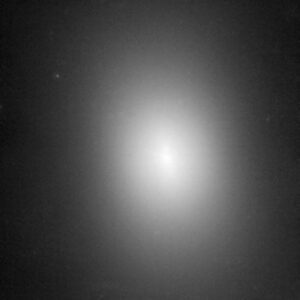
NGC 1600


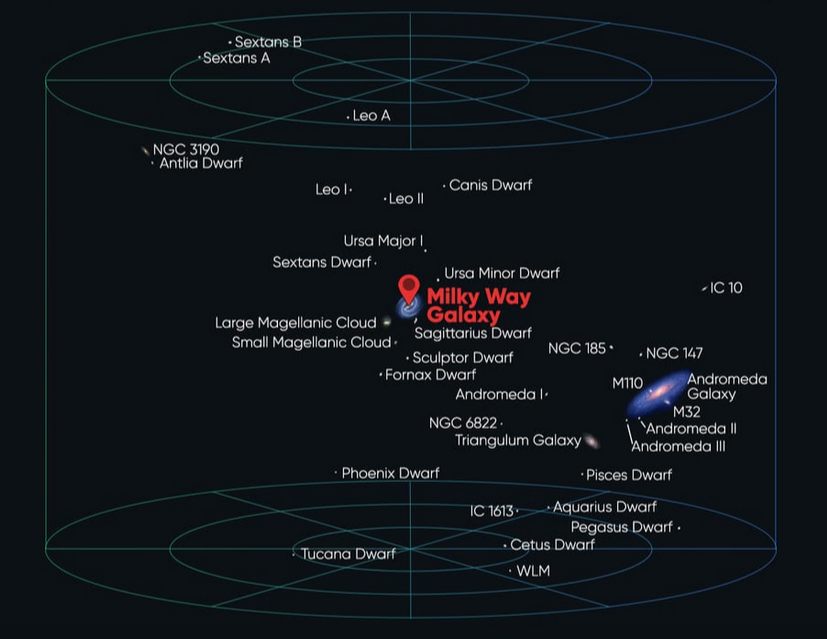
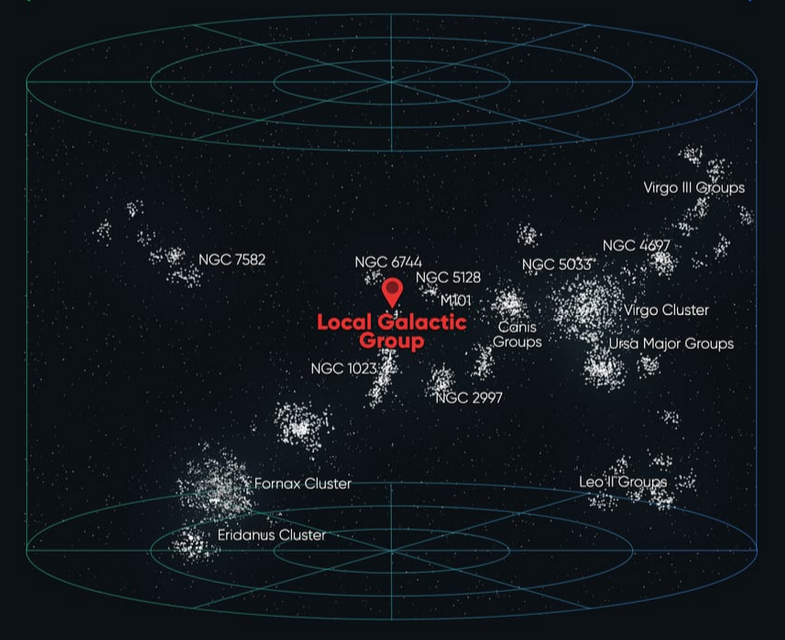
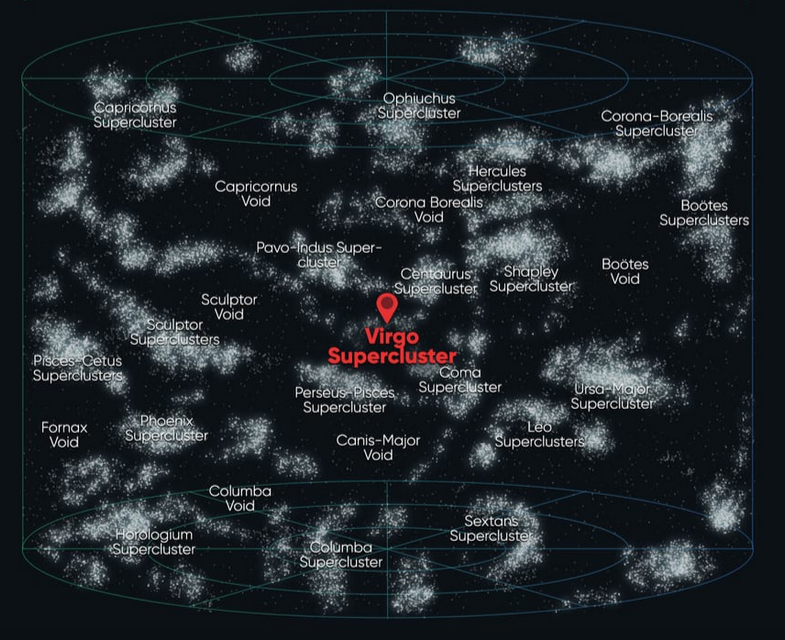
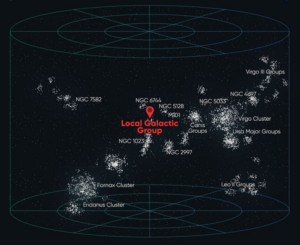
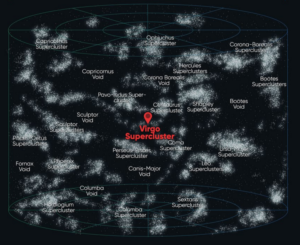
The Local Group of galaxies (see the 3D schematic in Figure 4) has a radius of about 3 cm on the adopted scale, and is surrounded in an “homogeneous” way by similar structures. For example, in Figure 5 a radius of 33 cm is considered on the same scale, and in Figure 6 a radius of about 1.5 m. Proceeding in an analogous way, one can reach the limit of the observable universe (that is, before redshift completely prevents sources from being detected) which, on the adopted scale, can be taken to be at a distance of just over 4 meters.


Figure 4 – Local Group of galaxies (source starwalk.space)
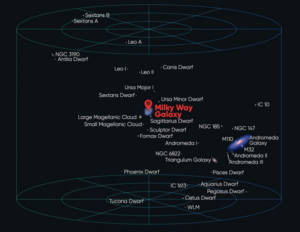
local galaxies cluster


Figure 5 – Virgo Supercluster, along with 100 other galaxy groups (source starwalk.space)
Virgo Supercluster


Figure 6 – Laniakea Supercluster which includes almost 100.000 galaxies more than ours (source starwalk.space)
Super Supercluster


We have reached the limit of the current theory of the standard cosmological model. It is a theory, based on creation from nothing through an initial Big Bang, which is strongly supported by observations but also has major gaps in explaining other evidence.
Our journey therefore stops right at the limit of ‘measurable’ findings grounded in commonly accepted theories; beyond this point, it becomes epistemology rather than cosmology.


Previous episodes:
Understanding the Sizes : 3 – Milky Way
Understanding the Sizes : 2 – Solar System
Understanding the Sizes : 1 – Earth and Moon
please, rate this post

Understanding the Sizes : 3 – Milky Way

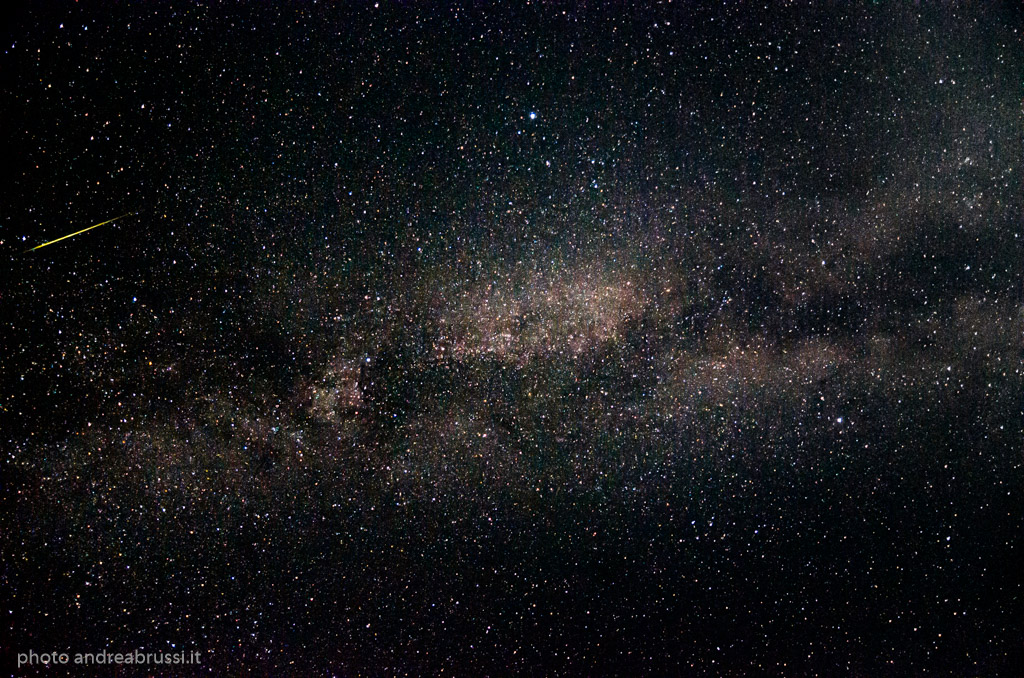
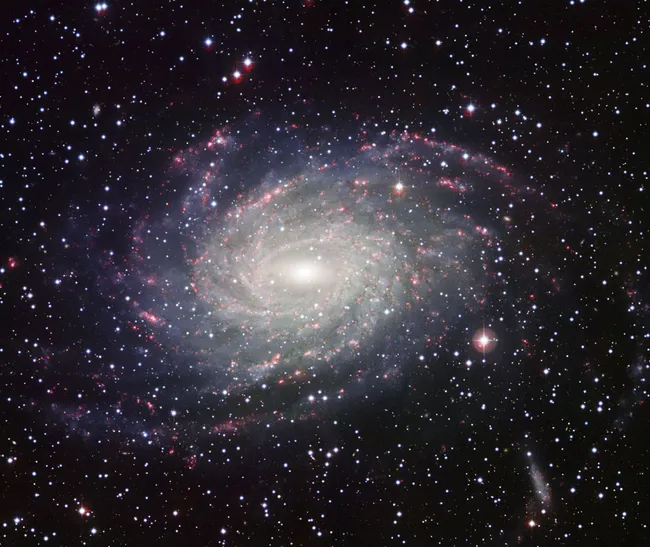
The Milky Way is our galaxy: a gravitationally bound structure that includes about 100 billion stars and an enormous amount of gas (essentially atomic hydrogen), with an approximate shape of a rotating disk, which, of course, we can only imagine and not actually see, since we are inside it (our view towards the galactic centre is known, see Figure 1, even if it is increasingly difficult to observe, due to atmospheric pollution, especially light pollution.). See Figure 2 for a photo of a similar example. The stars, gas, and dust that make up the disk rotate in the sense that they orbit around the roughly spherical central nucleus (the bulge), which instead is not rotating (its stars have chaotic motions).


Figure 1 -Milky Way as seen from Earth (my photo)

Milky Way


Figure 2 – example of a galaxy similar to the Milky Way: NGC 6744, taken at the European Southern Observatory’s La Silla Observatory in Chile (image credits: ESO)

Galaxy like Milky Way


To understand the sizes, it is necessary to change scale again compared with the previous post on the Solar System: the quantities involved become increasingly difficult to ‘grasp’. We have seen that Sun light takes about 4 hours to reach Neptune, the outermost planet of the Solar System. The star closest to us is Proxima Centauri (a red dwarf in a triple star system), about 4 light-years away. We therefore choose the light-year as the unit for this new distance scale, imagining 1 light-year as equal to 1 millimeter. Then Proxima Centauri is about 4 mm from the Sun (of course, since the difference is only a few light-minutes compared with 4 light-years, Earth and the Sun that Earth orbits can be considered at essentially the same distance).

All these stars orbit around the nucleus but also have their own independent motions, which are collisionless (we demonstrated this here, §1, not for newbies), a remarkable fact given the number of bodies, and in contrast, for example, with a collection of gas molecules in a container, which instead undergo continuous collisions (which determine its pressure and temperature). But compared with a gas, the distances between the components in a galaxy are immensely larger.

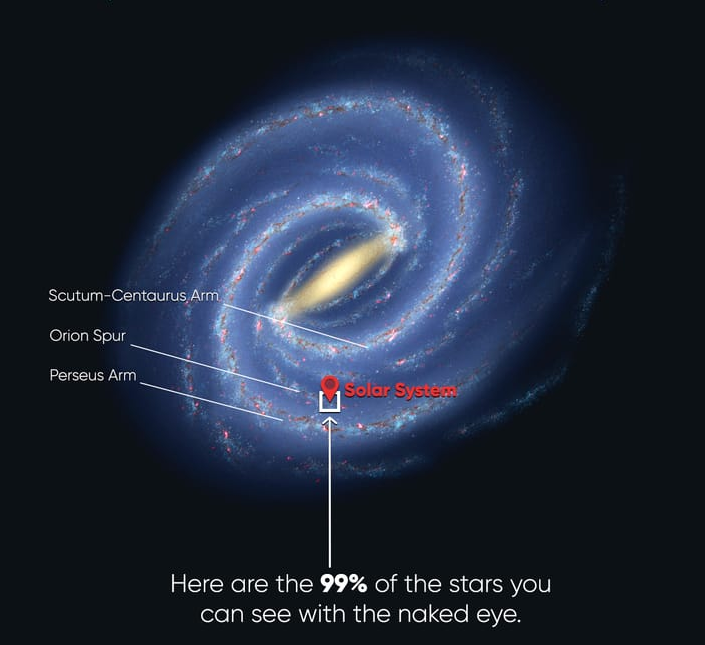
In the new scale we have adopted, the radius of the galactic disk is about 105 meters (about 105,000 light-years), and our position is about 26 meters from the center. In Figure 3 the drawing schematically outlines one possible configuration and the proportions. Our linear speed is about 790,000 km/h and we complete one orbit in about 250 million years, so on our scale, despite the crazy speed, we move only about 1.5 cm in a thousand years, in this 105-meter-radius disk. Since the Sun and Earth formed, about 4.5 billion years ago, we have made about 18 revolutions around the galactic nucleus.


Figure 3 – schematic drawing of the Milky Way and its proportions (gases beyond the star limit are not drawn but they are gravitationally relevant; source starwalk.space)

MIlky Way sketch


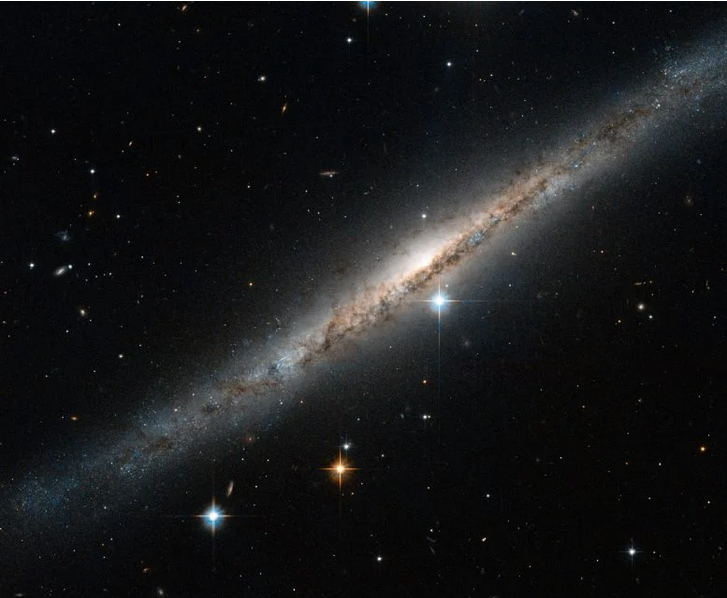
The disk of our galaxy is made up of several arms, where the concentration of stars is higher, and a more rectilinear component that originates from the central nucleus, from which the arms branch out, as schematized in Figure 3. A galaxy of this kind is called a ‘barred spiral’ and its shape when seen edge-on is similar to the example in Figure 4.
In a future post we will talk about the central black hole and the star-forming regions.


Figure 4 – Example of a spiral galaxy seen edge-on, ESO 121-6 (source: HST by ESA/Hubble & NASA)

Galaxy edge on Eso121-6


As a final remark, note that nearly all the stars visible to the naked eye belong to the Sun’s local stellar neighborhood, as highlighted in Figure 3. It’s a tiny region compared with the size of the whole Milky Way. Most of the Galaxy’s other stars are too faint and/or too obscured by interstellar dust to be seen individually, and instead contribute to the Milky Way’s diffuse glow: a blend of millions to billions of unresolved stars.


Next episode:
Understanding the Sizes : 4 – galaxy clusters and beyond

Previous episodes:
Understanding the Sizes : 2 – Solar System
Understanding the Sizes : 1 – Earth and Moon

please, rate this post