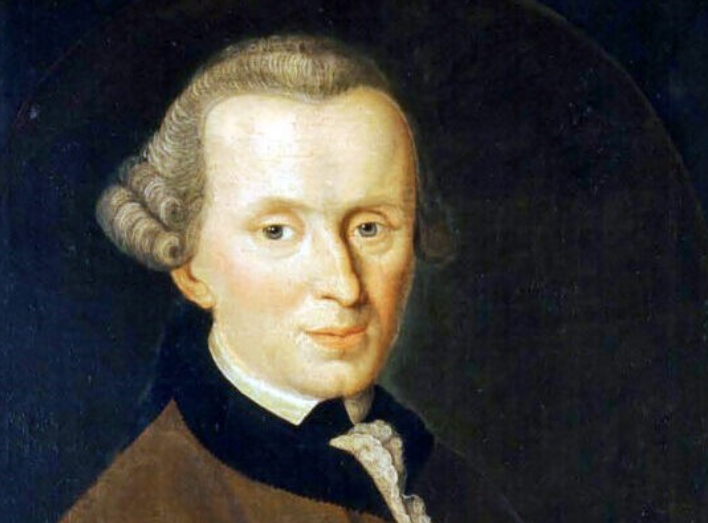
The redefinition of the concept of space is one of the revolutionary foundations thought of Immanuel Kant (1724-1804): the abandonment of the common, Newtonian-derived idea of space as an absolute entity or an objective ‘container’ of reality. Kant addresses the problem within the Transcendental Aesthetic, the section of the Critique of Pure Reason devoted to sensibility. He distinguishes a metaphysical exposition, which establishes the a priori nature of space, and a transcendental exposition, which derives from it space’s role as a condition of the possibility of experience and of geometry.
Space as Pure Intuition
In contrast to empiricists, Kant argues that space cannot be derived from experience. In order to perceive an object as located in a place different from that occupied by another object, or simply as ‘external’ to us, we must already presuppose the representation of space. Therefore, space is not a general concept constructed by abstraction, but a pure a priori intuition:
– intuition: because it is not a logical construction, but an immediate and singular representation within which we place sensory data
– a priori: because it precedes every sensation and is its necessary condition.
Transcendental Subjectivity
This is the core of Kant’s ‘Copernican Revolution’. Kant claims that space does not belong to things in themselves (noumena), but is the form of outer sense. In other words, it is the way in which the human subject is structured to receive information from the world. This leads to a fundamental epistemological distinction:
– transcendental ideality: if we abstract from the knowing subject, space is nothing as a thing in itself; it has no autonomous existence outside our faculties and is not a determination of noumena
– empirical reality: at the same time, space has objective validity for all phenomena (for every possible experience), for every object that could ever present itself to our senses.
The Foundation of Geometry
Kant uses this view to explain, in a scientific context, the nature of geometry’s synthetic a priori judgments. He is, of course, considering only Euclidean geometry as a description of the space of experience, having lived half a century before Bernhard Riemann (1826-1866) and the development of elliptic geometry. If geometry is the science that studies the properties of space, and if space is the a priori form of our mind, then geometrical theorems will be universally and necessarily valid for all objects of experience. In short, geometry applies to the physical world not because the world is ‘geometrical by nature’, but because we can perceive the world only through a spatial structure that we ourselves project onto phenomenal reality.
In conclusion, for Kant space is not an object of physical investigation like others, but the condition of possibility of our experience. Without this subjective structure, the perception of the external world would be impossible.
Clearly, this Kantian interpretation should be reconsidered in light of the implications of elliptic geometry and of General Relativity, and of the consequences of Special Relativity. In General Relativity, Einstein showed that space is not merely a passive state of possibility, but a dynamic physical entity that bends under the influence of mass: space acts on matter, and matter acts on space. Special Relativity undermines the objectivity of spatial extensions: lengths are measures of objects, but ultimately they are measures of the spatial coordinate component parallel to the relative velocity between reference frames, which is not invariant. The requirement, as noted above, that this structure (space) be objective stands in sharp contradiction with the physical reality described by General and Special Relativity.
Quite simply, while Kant wanted to base science on philosophy, Einstein demonstrated that it is philosophy that must bow (and bend with General Relativity!) before the physical evidence of reality.
see also the post:
 Changing perspective: Einstein between Kant’s certainties and Hume’s doubts