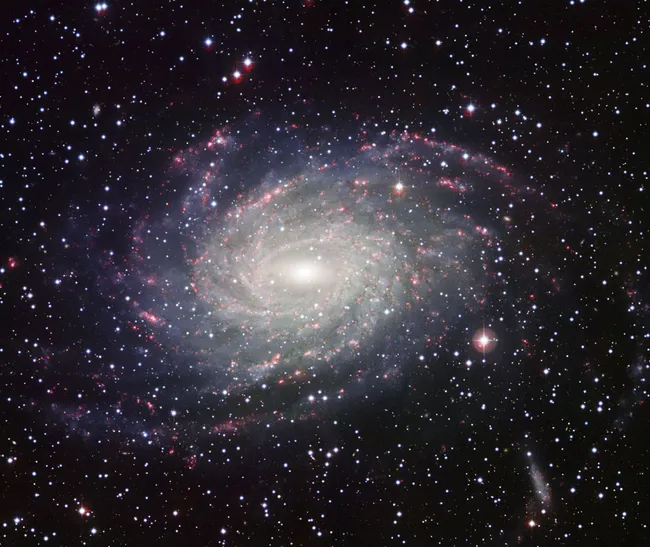
The Milky Way is our galaxy: a gravitationally bound structure that includes about 100 billion stars and an enormous amount of gas (essentially atomic hydrogen), with an approximate shape of a rotating disk, which, of course, we can only imagine and not actually see, since we are inside it (our view towards the galactic centre is known, see Figure 1, even if it is increasingly difficult to observe, due to atmospheric pollution, especially light pollution.). See Figure 2 for a photo of a similar example. The stars, gas, and dust that make up the disk rotate in the sense that they orbit around the roughly spherical central nucleus (the bulge), which instead is not rotating (its stars have chaotic motions).
Figure 1 -Milky Way as seen from Earth (my photo)
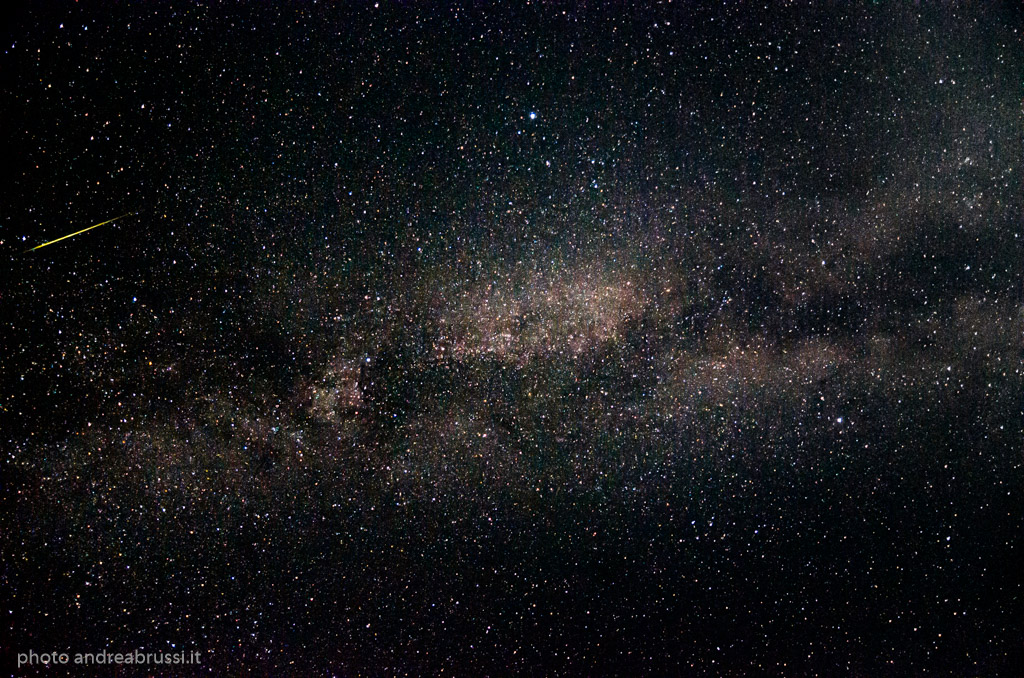
Figure 2 – example of a galaxy similar to the Milky Way: NGC 6744, taken at the European Southern Observatory’s La Silla Observatory in Chile (image credits: ESO)
To understand the sizes, it is necessary to change scale again compared with the previous post on the Solar System: the quantities involved become increasingly difficult to ‘grasp’. We have seen that Sun light takes about 4 hours to reach Neptune, the outermost planet of the Solar System. The star closest to us is Proxima Centauri (a red dwarf in a triple star system), about 4 light-years away. We therefore choose the light-year as the unit for this new distance scale, imagining 1 light-year as equal to 1 millimeter. Then Proxima Centauri is about 4 mm from the Sun (of course, since the difference is only a few light-minutes compared with 4 light-years, Earth and the Sun that Earth orbits can be considered at essentially the same distance).
All these stars orbit around the nucleus but also have their own independent motions, which are collisionless (we demonstrated this here, §1, not for newbies), a remarkable fact given the number of bodies, and in contrast, for example, with a collection of gas molecules in a container, which instead undergo continuous collisions (which determine its pressure and temperature). But compared with a gas, the distances between the components in a galaxy are immensely larger.
In the new scale we have adopted, the radius of the galactic disk is about 105 meters (about 105,000 light-years), and our position is about 26 meters from the center. In Figure 3 the drawing schematically outlines one possible configuration and the proportions. Our linear speed is about 790,000 km/h and we complete one orbit in about 250 million years, so on our scale, despite the crazy speed, we move only about 1.5 cm in a thousand years, in this 105-meter-radius disk. Since the Sun and Earth formed, about 4.5 billion years ago, we have made about 18 revolutions around the galactic nucleus.
Figure 3 – schematic drawing of the Milky Way and its proportions (gases beyond the star limit are not drawn but they are gravitationally relevant; source starwalk.space)
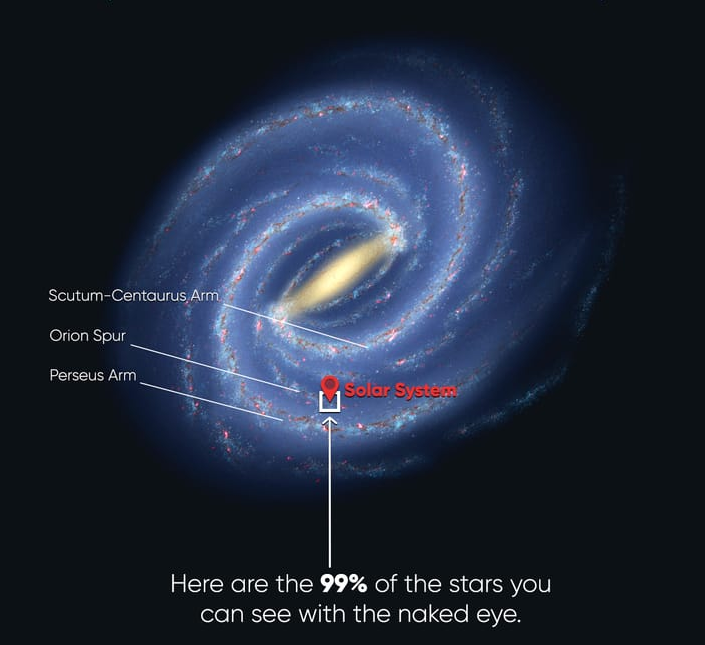
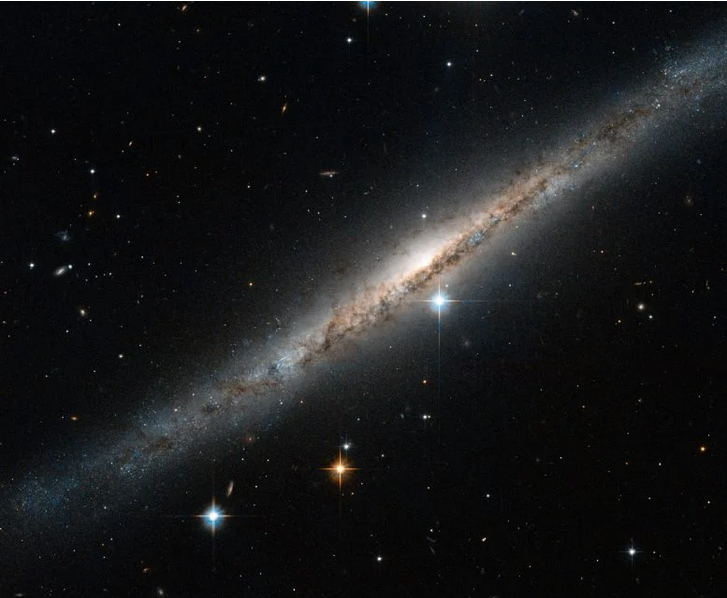
The disk of our galaxy is made up of several arms, where the concentration of stars is higher, and a more rectilinear component that originates from the central nucleus, from which the arms branch out, as schematized in Figure 3. A galaxy of this kind is called a ‘barred spiral’ and its shape when seen edge-on is similar to the example in Figure 4.
In a future post we will talk about the central black hole and the star-forming regions.
Figure 4 – Example of a spiral galaxy seen edge-on, ESO 121-6 (source: HST by ESA/Hubble & NASA)
As a final remark, note that nearly all the stars visible to the naked eye belong to the Sun’s local stellar neighborhood, as highlighted in Figure 3. It’s a tiny region compared with the size of the whole Milky Way. Most of the Galaxy’s other stars are too faint and/or too obscured by interstellar dust to be seen individually, and instead contribute to the Milky Way’s diffuse glow: a blend of millions to billions of unresolved stars.
Next episode:
Understanding the Sizes : 4 – galaxy clusters and beyond
Previous episodes:
Understanding the Sizes : 2 – Solar System
Understanding the Sizes : 1 – Earth and Moon

