The Stage of Reality – Why gravity is not a force and the speed of light is not a speed

Introduction
What we are about to explore is what I call ‘the stage of reality’, the place where we, and everything around us, move (a trivial side note: nothing is truly ‘at rest’ in our universe, as there is no absolute reference frame against which to measure motion). This stage is what we call spacetime, composed of the three familiar spatial dimensions plus time, which is simply an additional dimension. We cannot ‘visualize’ it unless we imagine removing one of the spatial dimensions, as seen in the famous Minkowski diagrams (see Figure, Hermann Minkowski, 1864-1909).
It was Albert Einstein (1879-1955), in his brilliant work in the early 1900s, who viewed the universe not as an empty space where time flows separately, but as a single four-dimensional context. These dimensions are inextricably linked by a metric governed by the laws of gravitation. In this scenario, time is not an external clock, but a real direction in which we move, just as we move North or South, to put it in geographic terms.

Gravity
Why is the force of gravity not a force? For centuries, thanks to Isaac Newton (1643-1727), we thought of gravity as a kind of ‘invisible hand’ that ‘pulls’ objects. But if we apply what Einstein called the equivalence principle (which he described as “the happiest thought of my life”), we discover a fundamental concept. He imagined being in an elevator in deep space, far from any gravitation, accelerating upwards (remember that acceleration is the variation of velocity). You would feel pressed to the floor exactly as you do on Earth. If you were to release Newton’s legendary apple, it would ‘fall’ toward the floor. Yet, there is no gravity ‘pulling’ it; there is only acceleration. Einstein realized that gravity is not a force acting in space; rather, the effect we observe and call ‘force’ is the consequence of the curvature of spacetime itself. In fact, the presence of mass —or rather, mass-energy, since they are the same thing except for a conversion factor (the famous E=mc² )— warps the fabric of spacetime like a weight on an elastic sheet. For example, the Earth, with its concentration of mass-energy, creates a geometric deformation: the apple doesn’t fall because a force pushes it, but because it is simply following the straightest possible line (called a geodesic) in a space that has become curved.
According to Newton’s laws of motion, a body with no forces acting upon it moves with uniform rectilinear motion (respecting the principle of inertia). According to Relativity, an apple falling in a gravitational field is, paradoxically, the only object experiencing no force at all (respecting the principle of inertia). To quote Einstein again: “Matter [mass-energy] tells spacetime how to curve, and spacetime tells matter how to move.”

Light
Now let’s consider light. We attribute a ‘speed’ to it (which we define as a change in position), but as physicist Leonard Susskind (1940-) explains, it is not a speed in the common sense of the term (like that of a car). Instead, it is a fundamental property of the geometry of spacetime —a simple ‘conversion factor’ between spatial and temporal coordinates.
In the four-dimensional universe in which we exist, space and time are different directions of the same thing, and  c  is the number that tells us how many meters are equivalent to one second. That is: time=space / c .
The value of the universal constant c is approximately 300,000 km per second, or just over a billion km per hour (approx. 1.08 billion km/h).
Susskind’s profound suggestion is that every object in the universe always and constantly moves at the exact same speed:
– When we are ‘still’ in space—for instance, sitting in our chairs—we are traveling at the speed of light along the axis of time
– If we start moving through space, we must ‘subtract’ speed from time to compensate for the spatial movement (as if paying a toll using the conversion factor, ). From this, the relativistic time dilation is derived (e.g., the twin paradox).
There are no variable speeds; there is only a distribution of the ‘total speed’ among different dimensions. Therefore, light isn’t ‘racing’: we could say that light spends its entire ‘allowance’ on space, leaving zero for time, based on the conversion factor c .
This constant —the speed of light— is the geometric limit of what can happen in the universe.

Conclusions
There is, therefore, no speed limit; there is only a global geometry in which we are all immersed. Gravity is the curvature of the road; the constant holds together the very fabric of the reality surrounding us. Physics does not describe ‘what happens’, but describes the geometric structure in which everything is already contained.
Understanding this means stopping looking at ‘things’ that move and starting to look at the shape of the stage on which they move.


A Minkowsky diagram (credits to medium.com)


MInkowsky diagram

please, rate this post

The URD Framework – under development

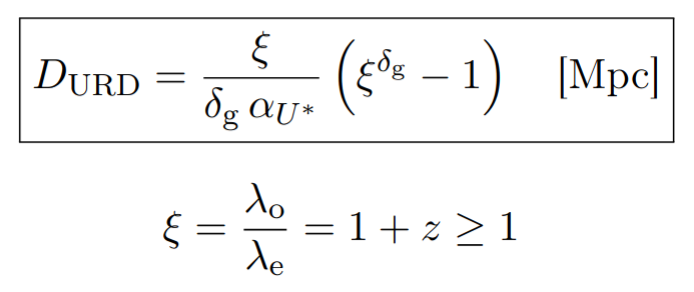
The URD Framework: Cosmological Distances from Redshift in a Non-Standard Context

While I am still developing the project —including through parallel studies on the Tolman test and the quality of indirect data obtained from recent galaxy surveys— I am making my work public as a preprint. I always hope that someone might be interested in my conjectures or perhaps even willing to collaborate with me to address the critical issues of the URD Framework.


Abstract
A phenomenological framework for determining cosmological distances is proposed, based on a non-expanding spacetime interpretation consistent with current observational datasets. The model introduces a redshift mechanism associated with cumulative photon energy attenuation along the line of sight, formulated in a way that is not equivalent to standard tired light scenarios. The approach is constructed to remain compatible with established relativistic principles whereas adopting boundary conditions distinct from the metric expansion paradigm. Distance estimation is achieved through the URD equation (U energy density, Redshift, Distance), which incorporates two phenomenological parameters that describe conformal geometric dissipation in extended gravity and an effective relativistic path-length correction. Within this formulation, the model addresses the primary shortcomings traditionally associated with energy dissipation effects, specifically reconciling time dilation in supernova light curves and the Tolman surface brightness relation. The model is calibrated using the Pantheon+ supernova sample by comparing and cross-validating distances inferred from the proposed redshift mapping with redshift-independent indicators, with additional comparison performed against baryon acoustic oscillations, radio galaxy samples, and high-energy quasars. Across these datasets, the framework reproduces observational constraints over a wide redshift range within a phenomenological, non-standard cosmological setting. The results indicate that alternative, non-expansion-based mappings between redshift and distance can be constructed that remain consistent within the observational range considered, suggesting a phenomenological alternative worth further study.
Keywords
cosmological distance ladder; redshift-distance relation; non-expanding spacetime; cosmic microwave background; extended gravity; Pantheon+ sample; baryon acoustic oscillations; Tolman test; time dilation; geodetic correction


Here is the last version of the preprint (5.1 MB):

pdf Brussi 2026_URD Framework Preprint

Version uploaded to Zenodo:

link DOI – zenodo.20763682


URD distance formula

please, rate this post

Leonard Susskind about the c constant

An in-depth analysis by Leonard Susskind of the constant c, commonly referred to as the “speed of light.” It is essentially a collection of familiar concepts, but reinterpreted in an illuminating way, that are well worth considering.


please, rate this post

Cosmology for a static universe

Abstract

This brief work, then became an Appendix to my URD Framework study, proposes a cosmological model characterized by a globally flat, spatially infinite, and non-time-limited spacetime. It challenges the standard application of the Friedmann-Lemaître-Robertson-Walker metric by reinterpreting general relativity as a strictly local phenomenon within a non-continuum matter distribution. In this framework, the observed flatness of the universe is a fundamental geometric property rather than a dynamical result of inflation, and cosmological redshift is modeled as a cumulative energy dissipation process rather than metric expansion.

pdf  Brussi 2026_Cosmology for a static universe


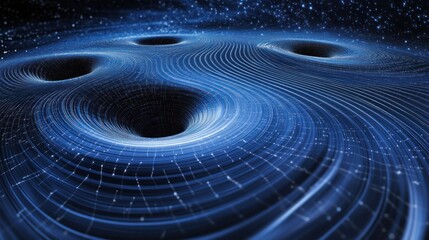
gravitational emotion

Ai generated image from free Adobe stock

please, rate this post

The Boltzmann Brain – an epistemological provocation

The Boltzmann Brain  (Ludwig Boltzmann, 1844-1906) is one of the most unsettling thought experiments in modern physics, sitting right at the intersection of thermodynamics and the philosophy of mind. It suggests a provocative paradox: in an infinite universe governed by entropy, it is statistically more likely for a single, self-aware brain to spontaneously flicker into existence -complete with false memories of a life it never lived- than for an entire structured universe to evolve over billions of years.
At its core, this concept challenges our very definition of reality. If we are more likely to be a random ‘fluctuation’ in a sea of chaos than biological products of a long evolutionary chain, how can we trust our observations of the cosmos? It’s not just a puzzle about physics; it’s a fundamental question of epistemology: how do we know we are truly part of a stable universe and not just a fleeting thought in the void?

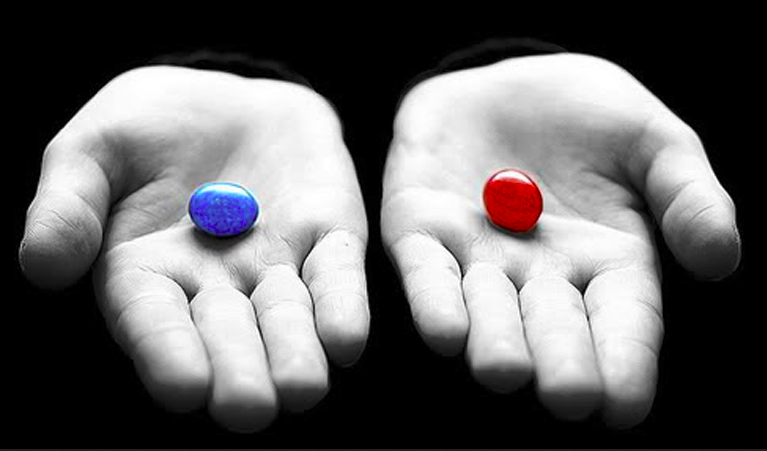
It’s impossible not to think about the brilliance of The Matrix.
But while The Matrix asks us to choose between a comfortable lie and a harsh truth, the Boltzmann Brain suggests that truth might not be a structure at all, but rather an accidental flash of order in an ocean of nothingness. In both scenarios, the epistemological question remains the same: if your senses and memories were the only data you possessed, how could you ever prove you aren’t just alone in a timeless void?


blue red

please, rate this post

A wearable math problem

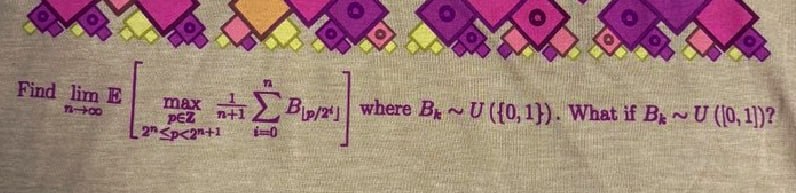
I was given this problem, printed on a T-shirt handed out at a math conference.
Below is my answer to the first part, which I believe is correct.
Does anyone know the answer to the second question as well?


math shirt


The defined structure is a ‘binary’ fractal because it divides into two parts each time.
The first question is to find the maximum expected value for the average of the values encountered when traversing the entire structure, as the number of subdivisions approaches infinity, if the values 0 or 1 are randomly assigned to each small square. That is, the maximum average value obtainable by following one of the paths.
[One path could be, for example, 1+0+1+0+1+0+0+1+1+1+…, another 1+1+1+1+1+1+1+1+1…]
Since the subdivision is binary, the chance of getting a 1 each time is 1/2 (one in two). But the number of paths grows at the same rate at which the probability decreases (doubling at each step), so it should always be possible to find a path where all the squares contain 1s; therefore, I would say the answer for the maximum of this expected value is “1”.
The following “what if” question, however, asks for the same expected value not for two discrete values, {0, 1}, but for the continuous values of the interval [0, 1] …
Not trivial… the chances of obtaining a number are no longer as simple as the 1 in 2 from before…


please, rate this post

On Mars after sunset

The following image shows Venus, Earth, and Jupiter in the sky of Mars. It was published on X, but some users claimed it was fake, saying that the three planets couldn’t be seen aligned because Mars’s orbit was in the middle of theirs.


Mars landscape


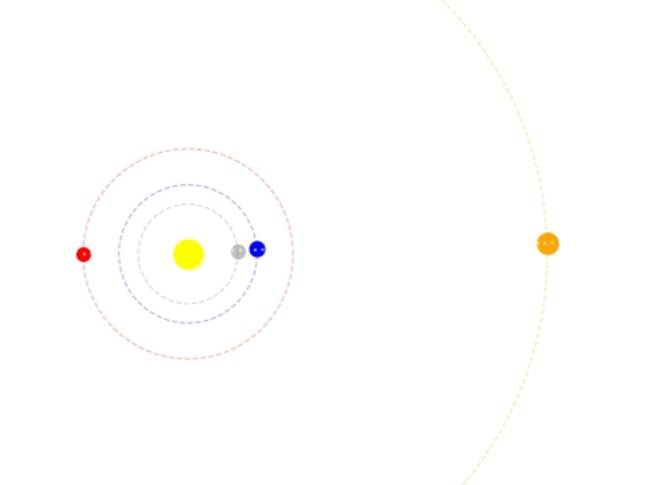
So I created the following diagram to explain that it is absolutely possible to see them like this, after sunset, even if it’s not a frequent configuration. For the planets to be seen, Jupiter, Earth, and Venus must be illuminated by the Sun, so they must be on the other side of the Sun’s orbit, as in my drawing. (Note: the orbits are to scale; the planets and the Sun’s measurements are not!)


Solar System


However, I cannot guarantee that the photo isn’t fake!

please, rate this post

Cute math game

Let us consider the number
[1] x=0.9999…
where the dots … indicate that the numbers continue the same without end.

It seems obvious that we can state that
[2] x<1

However, if we carry out the following steps:

x=0.9999…
10x=9.9999…
10x−x=9.000…
9x=9
[3] x=1

Does [3] contradict [2]?

Where is the ‘problem’?

Write your opinion in the comments
let’s see if someone wins a little doll… ; )

please, rate this post

How much does air weigh?

Let us first consider the air we breathe on Earth.
It is a mixture of gases, as well as water vapour (from 0% to 4%) and dust.
The main gases are:
– Nitrogen (N₂): 78.08%, a molecule made of two nitrogen atoms
– Oxygen (O₂): 20.95%, a molecule made of two oxygen atoms
– Argon (Ar): 0.93%, a noble gas—so called because it does not bind into molecules (its outer electron shell is complete, with the 8 electrons allowed)
– Carbon dioxide (CO₂): about 0.04%, made of one carbon atom and two oxygen atoms.
With rounding, the total comes to 100%, but there are also traces of other gases, such as neon (Ne), helium (He), methane (CH₄), ozone (O₃). From everyday experience we know its elastic properties, which make it compressible and give concrete meaning to the concept of pressure (force applied on a surface), but we rarely think about its weight.

One litre, i.e., one cubic decimetre, of dry air at sea level and at the standard temperature of 15°C weighs about 1.2 grams. Stated like that it sounds like little, but it means that 1 cubic metre weighs 1.2 kg. That is why the kilometres of air above our heads ‘weigh’: as you go up the gases become increasingly rarefied and the air weighs less, but we are talking about tens of kilometres, if not more (to give a more precise estimate one would have to set a limit in pressure or in specific weight). This weight, obviously determined by gravitational attraction, is substantial: the standard pressure of 1 atmosphere corresponds to about 1 kg of weight per square centimetre. In other words, for every square centimetre of our body (a little less than an average fingernail) the acting force is equivalent to 1 kg of weight.
We are not crushed by it and we scarcely notice it because from the inside our body exerts an equal and opposite pressure: we are essentially like balloons that do not burst because the pressures balance. In addition, pressure acts in all directions, not only vertically, so we are not ‘pushed’ one way, we receive the push from every side.

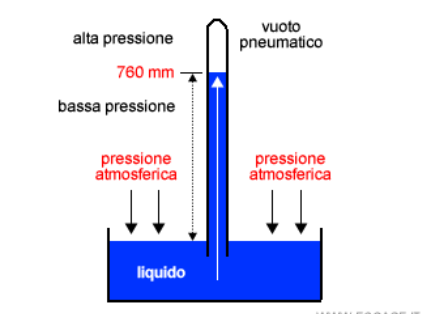
The instrument for measuring atmospheric pressure was invented in 1643 by Evangelista Torricelli (1608–1647), a student of Galileo Galilei (1564–1642). He observed that a transparent tube closed at one end and filled with mercury, when inverted into a basin also containing mercury, maintained a height of about 76 cm, as in Figure 1. Therefore, the weight of the mercury column in the tube had to be equivalent to the weight of the air. The standard unit of measurement for atmospheric pressure is the Pascal (or the hectoPascal, hPa, equal to 100 Pascals, called millibar in meteorology as a submultiple of the bar). One atmosphere, defined as the average pressure at sea level, corresponds to 1,013 hPa, and is the simplest measure for quick explanations. For example, as you gain altitude the trend is not linear because, as mentioned, the air becomes lighter; but at first the pressure halves roughly every 5,500 metres. To give easily testable figures, at 1,500 metres above sea level the pressure is about 84%, at 3,000 metres it is about 69%. That is to say: at 1,500 metres altitude the pressure difference (negative) is comparable to that of a couple of metres of water depth—this is why, even when going into the mountains, it is often necessary to equalize the pressure on our eardrums.


Figure 1 – Torricelli’s barometer (source: ecoage.it, under CC  Creative Commons licence)

Barometro di Torricelli


In this post I will not go into meteorological questions, but it is clear that depending on humidity content and temperature this weight changes, determining differences between locations that generate weather phenomena: wind, clouds, rain, air-mass fronts, etc.

Returning to weight, by analogy with the measure of one atmosphere, note that it corresponds to a column of water about 10 metres high (because of the large difference in density between the two fluids: mercury is almost 14 times as dense as water). Thus, the pressure of the kilometres of air above us is equivalent to 10 metres of water; that is, when we dive, at 10 metres depth we experience a pressure about double what it was before we entered the water. Okay, this is not something people normally do, but anyone who has dived even just a few metres has clearly felt the external pressure (and the need to equalize the internal pressure in the ears). With simple multiplication, this means that at 50 metres depth the “weight” is 5 kg per cm², and at 1,000 metres it is 100 kg per cm².

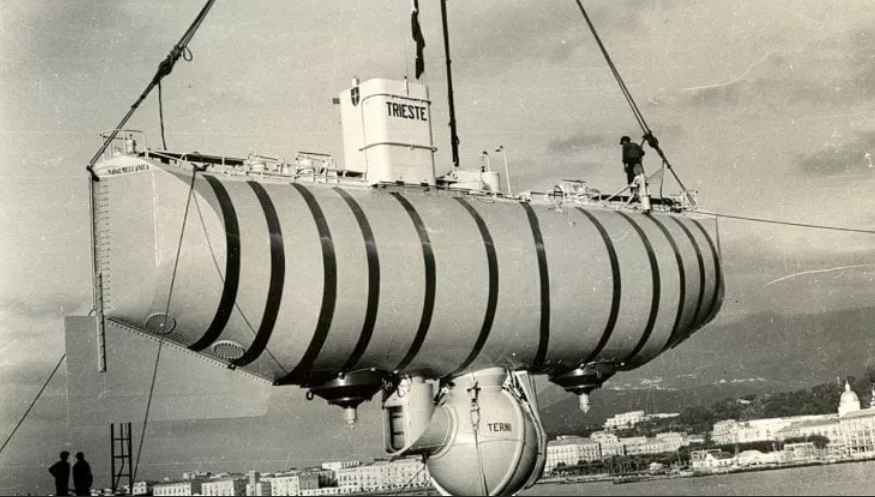
In the Mariana Trench, where the bathyscaphe Trieste (built in Italy, Figure 2) first arrived with the exploration pioneers Jacques Piccard and Don Walsh in 1960, at nearly 11,000 metres depth, the pressure was over one tonne per cm². To withstand it, the steel hull was about 13 cm thick!


Figure 2 – Bathyscaphe Trieste (source: repubblica.it)

Batiscafo Trieste


And how much does the air weigh on Mars?
The Martian atmosphere is composed of about 95% carbon dioxide (CO₂) (oxygen is only about 0.13%). The pressure is very low, about 1% of Earth’s, around 6 hPa compared with our 1013 hPa. It might seem like a paradise for plants that ‘breathe’ CO₂, but aside from the fact that at night plants also breathe oxygen (so they would suffocate), the very low pressure and extremely low temperature (−60°C) would not allow water to be liquid, so the plant’s biochemistry would come to a halt as well.

A significant problem with very low pressure for the human body is the so-called Armstrong limit (about 63 hPa), below which water and blood (at body temperature) would begin to ‘boil’ spontaneously because the external pressure is too low to keep them in the liquid state. A walk on Mars without a pressurized suit is strongly discouraged, regardless of the temperature and the lack of oxygen! On Earth this limit is reached at around 18 km of altitude.

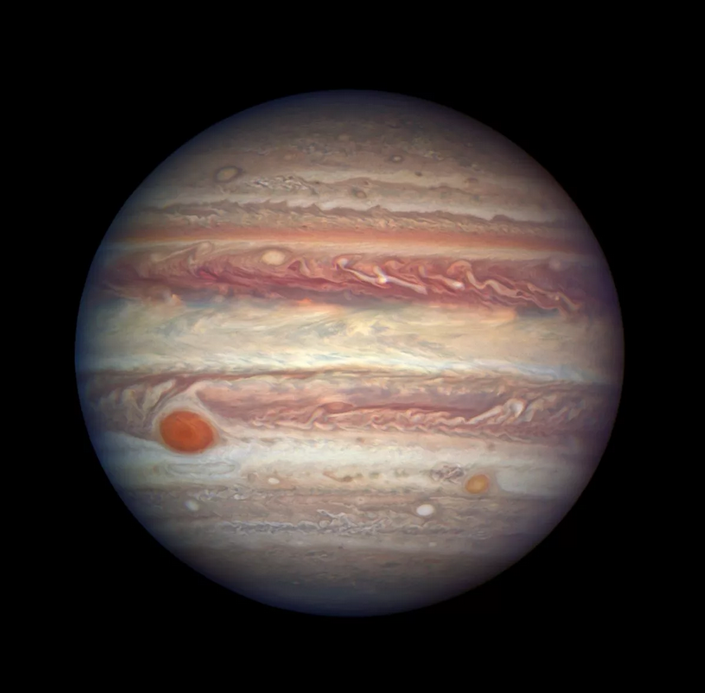
On Jupiter things ‘get worse’ considerably: first of all there is no solid surface; the planet is entirely gaseous, made of about 90% hydrogen (H₂) and 10% helium (He), plus traces of other gases (which are what determine the coloured bands and spots we observe, see Figure 3). Moving inward from the outer layers, because of pressure these gases become liquids and temperatures become extremely high, perhaps 30,000°C near the core, consisting of molten metallic hydrogen (i.e., behaving like a molten metal, for example mercury), which produces its intense magnetic field (20 to 50 times Earth’s and more than twice the Sun’s, except in sunspots, where it is about 300 times stronger). The pressure, which on the outside is of the same order of magnitude as ours, likely reaches 100 million times that toward the centre.
Jupiter is basically a failed star, a terrible place.


Figure 3 – Jupiter (source: NASA / Space Telescope Science Institute, 2017)

Giove


please, rate this post

Strange mathematical objects: Klein bottle

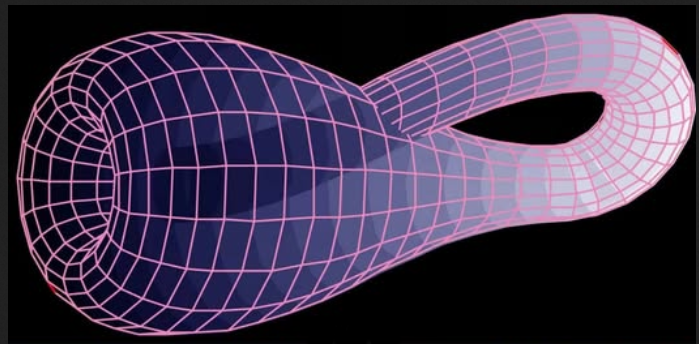
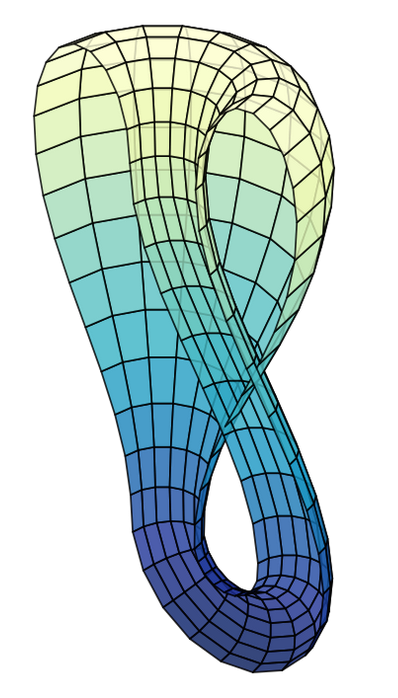
Figure 1 – Klein bottle

Klein bottle


The Klein bottle, or Klein surface, named after the German mathematician Felix Christian Klein (1849–1925), who described it at the end of the 19th century during the development of topology*, it’s an example of one sided surface, with no distinct inside or outside. It is a so-called non-orientable two-dimensional manifold, like the previously seen the Möbius strip, with the important difference that it has no edges.
It is a kind of bottle in which the neck connects to the bottom, having to pass through the wall of the same bottle, as in Figure 1. This is how it appears in a three-dimensional visualization, but like other topological spaces (which we always consider Euclidean), it is not easily visualized in ℝ³. When analyzed in ℝ⁴ there are no overlaps (self-intersections); one understands that the neck does not touch the surface.

Proceeding to higher dimensions, one can imagine a non-orientable three-dimensional manifold that cannot be embedded in ℝ⁴ but can be embedded in ℝ⁵. For example connecting two ends of a Spherinder to each other in the same manner as the two ends of a cylinder for a Klein bottle.

If cut in half, the Klein bottle creates two Möbius strips as in Figure 2, remembering that in reality the intersection does not exist in ℝ⁴.


Figure 2 – A Klein bottle cut in half results in two Möbius strips (source: wikimedia licensed under the Creative Commons Attribution 4.0 Int license)

Klein bottle cut in half


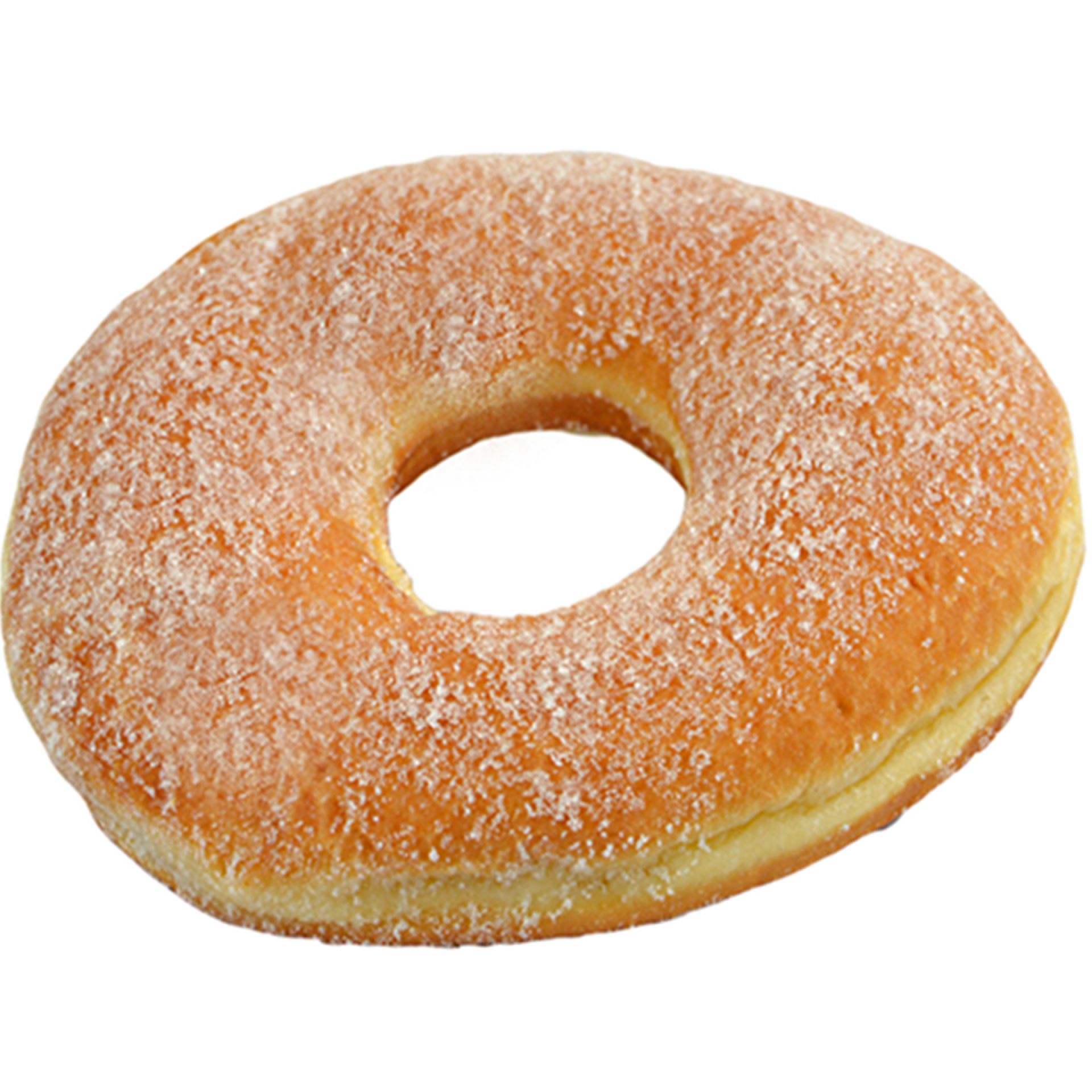
Figure 3 – A tasty solid torus

A tasty solid torus


The traditional (immersed) representation of the Klein bottle is achiral (that is, its mirror image cannot be distinguished from the object). The solid Klein bottle is considered the non-orientable version of the solid torus (such as the one in Figure 3).


Topology*
Topology is an area of mathematics that studies the properties of mathematical objects (shapes) that do not change when a deformation is performed without ‘holes’, ‘overlaps’, or ‘gluing’. For example, a cube is topologically equivalent to a sphere, whereas a torus (a doughnut) is not, because it has a hole that cannot be removed by deformation.
For further reading, the Wikipedia page is comprehensive.

please, rate this post