The chain rule in differential equations is a small but powerful trick often used to derive composite functions by finding the derivative of the outer function while keeping the inner function unchanged.
For example, the expression dy/dx can be rewritten as:
[1] dy/dx = dy/du * du/dx .
In this way, we can obtain a derivative with respect to a variable that is more useful, for example because we know its value (possibly in a simpler formal expression, or already known), or is easier to integrate.
In simple terms, this means transforming the rate of change of x with respect to y into the product of the rate of change of u with respect to y and the rate of change of x with respect to u .
Regarding rules for deriving functions, the chain rule leads to the proof that if F(x) = f(g(x)) , its derivative is:
[2] F'(x) = f'(g(x) * g'(x) .
But while this rule for deriving functions is used every day without thinking about it, the chain rule can be a useful trick in solving many physics problems when we don’t know the direct rate of change between two variables.
A simple example of its use in astrophysics is in the study of star formation and Jeans’ Mass (the critical threshold required for a cloud of interstellar gas and dust to collapse under its own gravity to form stars). The chain rule is used to convert acceleration into a form that depends on position rather than time, making the differential equation integrable. In formal terms, as in [1] , we can write:
[3] d²R/dt² = dv/dt = dv/dR * dR/dt = v * dv/dR ,
where v = dR/dt .
In this case, this substitution allows us to integrate the equation of motion with respect to radius R to determine the free-fall time of a collapsing gas cloud (off-topic calculation omitted).
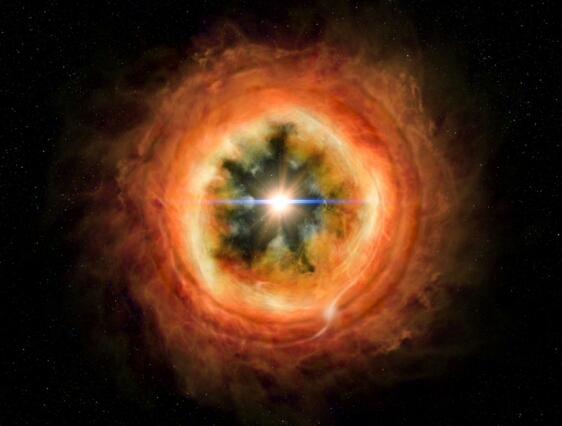
Collapsing gas cloud(source accademiadellestelle.org)

