Galactic Energy Profiles I

Galactic Energy Profiles: GEP I. Radiant and Relativistic Fluxes

Update: I decided to publish this work, part of the GEP series, on Zenodo without peer review and to use it as a basic tool for building a subsequent dataset (GEP III). Note: This work is version 2.0 of the previous NAGE I work, which has been superseded.


Abstract
Standard galactic energy inventories typically focus on the virialized components of the system, namely the kinetic and gravitational potential energy, derived from baryonic mass distributions and stellar luminosity. This paper, the first in the Galactic Energy Profiles series, introduces a reproducible geometric framework for accounting radiant and relativistic fluxes as a standing energy reservoir. By considering the photon and neutrino escape time τ across the galactic Halo, we quantify the energy density of radiation currently in transit as a component of the total galactic budget, complementary to the standard flux-based description. The resulting closed-form expressions, together with the accompanying open-source Python implementation, are intended as a calibrated methodological baseline for the subsequent application of this framework to observed galactic samples.

Keywords
galactic energy inventory; energy residence time; galactic radiant fluxes; galactic Halo energy; galaxy morphology


Here is the Zenodo version of the paper (1.1 MB):

pdf Brussi 2026 GEP I


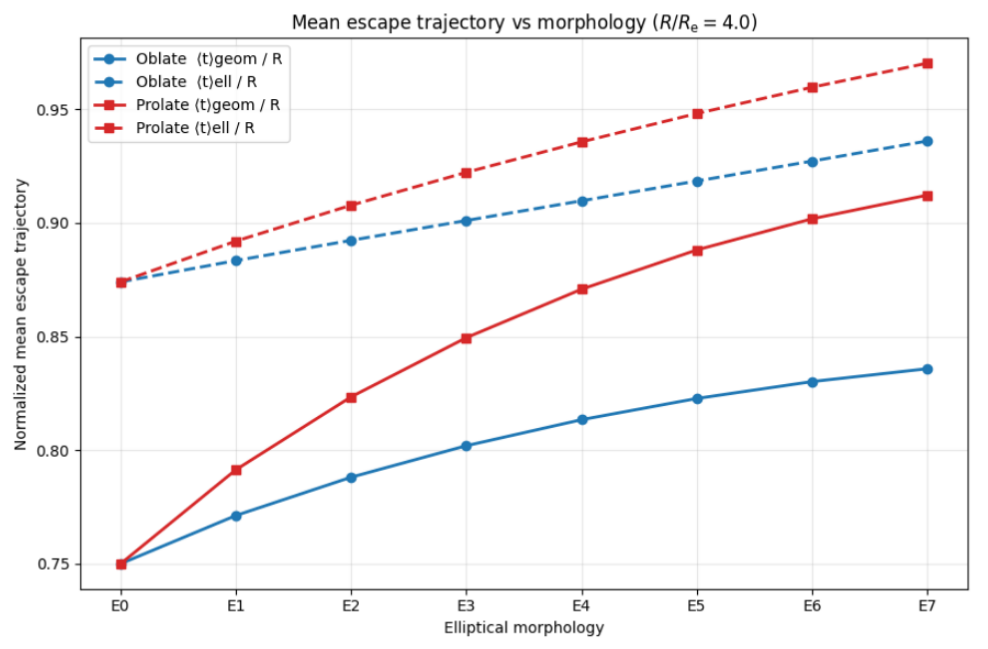
GEP I mean escape trajectory length

please, rate this post

Ludwig Boltzmann, an underrated scientist

Many are familiar with Albert Einstein (1879-1955) or Isaac Newton (1643-1727), but few know that the profound architecture of the reality we live in today was designed by Ludwig Boltzmann (1844-1906).
If today we naturally accept that everything around us is made of atoms, we have him to thank. But the price Boltzmann paid for this insight was extremely high: intellectual solitude and, ultimately, his life.

The Bet on Atoms
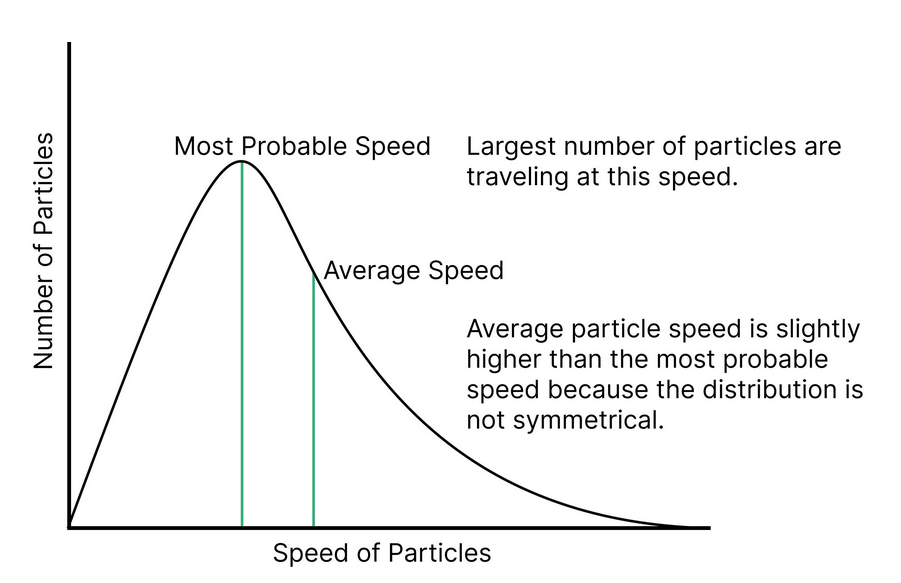
At the end of the 19th century, most scientists (like the influential Ernst Mach, 1838-1916, one of his main detractors) considered atoms merely as “convenient mathematical models,” not as real objects. Boltzmann, on the other hand, was convinced that atoms actually existed. To demonstrate this, he made a logical leap using statistics: he realized that it’s not necessary to know the trajectory of every single molecule to understand how a gas behaves, but rather to calculate the average of their collisions (see Figure 1). From these principles, he developed what later became Statistical Mechanics.


Figure 1 – Diagram of the statistical distribution of particles velocities in a gas (credits: Shutterstock)

particles statistic


Entropy and the ‘arrow of time’
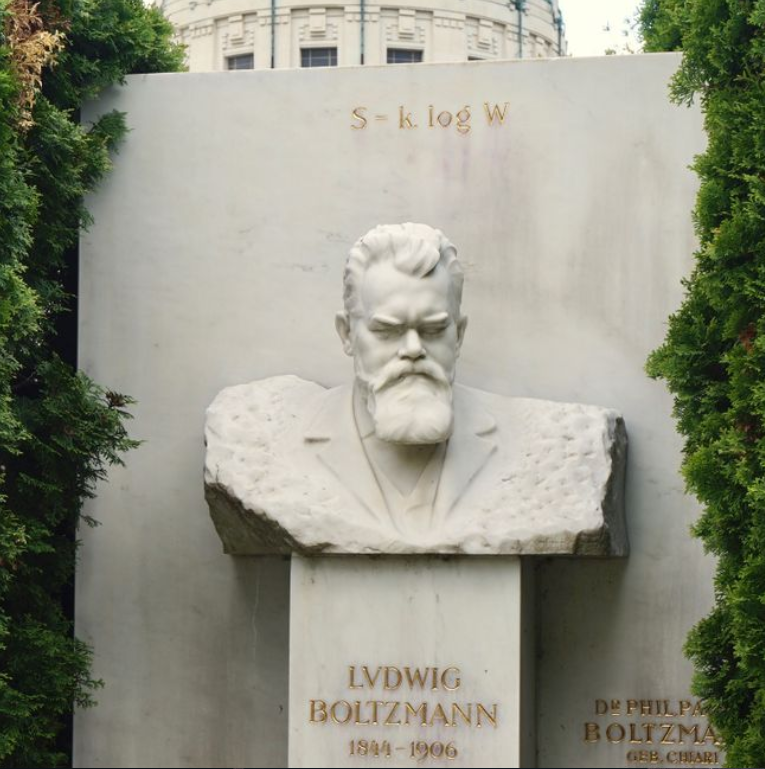
His masterpiece is the famous formula carved on his tomb in Vienna (Figure 2):
S = k log W
This equation connects the visible world (S, entropy) to the invisible world (W, the number of ways atoms can arrange themselves).
One interpretation of entropy is emergent temporal asymmetry: it explains why time only moves forward, not because of a law of mechanics, but because of probability. Heat flows from a hot body to a cold one simply because it is statistically more likely that energy will be dispersed in disorder rather than remain concentrated.
And similarly for the configurational states that hold matter together. Among many, we recall the famous example of the cup falling and breaking into pieces while we don’t observe the pieces spontaneously rejoining to form a whole cup. This happens because the whole cup is a very low-probability state (very ordered); the shattered cup is a very high-probability state (very disordered).
Boltzmann understood that the entire universe is just a gigantic transition to the most probable state.

A misunderstood genius, still underappreciated today
Boltzmann was fiercely attacked by his contemporaries. Scientists of the time, tied to a more continuous view of matter, mocked him. This implacable opposition, combined with a personality prone to depression, led him to commit suicide in 1906, in Duino, near Trieste.
Just a year earlier, in 1905, a young Albert Einstein had published a paper on Brownian motion that proved Boltzmann was right: atoms existed.
He was the first to understand that disorder is the driving force of the universe, and he transformed physics from a science of certainties to a science of probabilities. Without his statistical method and the constant (k) that characterizes it, Max Planck (1858-1947) would never have been able to launch the quantum revolution.
Boltzmann represents the bridge that took physics from the age of steam to the age of the atom and information.


Figure 2 – Ludwig Boltzmann

Ludwig Boltzmann

please, rate this post

References for laymen: What is energy?

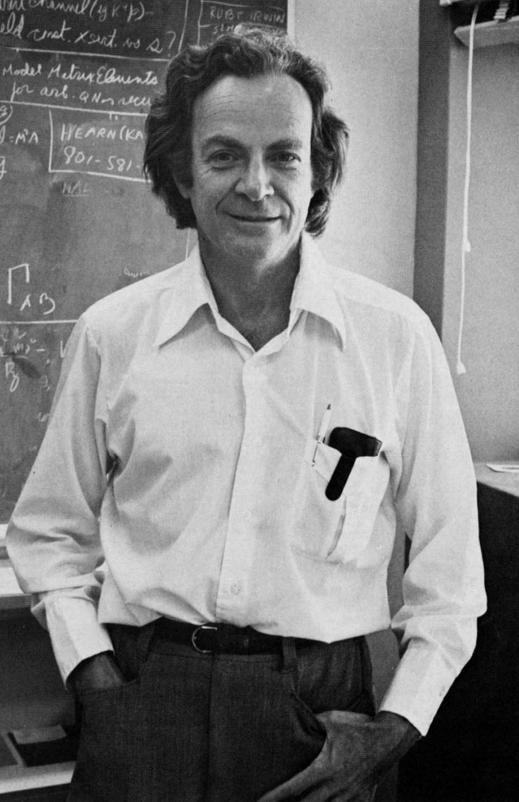
The great physicist Richard Feynman (1918-1988) honestly admitted that in modern physics we have no idea what energy ‘per se’ is. He described it as a kind of magical accounting: in the universe (or rather, in an isolated system), a lot of things happen, but at the end of each day, if we add up certain numbers characteristic of each event, the total is always the same. That number that never changes is energy. It is never created or destroyed, but always transformed.

The scholastic answer, “Energy is the capacity to do work” (given as known the concepts of work, force, etc.), is actually incorrect, because energy naturally tends to ‘spread’; that is, it prefers disorder. And as described by Ludwig Boltzmann (1844-1906), the measure of this disorder, called entropy, always increases in an isolated system. But since entropy also defines energy’s ability to do work, this ability actually always decreases, whereas energy is always conserved.

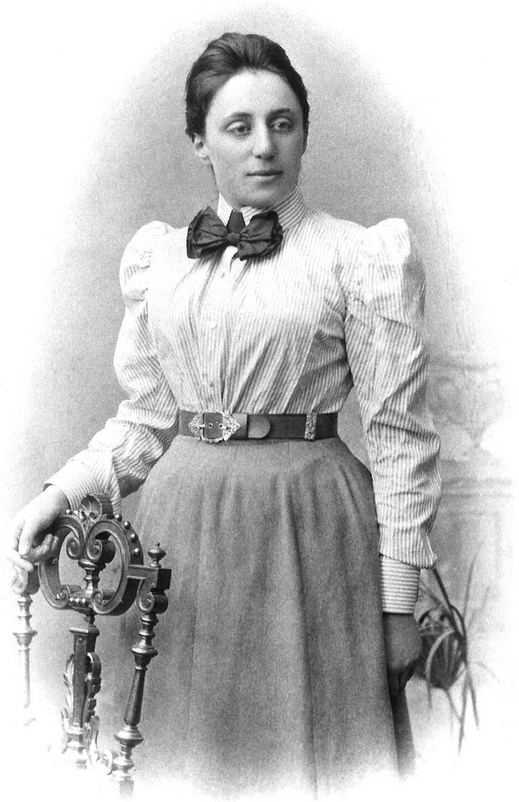
A more technical way to think about energy comes from Emmy Noether (1882-1935), who demonstrated that every conservation law in physics derives from a symmetry: energy is conserved because the Universe has a “translational time symmetry,” meaning the laws of physics remain the same as time passes, and the quantity that mathematically must remain constant is energy. In these terms, one could say that energy is time.

One way to calculate energy is the one defined by Einstein (see Einstein’s formula for energy), even if we don’t know what ‘stuff’ it’s made of. Simply put: even if an object is still and tiny, it hides a monstrous amount of energy within itself thanks to its mass (the constant of proportionality c² is a really huge number). And if it then begins to move due to external action, this energy increases.

Conclusion
We could define energy as the invisible ‘engine’ of reality. We can’t ‘touch’ it, but it ensures that the universe keeps its accounts in order (including the symmetry of time). Every time we do something, or even simply exist, we participate in this immense exchange of ‘tokens’ that has been going on ‘forever’.


Richard Feynman e Emmy Noether

Richard FeynmanEmmy Noether

please, rate this post

Einstein’s formula for energy

The most famous physics formula in the world is probably that of Albert Einstein (1879-1955):
(1) E = mc²
that is, the energy of a body is equal to its mass times the speed of light squared.
Perhaps not many have truly understood it, but certainly almost no one (without university studies) knows the complete formula, which takes into account both moving bodies and the energy of massless particles.

For moving bodies, a multiplication factor must be considered:
(2) E = γ mc²
According to Einstein’s own special relativity (work from 1905), if we consider ‘particles’ moving in four-dimensional spacetime, the change in their momentum (p), is expressed by the relativistic formula of four-momentum. This is a four-vector* in which the time component is represented by energy and the space components by momentum. In particular, in the case of a moving body, its inertia increases, as in (2), according to a factor proportional to the velocity, called the Lorentz factor (after Hendrik Lorentz, 1853-1928):
γ = 1 / √ (1-v²/c²)
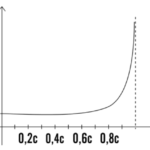
where v is the velocity of the body and c is the speed of light. As can be seen from the formula and from Figure 1 which traces its progression, γ increases as the velocity increases, but remains very close to 1 until the velocities are of the order of magnitude of that of light. For this reason, it is generally omitted, considering γ ≈ 1 . The asymptotic behavior of γ also highlights the difficulty of accelerating material bodies to speeds approaching that of light, whose inertia would have an equally asymptotic behavior.


Figura 1 (credits: youmath.it)
gamm


But the four-momentum also takes into account particles that have no mass, such as photons. From the intuition of Louis de Broglie (1892-1987), the wavelength of a photon is inversely proportional to its momentum:
λ = h / p
where h is Planck’s constant. Recalling that the photon’s energy can be expressed as:
E = hc / λ
it is easy to obtain the relation:
(3) E = pc

Einstein’s complete formula for the energy equation is therefore:
(4) E² = (pc)² + (mc²)²

It is easy to see how, in the case of a massless photon, (4) reduces to (3), the energy of the photon, and in the case of a non-moving particle, (4) reduces to (1), the energy of matter at rest. In the case of a moving body, both the energy due to the movement and the energy at rest must be taken into account, i.e. relation (2).


  • A four-vector is a four-dimensional vector defined in (relativistic) Minkowski (Hermann Minkowski 1864-1909) spacetime. It unifies a temporal quantity and the three corresponding spatial quantities (for example, time and space, or energy and momentum) into a single mathematical object.
    Its fundamental characteristic is that its magnitude (its length) remains unchanged for every observer, ensuring that the laws of physics remain the same even when observed from reference frames in relative motion to each other.
please, rate this post

Ontology vs. Epistemology of Time

My belief is that time does not exist in Nature.

To understand how time can be nonexistent in Nature while general relativity (GR) remains valid, it is necessary to distinguish between what the world is and how we describe it:
– Ontological Plane (Nature): Reality is an accident of events according to a ‘grammar’ of cause and effect. In this view, time does not exist as an external container or clock; there is only the logical necessity that certain events presuppose the occurrence of others. Nature does not ‘wait’ for time to pass: it acts according to an intrinsic causal ladder.
– Epistemological Plane (GR): General Relativity is our logical ‘map’. Since the human mind cannot perceive the entire network of atomic and discrete events, it uses the construct of spacetime to organize, measure, and, above all, predict.

Causality as the Skeleton of GR
In physics, the causal structure of a manifold is defined by the set of precedence relations between events. If Nature operates according to a ‘causal ladder’ (A must precede B), GR encodes this necessity through the metric tensor*.
The fact that GR ‘works’ means that its mathematical architecture faithfully respects the logical sequence of natural events. The coordinated time t of GR is nothing more than a numerical index that we assign to events to keep track of their causal succession.

Predictability vs. Occurrence
The difference between the anthropic and natural visions lies in the concept of determinism vs. necessity:
– For Nature: Things happen when they are meant to happen. There is no delay or waiting; there is only the satisfaction of causal conditions.
– For Human Beings (GR): We need predictability. For us, it is not enough to know that B will follow A; We want to know when (according to our parameters) and where. GR introduces tools like Cauchy hypersurfaces to allow us to calculate the ‘future’. This computational capacity is a human need: Nature does not calculate its next state, it simply executes it.

GR as a relational model
GR remains valid because it describes how matter-energy influences the configuration of causal links. Even if we eliminate the idea of ​​a ‘container’ time, GR continues to tell us how the logical proximity between events is altered by the presence of mass. In this sense, the curvature of spacetime is not the deformation of a ‘time substance’, but the deformation of the network of causal relations that constitutes the world.

In short: Nature is the ‘ladder’ of facts, GR is the technical manual that humanity has written to index that ladder and transform it into prediction.


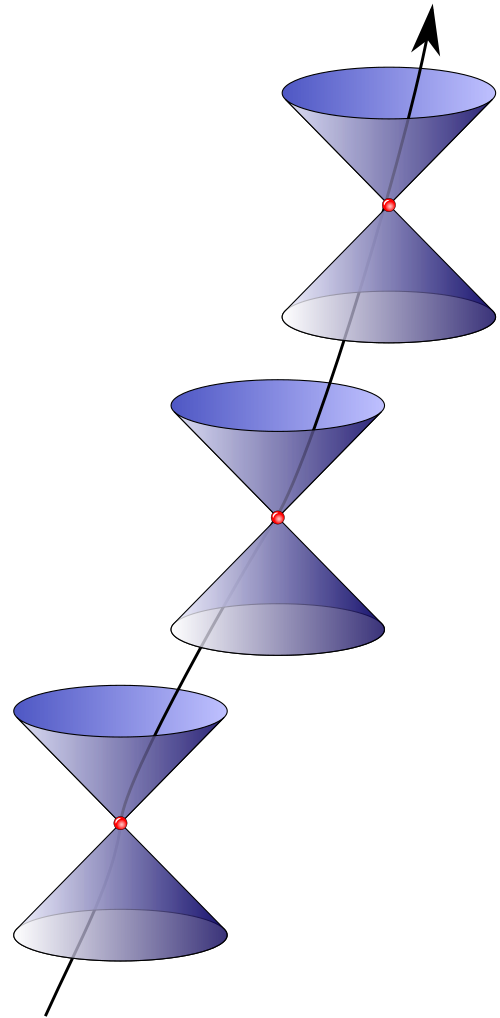
Universe line (credits: wikipedia)


universe line


* The Metric Tensor (gμν)
Mathematically, a tensor can be understood here as a matrix that establishes how coordinates—representing spacetime events—transform from one reference frame to another while preserving physical invariants. The metric tensor specifically dictates the geometry of this manifold. In every point of the universe, it acts as a local ‘ruler’ and ‘chronometer’ by defining the spacetime interval (ds2 = gμνdxμdxν). Most crucially for causality, it shapes and tilts the light cones, which delineate the absolute geometric boundaries beyond which information cannot travel. Therefore, the metric tensor is the mathematical structure that translates the causal sequence (event A preceding event B) into the invariant fabric of spacetime geometry.

please, rate this post

The Stage of Reality – Why gravity is not a force and the speed of light is not a speed

Introduction
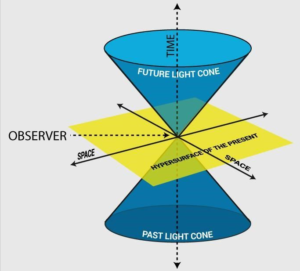
What we are about to explore is what I call ‘the stage of reality’, the place where we, and everything around us, move (a trivial side note: nothing is truly ‘at rest’ in our universe, as there is no absolute reference frame against which to measure motion). This stage is what we call spacetime, composed of the three familiar spatial dimensions plus time, which is simply an additional dimension. We cannot ‘visualize’ it unless we imagine removing one of the spatial dimensions, as seen in the famous Minkowski diagrams (see Figure, Hermann Minkowski, 1864-1909).
It was Albert Einstein (1879-1955), in his brilliant work in the early 1900s, who viewed the universe not as an empty space where time flows separately, but as a single four-dimensional context. These dimensions are inextricably linked by a metric governed by the laws of gravitation. In this scenario, time is not an external clock, but a real direction in which we move, just as we move North or South, to put it in geographic terms.

Gravity
Why is the force of gravity not a force? For centuries, thanks to Isaac Newton (1643-1727), we thought of gravity as a kind of ‘invisible hand’ that ‘pulls’ objects. But if we apply what Einstein called the equivalence principle (which he described as “the happiest thought of my life”), we discover a fundamental concept. He imagined being in an elevator in deep space, far from any gravitation, accelerating upwards (remember that acceleration is the variation of velocity). You would feel pressed to the floor exactly as you do on Earth. If you were to release Newton’s legendary apple, it would ‘fall’ toward the floor. Yet, there is no gravity ‘pulling’ it; there is only acceleration. Einstein realized that gravity is not a force acting in space; rather, the effect we observe and call ‘force’ is the consequence of the curvature of spacetime itself. In fact, the presence of mass —or rather, mass-energy, since they are the same thing except for a conversion factor (the famous E=mc² )— warps the fabric of spacetime like a weight on an elastic sheet. For example, the Earth, with its concentration of mass-energy, creates a geometric deformation: the apple doesn’t fall because a force pushes it, but because it is simply following the straightest possible line (called a geodesic) in a space that has become curved.
According to Newton’s laws of motion, a body with no forces acting upon it moves with uniform rectilinear motion (respecting the principle of inertia). According to Relativity, an apple falling in a gravitational field is, paradoxically, the only object experiencing no force at all (respecting the principle of inertia). To quote Einstein again: “Matter [mass-energy] tells spacetime how to curve, and spacetime tells matter how to move.”

Light
Now let’s consider light. We attribute a ‘speed’ to it (which we define as a change in position), but as physicist Leonard Susskind (1940-) explains, it is not a speed in the common sense of the term (like that of a car). Instead, it is a fundamental property of the geometry of spacetime —a simple ‘conversion factor’ between spatial and temporal coordinates.
In the four-dimensional universe in which we exist, space and time are different directions of the same thing, and  c  is the number that tells us how many meters are equivalent to one second. That is: time=space / c .
The value of the universal constant c is approximately 300,000 km per second, or just over a billion km per hour (approx. 1.08 billion km/h).
Susskind’s profound suggestion is that every object in the universe always and constantly moves at the exact same speed:
– When we are ‘still’ in space—for instance, sitting in our chairs—we are traveling at the speed of light along the axis of time
– If we start moving through space, we must ‘subtract’ speed from time to compensate for the spatial movement (as if paying a toll using the conversion factor, ). From this, the relativistic time dilation is derived (e.g., the twin paradox).
There are no variable speeds; there is only a distribution of the ‘total speed’ among different dimensions. Therefore, light isn’t ‘racing’: we could say that light spends its entire ‘allowance’ on space, leaving zero for time, based on the conversion factor c .
This constant —the speed of light— is the geometric limit of what can happen in the universe.

Conclusions
There is, therefore, no speed limit; there is only a global geometry in which we are all immersed. Gravity is the curvature of the road; the constant holds together the very fabric of the reality surrounding us. Physics does not describe ‘what happens’, but describes the geometric structure in which everything is already contained.
Understanding this means stopping looking at ‘things’ that move and starting to look at the shape of the stage on which they move.


A Minkowsky diagram (credits to medium.com)

MInkowsky diagram

please, rate this post

The URD Framework – under development

The URD Framework: Cosmological Distances from Redshift in a Non-Standard Context

While I am still developing the project —including through parallel studies on the Tolman test and the quality of indirect data obtained from recent galaxy surveys— I am making my work public as a preprint. I always hope that someone might be interested in my conjectures or perhaps even willing to collaborate with me to address the critical issues of the URD Framework.


Abstract
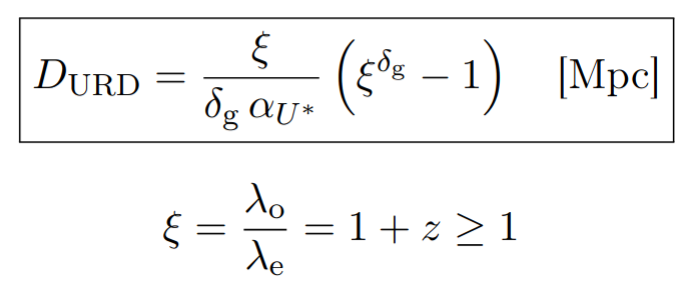
A phenomenological framework for determining cosmological distances is proposed, based on a non-expanding spacetime interpretation consistent with current observational datasets. The model introduces a redshift mechanism associated with cumulative photon energy attenuation along the line of sight, formulated in a way that is not equivalent to standard tired light scenarios. The approach is constructed to remain compatible with established relativistic principles whereas adopting boundary conditions distinct from the metric expansion paradigm. Distance estimation is achieved through the URD equation (U energy density, Redshift, Distance), which incorporates two phenomenological parameters that describe conformal geometric dissipation in extended gravity and an effective relativistic path-length correction. Within this formulation, the model addresses the primary shortcomings traditionally associated with energy dissipation effects, specifically reconciling time dilation in supernova light curves and the Tolman surface brightness relation. The model is calibrated using the Pantheon+ supernova sample by comparing and cross-validating distances inferred from the proposed redshift mapping with redshift-independent indicators, with additional comparison performed against baryon acoustic oscillations, radio galaxy samples, and high-energy quasars. Across these datasets, the framework reproduces observational constraints over a wide redshift range within a phenomenological, non-standard cosmological setting. The results indicate that alternative, non-expansion-based mappings between redshift and distance can be constructed that remain consistent within the observational range considered, suggesting a phenomenological alternative worth further study.
Keywords
cosmological distance ladder; redshift-distance relation; non-expanding spacetime; cosmic microwave background; extended gravity; Pantheon+ sample; baryon acoustic oscillations; Tolman test; time dilation; geodetic correction


Here is the last version of the preprint (5.1 MB):

pdf Brussi 2026_URD Framework Preprint

Version uploaded to Zenodo:

link DOI – zenodo.20763682


URD distance formula

please, rate this post

Cosmology for a static universe

Abstract

This brief work, then became an Appendix to my URD Framework study, proposes a cosmological model characterized by a globally flat, spatially infinite, and non-time-limited spacetime. It challenges the standard application of the Friedmann-Lemaître-Robertson-Walker metric by reinterpreting general relativity as a strictly local phenomenon within a non-continuum matter distribution. In this framework, the observed flatness of the universe is a fundamental geometric property rather than a dynamical result of inflation, and cosmological redshift is modeled as a cumulative energy dissipation process rather than metric expansion.

pdf  Brussi 2026_Cosmology for a static universe


gravitational emotion

Ai generated image from free Adobe stock

please, rate this post

The Boltzmann Brain – an epistemological provocation

The Boltzmann Brain  (Ludwig Boltzmann, 1844-1906) is one of the most unsettling thought experiments in modern physics, sitting right at the intersection of thermodynamics and the philosophy of mind. It suggests a provocative paradox: in an infinite universe governed by entropy, it is statistically more likely for a single, self-aware brain to spontaneously flicker into existence -complete with false memories of a life it never lived- than for an entire structured universe to evolve over billions of years.
At its core, this concept challenges our very definition of reality. If we are more likely to be a random ‘fluctuation’ in a sea of chaos than biological products of a long evolutionary chain, how can we trust our observations of the cosmos? It’s not just a puzzle about physics; it’s a fundamental question of epistemology: how do we know we are truly part of a stable universe and not just a fleeting thought in the void?

It’s impossible not to think about the brilliance of The Matrix.
But while The Matrix asks us to choose between a comfortable lie and a harsh truth, the Boltzmann Brain suggests that truth might not be a structure at all, but rather an accidental flash of order in an ocean of nothingness. In both scenarios, the epistemological question remains the same: if your senses and memories were the only data you possessed, how could you ever prove you aren’t just alone in a timeless void?


blue red

please, rate this post

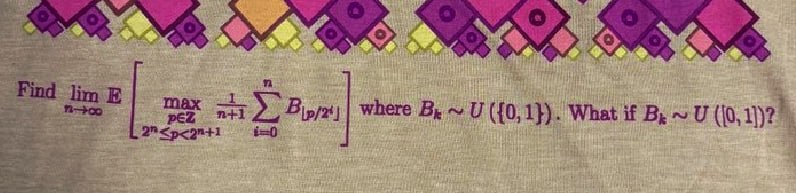
A wearable math problem

I was given this problem, printed on a T-shirt handed out at a math conference.
Below is my answer to the first part, which I believe is correct.
Does anyone know the answer to the second question as well?


math shirt


The defined structure is a ‘binary’ fractal because it divides into two parts each time.
The first question is to find the maximum expected value for the average of the values encountered when traversing the entire structure, as the number of subdivisions approaches infinity, if the values 0 or 1 are randomly assigned to each small square. That is, the maximum average value obtainable by following one of the paths.
[One path could be, for example, 1+0+1+0+1+0+0+1+1+1+…, another 1+1+1+1+1+1+1+1+1…]
Since the subdivision is binary, the chance of getting a 1 each time is 1/2 (one in two). But the number of paths grows at the same rate at which the probability decreases (doubling at each step), so it should always be possible to find a path where all the squares contain 1s; therefore, I would say the answer for the maximum of this expected value is “1”.
The following “what if” question, however, asks for the same expected value not for two discrete values, {0, 1}, but for the continuous values of the interval [0, 1] …
Not trivial… the chances of obtaining a number are no longer as simple as the 1 in 2 from before…


please, rate this post