The Boltzmann Brain – an epistemological provocation

The Boltzmann Brain  (Ludwig Boltzmann, 1844-1906) is one of the most unsettling thought experiments in modern physics, sitting right at the intersection of thermodynamics and the philosophy of mind. It suggests a provocative paradox: in an infinite universe governed by entropy, it is statistically more likely for a single, self-aware brain to spontaneously flicker into existence -complete with false memories of a life it never lived- than for an entire structured universe to evolve over billions of years.
At its core, this concept challenges our very definition of reality. If we are more likely to be a random ‘fluctuation’ in a sea of chaos than biological products of a long evolutionary chain, how can we trust our observations of the cosmos? It’s not just a puzzle about physics; it’s a fundamental question of epistemology: how do we know we are truly part of a stable universe and not just a fleeting thought in the void?

It’s impossible not to think about the brilliance of The Matrix.
But while The Matrix asks us to choose between a comfortable lie and a harsh truth, the Boltzmann Brain suggests that truth might not be a structure at all, but rather an accidental flash of order in an ocean of nothingness. In both scenarios, the epistemological question remains the same: if your senses and memories were the only data you possessed, how could you ever prove you aren’t just alone in a timeless void?


blue red

please, rate this post

Odifreddi’s Lucretius

Perhaps I will not add anything about an author who has demonstrated not only competence but also genuine originality in many of his works, but I want to write this review, trying not to slip into apologetics.
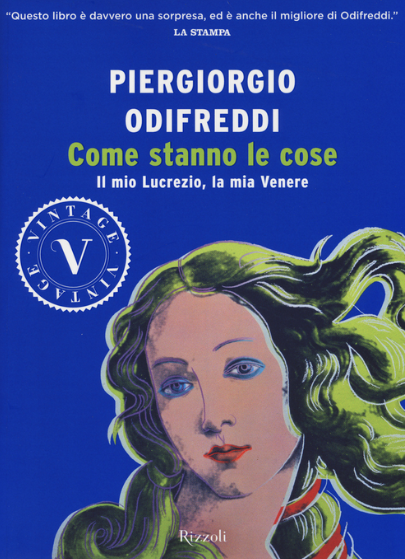
I am referring to Come stanno le cose. Il mio Lucrezio, la mia Venere, an essay (published by Rizzoli, 2014) by Piergiorgio Odifreddi (1950–), who, in a new complete translation of the poem De rerum natura by Titus Lucretius Carus (98/94–50/55), provides a version in modern words and meanings—not only to make it easier to understand ideas conceived two millennia ago, but above all to highlight their incredible modernity. An excellent conception of the work and an excellent execution, in which the translation on the right-hand pages and the interpretation on the facing pages make it possible to appreciate both the ideas that today we would call scientific and the philosophical visions of a great author.

In high school (a scientific high school) De rerum natura was the subject of a (mild) in-depth study (though we were required to buy a book about the poem, which I still keep). But our teacher was not able to convey its greatness and meanings, surely because he had not understood them himself, with the partial excuse that the ‘literal’ translation by someone who, perhaps like him, being wholly incompetent in scientific matters, was not even able to sense how, in recent centuries, science has confirmed some old intuitions, obviously at the level of general principles.

Odifreddi’s work, therefore, not only restores Lucretius to his full stature, but also tries to fill a gap that is perhaps typically Italian, where scientific culture has always been little widespread and little valued. This has not prevented excellence, of course, but Italians’ general lack of competence on scientific and technical topics is limiting in a modern world founded above all on technology. I realize I do not know the situation well in other countries, but my thought was also tied to the ‘historical responsibility’ of being part of a land that is a ‘cradle of civilization’ and of thought, now reduced to a third-rate caricature in geo-economic and political balances, unworthy of a cultural heritage that has no comparable equal in the world. A heritage that must be rediscovered, overcoming the obscurantist inertia of a ruling class inadequate to its role. And I am not referring only to the current one, except in the sense that, being in office, they are the only ones who could do more than a little to change things.

Perhaps it is a small gesture, Odifreddi’s, but it is an excellent achievement that deserves to be known.


Odifreddi Lucrezio

please, rate this post

17 February 1600 – the burning of Giordano Bruno

In Rome, in Campo de’ Fiori, one of the countless murders perpetrated throughout history for conquest and, as in this case, for maintaining imperial power over free thought and ultimately over peoples.
That the killing of the enemy has always been an anthropic standard is evident. Borrowed, as a degeneration, from the animal struggle for survival, to the point of turning it into a ‘moral rule’. Yet the physical violence of domination by the stronger is still understandable in a confrontation ‘on equal terms’. In ancient wars soldiers faced each other directly. Then, perhaps, the victors also abused civilian populations, but in some way they had demonstrated a physical superiority, at least in violence.

The qualitative leap to the suppression of ideas, ideas that differ from the theoretical framework of those in command, is typical of religions, which have often provided a moral and identity-based framework of legitimation for the violence of political and economic powers.

Starting from the common celebratory dating of an event of a religious nature (sun worship later becoming the birth of the ‘son of a god’), one underestimates the conditioning power of religions, namely of those responsible for managing religious sects, founded on the human weakness of the need for a superior being and for its interpreters. Each one claiming to be the bearer of the only truth, incidentally different from that of the others. All fine, if it ended there. But when a different idea is not confronted with better ideas, but by suppressing the bearer of the idea, what is at stake is not truth: what is at stake is power.

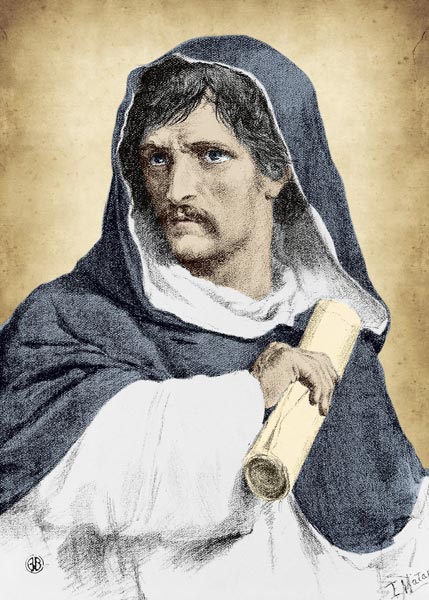
Nature is incredibly violent in its evolution, just think of a volcano or an earthquake on our small planet, or, with infinitely greater power, the explosion of a supernova or a black hole, or the gravitational merger of galaxies. We cannot apply criteria of morality or justice to Nature in events that vaporize entire planets in a few instants. But we can to the bipedal mammals of this mild and quiet planet. Endowed with the faculty of rational thought, we should respect this potential in others in order to respect it in ourselves. Yet the ambition for the power of domination has always won by a landslide. And so the bearers of opposing ideas, of a freedom of thought that could weaken one’s own positions as monopolists of ‘truth’, are killed, if possible amid atrocious suffering. Thus small, petty little men of a sect which, in the name of a revealed truth, resorted to coercion and to the killing, after years of imprisonment, of a visionary genius such as Giordano Bruno. Fortunately, however, he managed to pass on to us his thoughts, his visions, still relevant after more than four centuries.

And religious sects are still active today in many parts of the world and, by merging with political power, they become coercive apparatuses that often translate into systematic persecutions and violence—now industrialized in modern ways, but always with the same aim: the suppression of people’s freedom and of ideas, to impose their own dominion through violence and not comparing better ideas on a rational level.

For a more in-depth look at the life and thought of Giordano Bruno, the Wikipedia page is comprehensive.
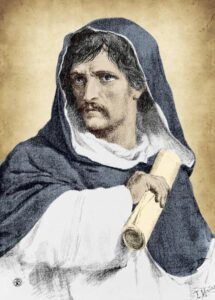

Giordano Bruno
Giordano Bruno (source copia-di-arte.com)

please, rate this post

Changing perspective: Einstein between Kant’s certainties and Hume’s doubts

We can imagine the context in which Albert Einstein’s Gedankenexperimente (thought experiments) were born: the study of philosophy. To dismantle the idea that space and time were the same for everyone, the young physicist had to engage in an intellectual duel with two giants of thought: Immanuel Kant and David Hume.

Kant’s legacy: space as an objective necessity
From an early age, Einstein had studied Kant in depth, and from him he learned a fundamental concept: we are not passive spectators of the world; our mind does not simply record reality, but actively processes it. Kant argued that space and time are internal structures of the mind, the necessary conditions for having any experience at all. See also my post Kant and Space.
This idea was crucial for Einstein because it helped him understand that science is not merely a collection of data, but a construction of reason. However, the limit of Kant’s thought lay in the claim that these structures must be rigid and identical for every rational being. For Kant, space was only the one described in Euclid’s geometry books, and time was a universal flow, the same for everyone.

Hume’s inspiration: the courage to doubt
When Einstein began working on his thought experiments about light, he realized that Kant’s ‘fixed rules’ no longer worked. To move beyond them, David Hume’s philosophy was certainly of help.
Hume was a radical philosopher who urged people to take nothing for granted. His motto was simple: if a concept cannot be verified by the senses or through a concrete measurement, then it is suspicious. Hume taught Einstein to have the courage to doubt concepts that seem obvious to ‘common sense’. Einstein was aware that no one had ever measured ‘absolute time’, flowing identically for all; it was only a belief grounded in habit, not in physical evidence.

The synthesis: Relativity is born
Without the support of Hume’s skepticism, Einstein might not have had the audacity to question time. He understood that if the speed of light must remain constant, then time and space must be able to change depending on the speed of the observer (the principles of Special Relativity).
In this way, Einstein went beyond Kant using Hume’s method: he retained the Kantian idea that the mind must create categories to read the world, but he showed that these categories are not immutable. Space and time are not unchanging a priori forms, but physical quantities that can contract or stretch.

Einstein was thus a philosopher among physicists. He learned from Kant that the mind must anticipate reality (that is, describe it even before physical observations) with a coherent theoretical model, but he learned from Hume that no idea is untouchable. In this way, he found the courage to understand that if old theories had become full of gaps or incapable of describing the universe in a unified (that is, invariant) way, one had to have the audacity to redesign the very structure of thought itself, even before the facts forced it.


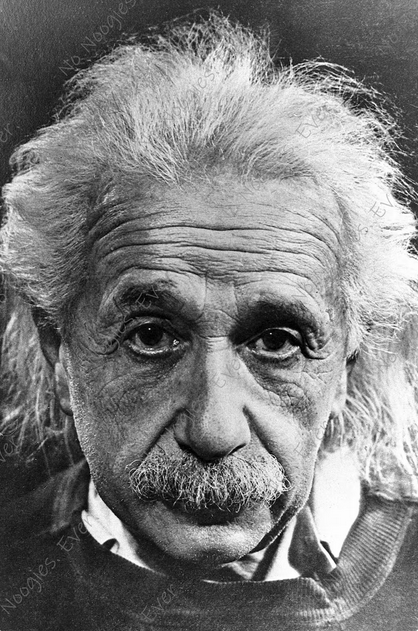
Albert Einstein

please, rate this post

Kant and Space

The redefinition of the concept of space is one of the revolutionary foundations thought of Immanuel Kant (1724-1804): the abandonment of the common, Newtonian-derived idea of space as an absolute entity or an objective ‘container’ of reality. Kant addresses the problem within the Transcendental Aesthetic, the section of the Critique of Pure Reason devoted to sensibility. He distinguishes a metaphysical exposition, which establishes the a priori nature of space, and a transcendental exposition, which derives from it space’s role as a condition of the possibility of experience and of geometry.

Space as Pure Intuition
In contrast to empiricists, Kant argues that space cannot be derived from experience. In order to perceive an object as located in a place different from that occupied by another object, or simply as ‘external’ to us, we must already presuppose the representation of space. Therefore, space is not a general concept constructed by abstraction, but a pure a priori intuition:
– intuition: because it is not a logical construction, but an immediate and singular representation within which we place sensory data
– a priori: because it precedes every sensation and is its necessary condition.

Transcendental Subjectivity
This is the core of Kant’s ‘Copernican Revolution’. Kant claims that space does not belong to things in themselves (noumena), but is the form of outer sense. In other words, it is the way in which the human subject is structured to receive information from the world. This leads to a fundamental epistemological distinction:
– transcendental ideality: if we abstract from the knowing subject, space is nothing as a thing in itself; it has no autonomous existence outside our faculties and is not a determination of noumena
– empirical reality: at the same time, space has objective validity for all phenomena (for every possible experience), for every object that could ever present itself to our senses.

The Foundation of Geometry
Kant uses this view to explain, in a scientific context, the nature of geometry’s synthetic a priori judgments. He is, of course, considering only Euclidean geometry as a description of the space of experience, having lived half a century before Bernhard Riemann (1826-1866) and the development of elliptic geometry. If geometry is the science that studies the properties of space, and if space is the a priori form of our mind, then geometrical theorems will be universally and necessarily valid for all objects of experience. In short, geometry applies to the physical world not because the world is ‘geometrical by nature’, but because we can perceive the world only through a spatial structure that we ourselves project onto phenomenal reality.

In conclusion, for Kant space is not an object of physical investigation like others, but the condition of possibility of our experience. Without this subjective structure, the perception of the external world would be impossible.
Clearly, this Kantian interpretation should be reconsidered in light of the implications of elliptic geometry and of General Relativity, and of the consequences of Special Relativity. In General Relativity, Einstein showed that space is not merely a passive state of possibility, but a dynamic physical entity that bends under the influence of mass: space acts on matter, and matter acts on space. Special Relativity undermines the objectivity of spatial extensions: lengths are measures of objects, but ultimately they are measures of the spatial coordinate component parallel to the relative velocity between reference frames, which is not invariant. The requirement, as noted above, that this structure (space) be objective stands in sharp contradiction with the physical reality described by General and Special Relativity.

Quite simply, while Kant wanted to base science on philosophy, Einstein demonstrated that it is philosophy that must bow (and bend with General Relativity!) before the physical evidence of reality.

see also the post:
link  Changing perspective: Einstein between Kant’s certainties and Hume’s doubts


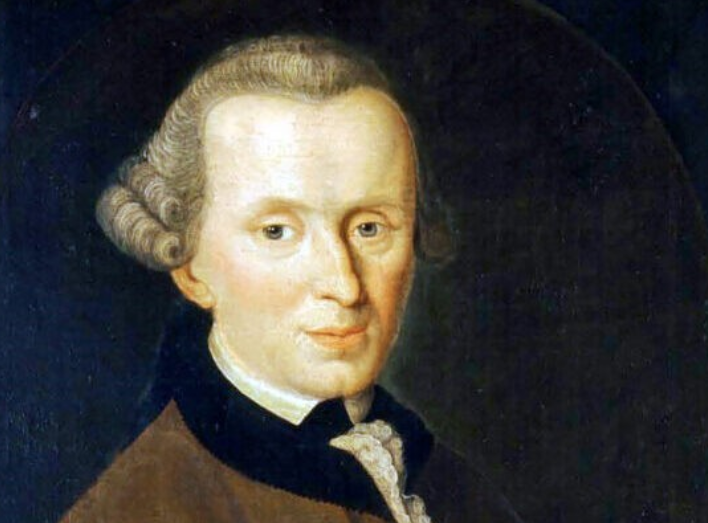
Immanuel Kant

please, rate this post

Schopenhauer on truth

Der Wahrheit ist immer nur ein kurzes Siegesfest beschieden, zwischen den beiden langen Zeiträumen, wo sie als paradox verdammt und als trivial geringgeschätzt wird.

“Truth is always granted only a brief victory celebration, between the two long periods of time where it is condemned as paradoxical and dismissed as trivial.”

Arthur Schopenhauer, Die Welt als Wille und Vorstellung, Leipzig: F.A. Brockhaus (1819)

An expression with an epistemological, not just philosophical, flavor. Schopenhauer’s thought, in fact, is dominated by cosmic pessimism, arguing that reality is driven by a blind and irrational force, the Will to Live, a source of perpetual suffering, since to will is to desire, and to desire means to lack and suffer. For him, existence is an oscillation between pain and boredom, and the paths to liberation are temporary (art) or permanent (compassion and asceticism), and deny the will itself, transforming non-will into the ultimate goal.

please, rate this post

Here I am

After a hiatus from 2021, I’m resuming my online presence with this small collection of suggestions, seeking intellectual dialogue. Let me know what you think in the comments or via email.
Thanks

p.s. I posted with the dates of the original documents


That's me

please, rate this post

My thesis work

My thesis work (written in italian) is published in the University of Padova archive:
pdf_ita  Brussi 2025_Epistemology of time and cosmological interpretations

As an appendix to the same thesis I put a first development draft of the non-standard framework, which, after significant revisions, later became my work
link  The URD Framework.


Abstract
The aims of this study on time are first to explore its ontological meaning in the historical developments that have accompanied its interpretative evolution, and then to examine some theoretical critical issues raised by recent literature. With some original theses, some alternative explanations for the expansion of the universe are then analyzed, which the current interpretation claims to be observed experimentally, by means of a model based on the ‘specific time’ of photons as an alternative to the ‘universal time’. Furthermore, it is hypothesized a model that considers the presence of an energy density in the cosmic fluid (called aether) that interacts with the incident radiation, thus determining a redshift effect in the wavelength, or an even longer time for the same radiation to diffuse. The consistency of ‘specific time’ has been verified with Minkowski spacetime, with Einstein’s principles of special relativity, and with Friedman’s equations of cosmic dynamics. Having demonstrated the fallacy of this ‘specific time’ hypothesis, the positive conclusion is that there is no need to postulate a universal time. Once one is defined, its uniqueness or universality can be demonstrated (within the limits of the adopted models). To complement the study, possible causes of the redshift, alternative to the standard cosmological model, were analyzed. It has been taken in consideration the hypothesis that the same universe behaves like a black body, emitting a radiation (the cosmic microwave radiation) that can interact with the observed photons coming from remote sources, attenuating their energy and determining their redshift. A cross section for photons, and a model for photon-photon interactions that respects the law of conservation of energy have therefore been hypothesized. As a basis for the conjectures, direct observational evidence was considered, not interpreted by means of theories, obtaining (from the comparison with other standard candles) better distance estimates than the official ones based on Hubble’s law. This addendum is included as an Annex, believing that the same conjectures and some original models can represent a reference for future in-depth studies.

The work is written in Italian (1.8 MB):

pdf_ita  Brussi 2025_Epistemologia del tempo e interpretazioni cosmologiche

please, rate this post