Galactic Energy Profiles II

Galactic Energy Profiles: GEP II. In-System and Background Energy Densities

Aggiornamento: Ho deciso di pubblicare questo lavoro, parte della serie GEP, su Zenodo senza revisione paritaria e di utilizzarlo come base per la creazione di un successivo dataset (GEP III). Nota: questo lavoro (in inglese) è la versione 2.0 del precedente lavoro NAGE II, che è superato.


Abstract
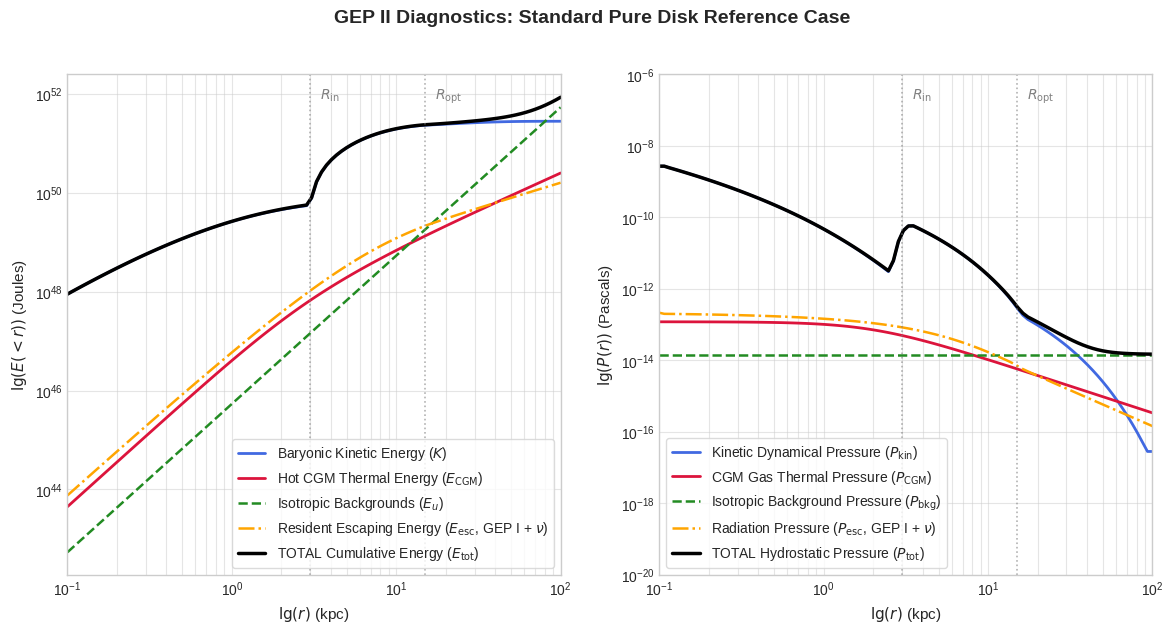
Standard galactic energy inventories typically focus on virialized components, namely kinetic and gravitational potential energy derived from baryonic mass distributions, together with energy inferred from bolometric luminosities. In the first paper of the Galactic Energy Profiles (GEP) series, we introduced a reproducible geometric framework for the radiant and relativistic fluxes of galactic origin, accounting for their finite escape time across the Halo. In this second work, we extend the framework toward a volumetric energy inventory, where bolometric luminosity is complemented by energy densities persistently present within the galactic volume. We consider the thermal and kinetic energy of baryonic matter—including bulk motions, turbulence, and rotational degrees of freedom from large-scale dynamics down to the intrinsic angular momentum of bound systems—together with cosmic rays confined by magnetic fields and extragalactic backgrounds (photons, neutrinos, and diffuse fields) permeating the Halo. This approach distinguishes between flux-based contributions and volume-based reservoirs, providing a complementary description of the total galactic energy budget. Crucially, by resolving these volumetric reservoirs into local radial profiles, we characterize the multi-component pressure support (including thermal, magnetic, cosmic ray, and radiant pressures) available to sustain the circumgalactic medium (CGM) in hydrostatic equilibrium. Although these components vary with morphology and evolutionary state, this study is purely theoretical and simplifies the extreme variability of galactic systems to derive reference estimates and ‘standard cases’. The resulting parametrized framework, supported by publicly available Python scripts, is intended as a further methodological baseline for the sample-wide application planned in later work.

Keywords
galactic energy inventory; galactic energy density; galactic Halo energy; energy distribution based on galactic morphology


Here is the Zenodo version of the paper (1.1 MB):

pdf Brussi 2026_GEP II


GEP_II

please, rate this post

Galactic Energy Profiles I

Galactic Energy Profiles: GEP I. Radiant and Relativistic Fluxes

Aggiornamento: Ho deciso di pubblicare questo lavoro, parte della serie GEP, su Zenodo senza revisione paritaria e di utilizzarlo come base per la creazione di un successivo dataset (GEP III). Nota: questo lavoro (in inglese) è la versione 2.0 del precedente lavoro NAGE I, che è superato.


Abstract
Standard galactic energy inventories typically focus on the virialized components of the system, namely the kinetic and gravitational potential energy, derived from baryonic mass distributions and stellar luminosity. This paper, the first in the Galactic Energy Profiles series, introduces a reproducible geometric framework for accounting radiant and relativistic fluxes as a standing energy reservoir. By considering the photon and neutrino escape time τ across the galactic Halo, we quantify the energy density of radiation currently in transit as a component of the total galactic budget, complementary to the standard flux-based description. The resulting closed-form expressions, together with the accompanying open-source Python implementation, are intended as a calibrated methodological baseline for the subsequent application of this framework to observed galactic samples.

Keywords
galactic energy inventory; energy residence time; galactic radiant fluxes; galactic Halo energy; galaxy morphology


Here is the Zenodo version of the paper (1.1 MB):
pdf Brussi 2026 GEP I


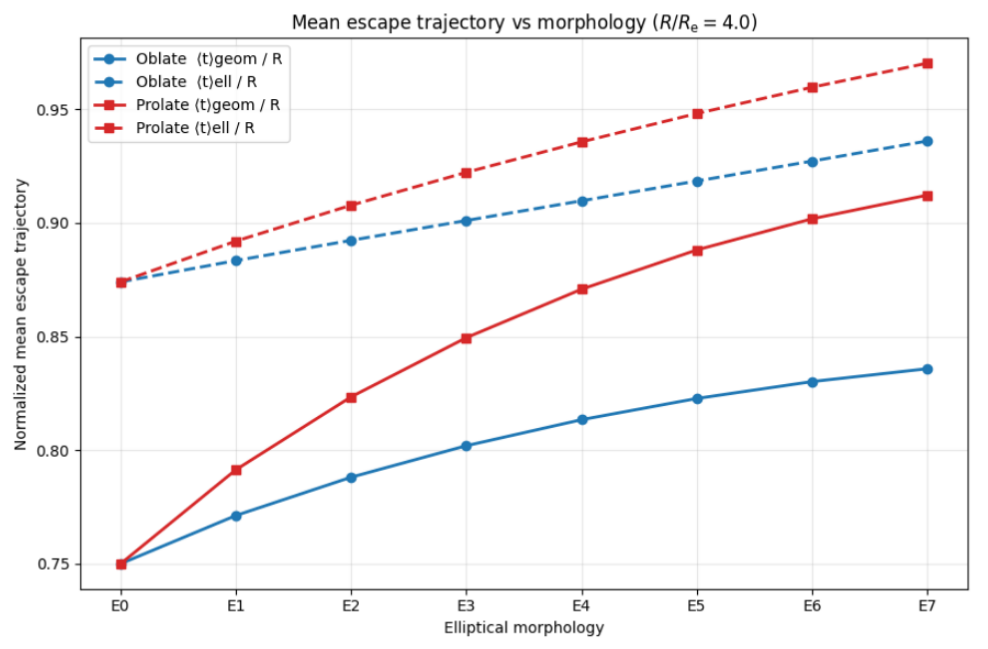
GEP I mean escape trajectory length

please, rate this post

The URD Framework – in sviluppo

La struttura URD: distanze cosmologiche dal redshift in un contesto non standard

Mentre sto ancora sviluppando il progetto, anche con studi paralleli sul Tolman test e sulla qualità dei dati indiretti ottenuti dalle recenti survey di galassie, rendo pubblico il mio lavoro come preprint. Spero sempre che qualcuno possa essere interessato alle mie congetture o magari anche disposto a collaborare con me per affrontare le criticità del modello URD. Lo studio è in inglese.


Abstract
A phenomenological framework for determining cosmological distances is proposed, based on a non-expanding spacetime interpretation consistent with current observational datasets. The model introduces a redshift mechanism associated with cumulative photon energy attenuation along the line of sight, formulated in a way that is not equivalent to standard tired light scenarios. The approach is constructed to remain compatible with established relativistic principles whereas adopting boundary conditions distinct from the metric expansion paradigm. Distance estimation is achieved through the URD equation (U energy density, Redshift, Distance), which incorporates two phenomenological parameters that describe conformal geometric dissipation in extended gravity and an effective relativistic path-length correction. Within this formulation, the model addresses the primary shortcomings traditionally associated with energy dissipation effects, specifically reconciling time dilation in supernova light curves and the Tolman surface brightness relation. The model is calibrated using the Pantheon+ supernova sample by comparing and cross-validating distances inferred from the proposed redshift mapping with redshift-independent indicators, with additional comparison performed against baryon acoustic oscillations, radio galaxy samples, and high-energy quasars. Across these datasets, the framework reproduces observational constraints over a wide redshift range within a phenomenological, non-standard cosmological setting. The results indicate that alternative, non-expansion-based mappings between redshift and distance can be constructed that remain consistent within the observational range considered, suggesting a phenomenological alternative worth further study.
Keywords
cosmological distance ladder; redshift-distance relation; non-expanding spacetime; cosmic microwave background; extended gravity; Pantheon+ sample; baryon acoustic oscillations; Tolman test; time dilation; geodetic correction


Questa è l’ultima versione del preprint (5.1 MB):

pdf Brussi 2026_URD Framework Preprint

Versione caricata su Zenodo:

link DOI – zenodo.20763682


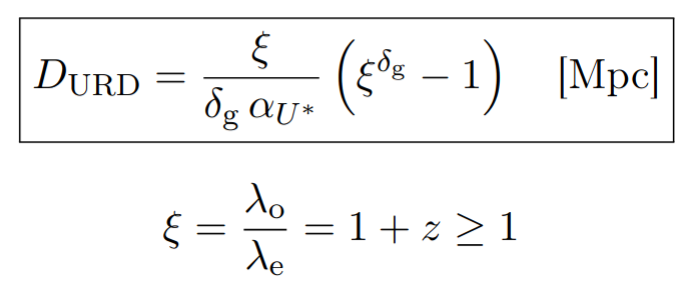
URD distance formula

please, rate this post

Tesi di laurea

La mia tesi di laurea (in italiano) è pubblicata nell’archivio dell’Università di Padova:
pdf_ita  Brussi 2025_Epistemologia del tempo e interpretazioni cosmologiche

In appendice alla tesi stessa, ho inserito una prima bozza di sviluppo del framework non standard, che, dopo una profonda revisione, è confluita nel mio lavoro
link  The URD Framework.


Abstract
Gli intenti di questo approfondimento sul tempo sono in primis esplorarne il significato ontologico negli sviluppi storici che ne hanno accompagnato l’evoluzione interpretativa, quindi esaminarne alcune criticità teoriche proposte dalla recente letteratura e, con alcune tesi originali, analizzare delle spiegazioni alternative all’espansione dell’universo, che l’interpretazione corrente pretende osservata sperimentalmente, per mezzo di un modello basato sul ‘tempo specifico’ dei fotoni alternativo al ‘tempo universale’ e di un modello che consideri la presenza di una densità energetica nel fluido cosmico (chiamato etere) che interagisca con la radiazione incidente e determini un effetto di redshift nella lunghezza d’onda, quindi ancora un maggior tempo per la diffusione della radiazione stessa. Del ‘tempo specifico’ è stata verificata la consistenza con lo spaziotempo di Minkowski, con i princìpi della relatività ristretta di Einstein e con le equazioni della dinamica cosmica di Fridman. Dimostrata la fallacia di questa ipotesi del ‘tempo specifico’, si è tratto come risultato positivo la non-necessità di postulare un tempo universale considerato che, definitone uno, se ne può dimostrare l’unicità o universalità (nei limiti dei modelli adottati). A integrazione dell’approfondimento, sono state analizzate possibili cause del redshift alternative alle dinamiche espansive dell’universo e si è considerata l’ipotesi che l’universo stesso si comporti come un corpo nero, emettendo una radiazione che possa interagire con i fotoni delle sorgenti remote attenuandone l’energia e determinandone un redshift, dopo aver ricavato una sezione d’urto per i fotoni che consenta le interazioni fotone-fotone. A fondamento delle congetture sono state considerate le evidenze osservative dirette, non interpretate per mezzo di teorie. Purtroppo non si è “chiuso il cerchio” con una spiegazione scientifica alle congetture presentate che fosse pienamente sostenibile, ma si riporta l’intero approfondimento come Allegato, ritenendo che le stesse congetture e alcuni modelli originali possano rappresentare un potenziale riferimento per futuri approfondimenti.

Tesi (1,8 MB):

pdf_ita  Brussi 2025_Epistemologia del tempo e interpretazioni cosmologiche

please, rate this post