La struttura URD: distanze cosmologiche dal redshift in un contesto non standard
Mentre sto ancora sviluppando il progetto, anche con studi paralleli sul Tolman test e sulla qualità dei dati indiretti ottenuti dalle recenti survey di galassie, rendo pubblico il mio lavoro come preprint. Spero sempre che qualcuno possa essere interessato alle mie congetture o magari anche disposto a collaborare con me per affrontare le criticità del modello URD. Lo studio è in inglese.
Abstract
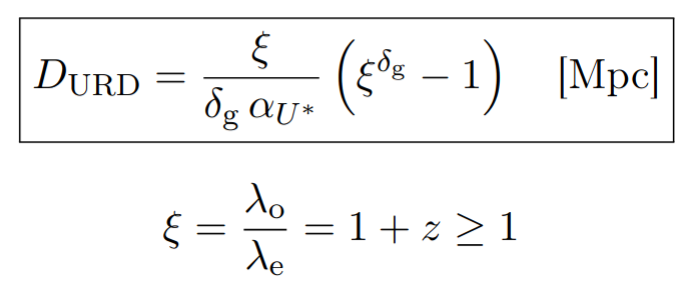
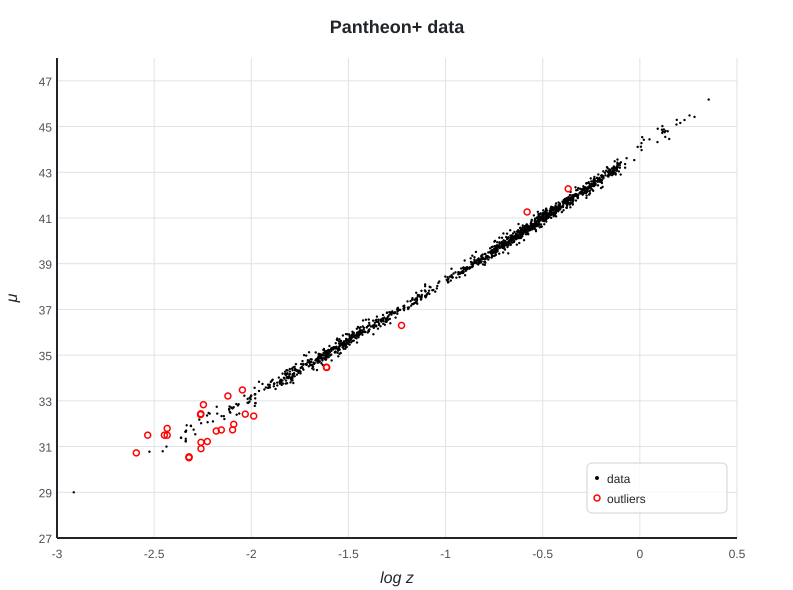
A phenomenological framework for determining cosmological distances is proposed, based on a non-expanding spacetime interpretation consistent with current observational datasets. The model introduces a redshift mechanism associated with cumulative photon energy attenuation along the line of sight, formulated in a way that is not equivalent to standard tired light scenarios. The approach is constructed to remain compatible with established relativistic principles whereas adopting boundary conditions distinct from the metric expansion paradigm. Distance estimation is achieved through the URD equation (U energy density, Redshift, Distance), which incorporates two phenomenological parameters that describe conformal geometric dissipation in extended gravity and an effective relativistic path-length correction. Within this formulation, the model addresses the primary shortcomings traditionally associated with energy dissipation effects, specifically reconciling time dilation in supernova light curves and the Tolman surface brightness relation. The model is calibrated using the Pantheon+ supernova sample by comparing and cross-validating distances inferred from the proposed redshift mapping with redshift-independent indicators, with additional comparison performed against baryon acoustic oscillations, radio galaxy samples, and high-energy quasars. Across these datasets, the framework reproduces observational constraints over a wide redshift range within a phenomenological, non-standard cosmological setting. The results indicate that alternative, non-expansion-based mappings between redshift and distance can be constructed that remain consistent within the observational range considered, suggesting a phenomenological alternative worth further study.
Keywords
cosmological distance ladder; redshift-distance relation; non-expanding spacetime; cosmic microwave background; extended gravity; Pantheon+ sample; baryon acoustic oscillations; Tolman test; time dilation; geodetic correction
Questa è l’ultima versione del preprint (5.1 MB):
 Brussi 2026_URD Framework Preprint
Versione caricata su Zenodo: