References for laymen: angles in the sky

The positions and the sizes of cosmological objects observed as projected onto a background sphere are measured in degrees, starting from reference orientations. This brief note aims to highlight the observational ‘measurements’ of certain cosmological objects, measurements that are rarely taken into consideration.
We imagine a simple observation of the night sky with the naked eye…

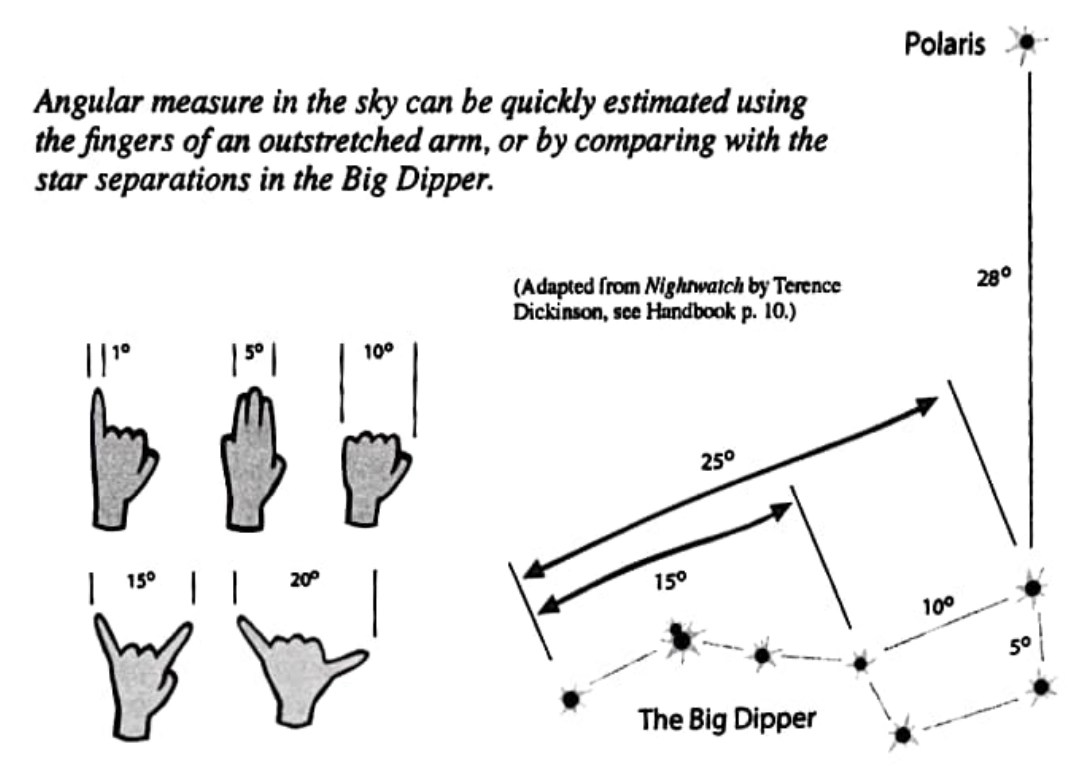
An approximate idea of the measurements in degrees can be obtained from Figure 1. Other references are the measurements of the Sun and Moon, both approximately 0.5° (which is why we have total solar eclipses).
Since they cannot be seen ‘at a glance’ because they are not very bright, we do not realize that some cosmological objects are actually ‘large’ in the sky.


Figure 1 – Easy reference for measuring angles in the sky (image credit: Nightwatch, Terence Dickinson)

For example:
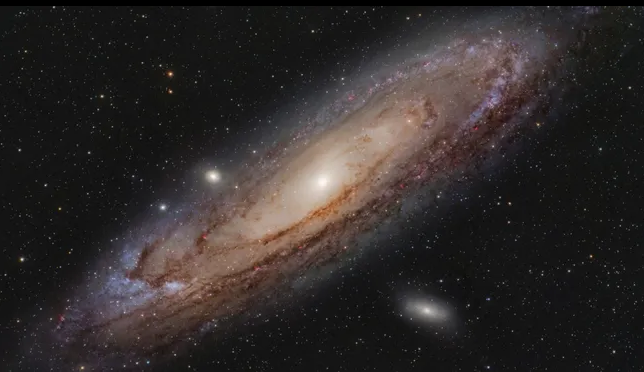
– the Andromeda galaxy (Figure 2) measures about 3° x 1° (so it is 6 times the size of the Moon)


Figure 2 – Andromeda galaxy (image credit: Westend61 via Getty Images)

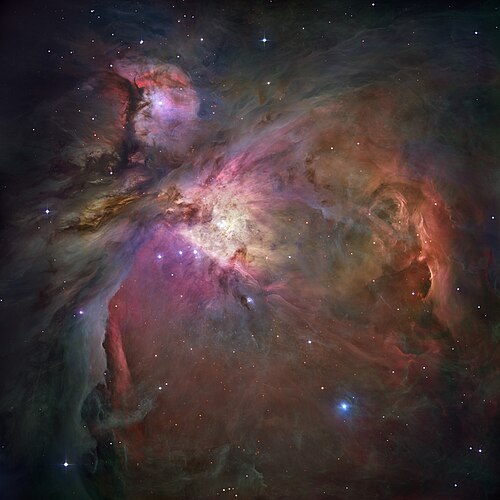
– the Orion Nebula (Figure 3, the star-forming region closest to us in our galaxy, about 1350 light-years away) measures about 1° x 1° (i.e., twice the size of the Moon)


Figure 3 – Orion Nebula (image credit: NASA/ESA’s Hubble Space Telescope)

– The Large Magellanic Cloud (Figure 4, visible in the southern hemisphere) measures approximately 11° x 9° (i.e., it is 22 times wider than the Moon).


Figure 4 – Large Magellanic Cloud (image credit: Spitzer Space Telescope by NASA)
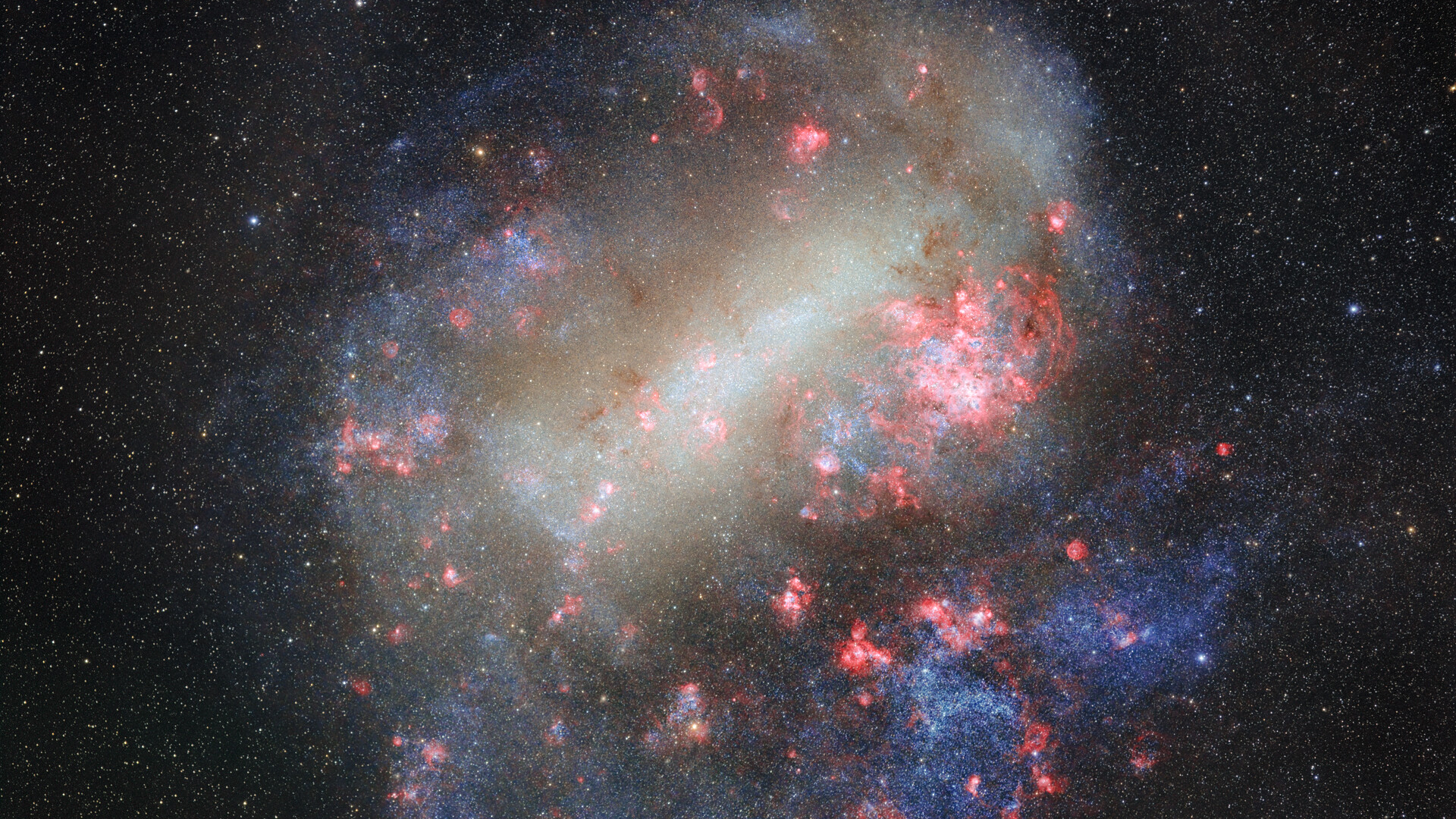
LMC


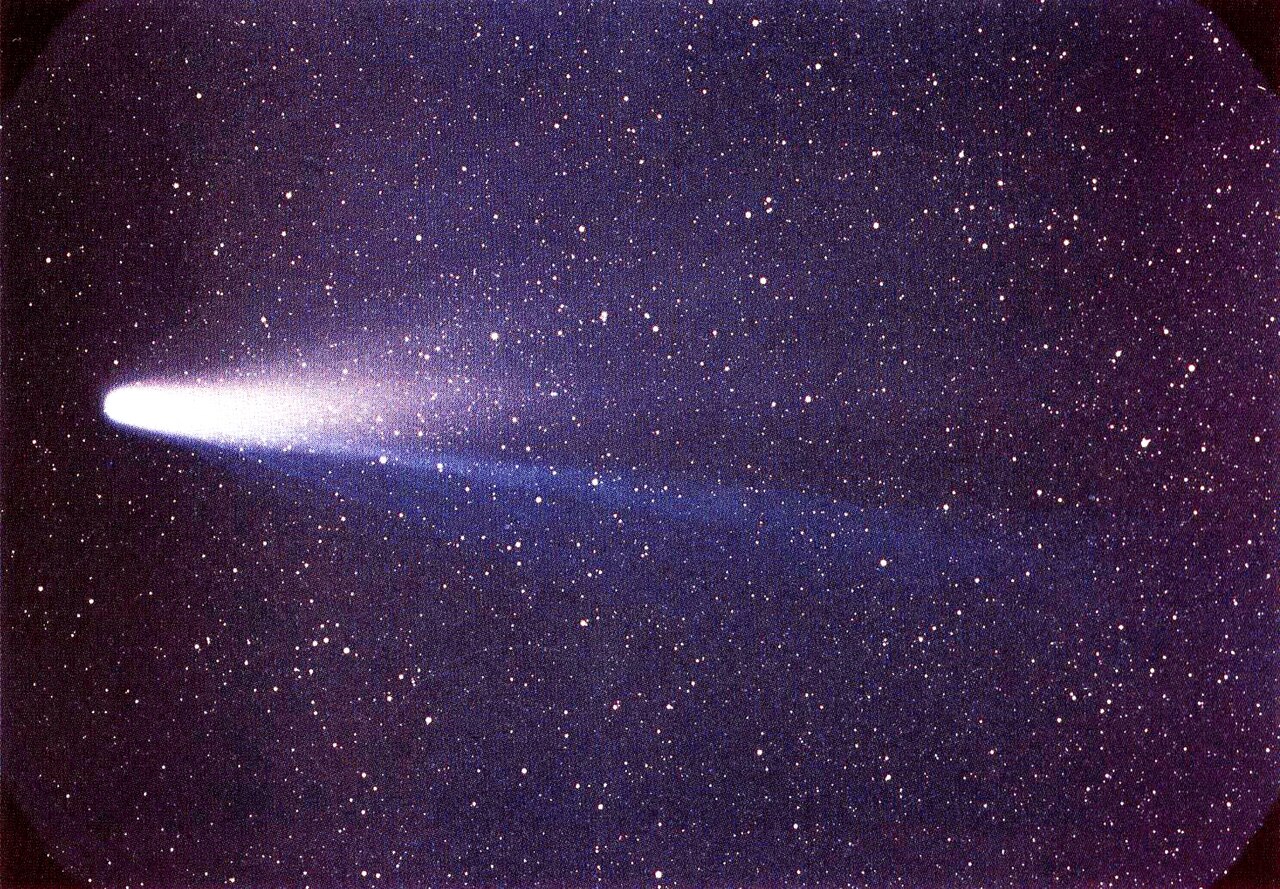
– Halley’s Comet (Figure 5), which passed by in 1986 (and will pass by again in 2061), measured a maximum of 15° (i.e., 30 times the width of the Moon).


Figure 5 – Halley’s Comet (image credit: W. Liller, Easter Island, part of the International Halley Watch IHW)

For comparison with the nearby planets in our solar system:
– Jupiter (whose diameter is about 11 times that of Earth) can reach a maximum of 50″ (or only 1/36 of the width of the Moon)
– Saturn (whose diameter is about 9.5 times that of Earth) can reach a maximum of 20″.


Credits: Teaching material for Spherical and Practical Astronomy course, Prof. Enrico Maria Corsini (University of Padua, Italy)

please, rate this post

Brief on Kramers’ Opacity Law in Stellar Astrophysics

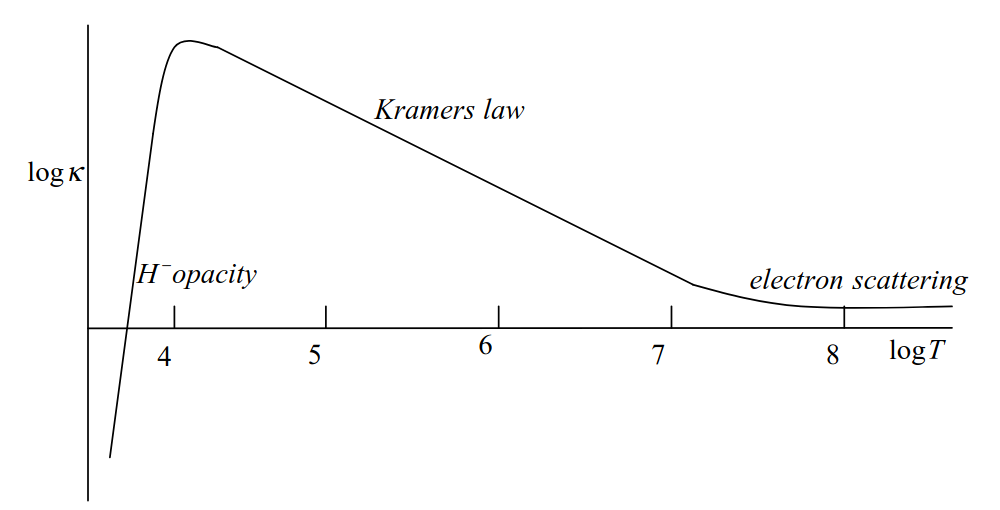
In stellar astrophysics, opacity  ( k ) is a measure of a material’s resistance to the flow of radiative energy. One analytical descriptions of this phenomenon is Kramers’ opacity law, a power-law relation derived from atomic physics that characterizes how stellar matter interacts with radiation under specific thermodynamic conditions.

pdf  Brussi 2026_Brief on Kramers’ Opacity Law in Stellar Astrophysics


please, rate this post

Chandrasekhar dynamical friction formula

Brief analysis of Chandrasekhar’s formula on dynamic friction in the general case of galactic encounters in the study of Galactic Dynamics.

Spoiler: we get a result for the dynamical friction timescale which means that in a time span of a few Gyr, for instance with the values of our assumptions applied to the Milky Way, the orbit of a massive satellite has substantially reduced, while the orbit of lower mass satellites (such as globular clusters) has not been significantly affected by dynamic friction.

pdf  Brussi 2026_Chandrasekhar dynamical friction formula


please, rate this post

Note for laymen – what is the dark matter?

Let’s consider a disc galaxy with billions of stars forming the disc, which rotates (the Andromeda galaxy in the photo, to give a well-known example). We can consider for each of these stars that the centripetal acceleration
[1]    a’ = v²/R
is equal to the gravitational acceleration
[2]    a” = G M/R²
therefore from  [1] = [2]  we obtain:
[3]    v = √(G M/R)
where  v  is the local velocity of the source considered,  R  is its distance from the galactic center,  G  is the gravitational constant,  M  is the total mass contained within the radius  R  (which determines the gravitational attraction).
Measuring the rotational velocities of galaxies is relatively easy, if they are not seen face on, and it is generally observed that throughout the disk the rotational velocities of the sources (stars but also gas clouds) are almost constant. Therefore, from relation  [3]  it follows that the mass  M  must increase in proportion to the radius  R , since  G  is a constant. Indeed, the mass contained within the radius  R  increases as  R  increases, but what is observed is not sufficient to justify the constant value of  v . These considerations leads to the hypothesis that there is a substance that is invisible and non-baryonic in nature (i.e., not made up of protons and neutrons, which are not detected) that manifests itself only through gravitational behavior, which is called dark matter.


Processed photograph of M31, Andromeda. It was not possible to obtain the author of this beautiful photograph.


Andromeda

please, rate this post

Ole Rømer and the finite speed of light

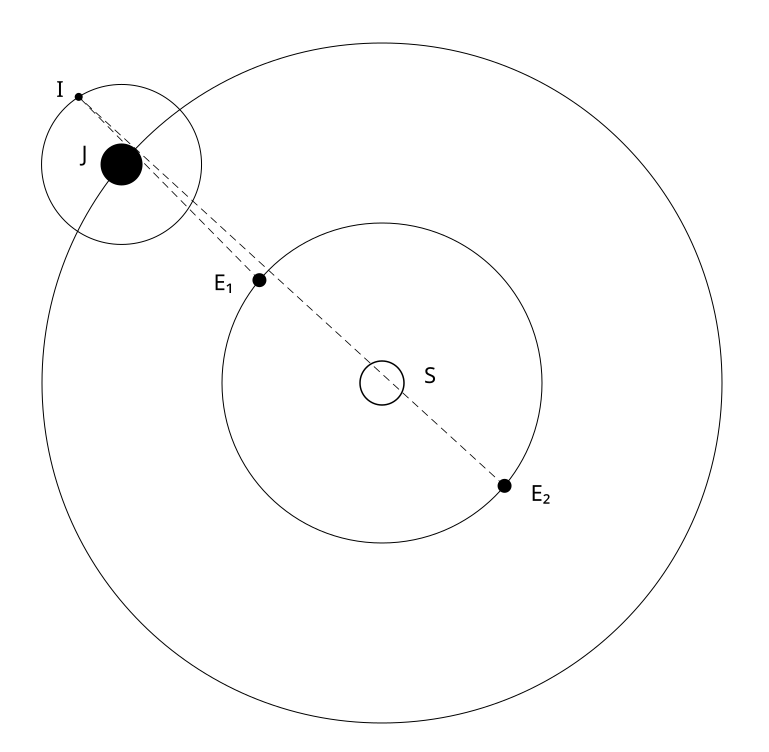
The first to observe that the propagation of light was not instantaneous was the astronomer Giovanni Domenico Cassini (1625-1712); the first to estimate its speed, in 1676, was the Danish astronomer Ole Christensen Rømer (1644-1710), both based their observations on the solar system.

pdf  Brussi 2026_Ole Rømer and the finite speed of light


please, rate this post

Schopenhauer on truth

Der Wahrheit ist immer nur ein kurzes Siegesfest beschieden, zwischen den beiden langen Zeiträumen, wo sie als paradox verdammt und als trivial geringgeschätzt wird.

“Truth is always granted only a brief victory celebration, between the two long periods of time where it is condemned as paradoxical and dismissed as trivial.”

Arthur Schopenhauer, Die Welt als Wille und Vorstellung, Leipzig: F.A. Brockhaus (1819)

An expression with an epistemological, not just philosophical, flavor. Schopenhauer’s thought, in fact, is dominated by cosmic pessimism, arguing that reality is driven by a blind and irrational force, the Will to Live, a source of perpetual suffering, since to will is to desire, and to desire means to lack and suffer. For him, existence is an oscillation between pain and boredom, and the paths to liberation are temporary (art) or permanent (compassion and asceticism), and deny the will itself, transforming non-will into the ultimate goal.

please, rate this post