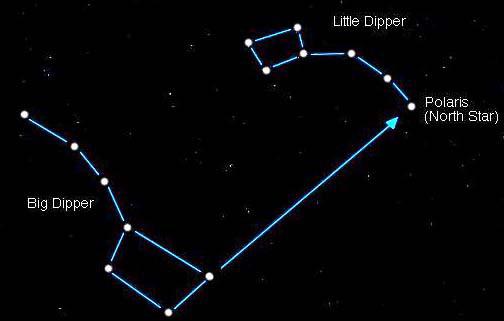
At night, everyone knows that North is roughly indicated by the North Star, which is easy to locate using the well-known asterism of the Big Dipper (and/or the slightly less prominent Little Dipper), see Figure 1.
Figure 1
During the day, however, the easiest direction to identify is South, which is accurately indicated by the Sun at its culminate point at noon every day of the year. Without having to wait for the culmination, knowing the time, you can estimate the direction of South by adding to the direction of the Sun at that moment (in the northern hemisphere, to the right in the morning and to the left in the afternoon) the angle missing to reach noon, considering 15° for each hour to midday (a full rotation of the Earth of 360° divided by 24 hours = 15°).
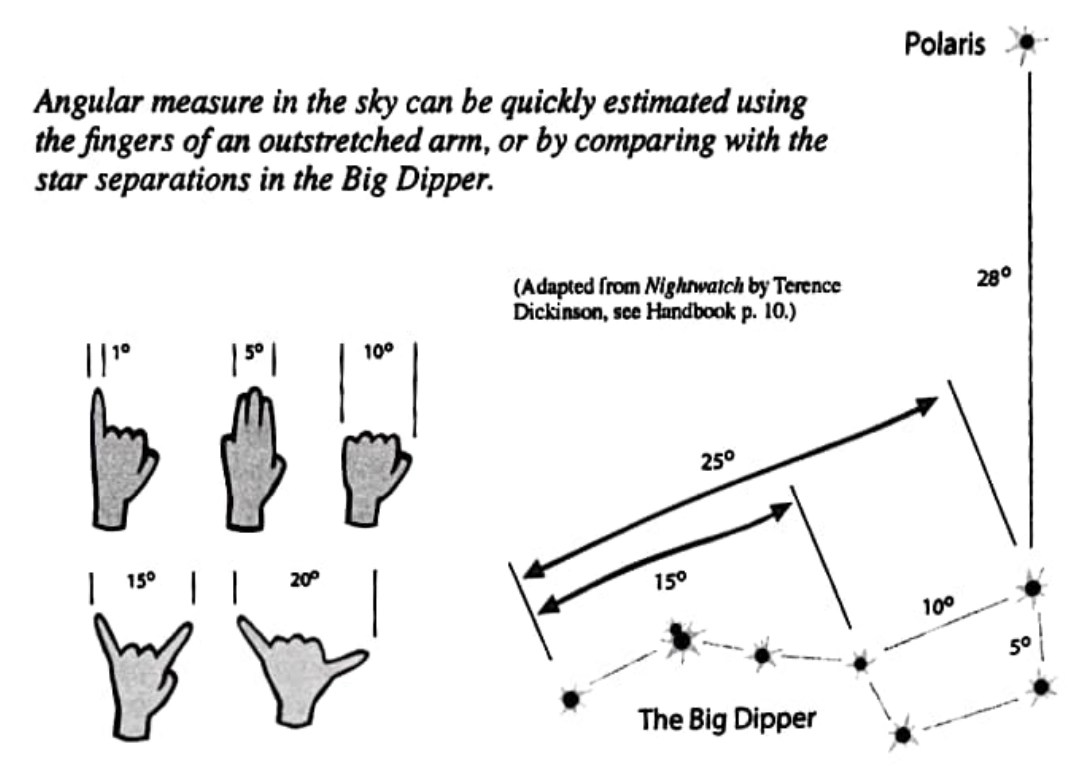
See Figure 2 for some practical references for estimating angles in the sky.
The height in degrees of the Sun above the horizon at its culmination point has been used for thousands of years to determine the observer’s latitude. Eratosthenes of Cyrene (276-194) used it to calculate the circumference of the Earth in a way that was effective for the knowledge of the time.
And again, thanks to knowing the exact ‘universal’ time, you can determine the longitude by converting the hours/minutes difference between the local culmination time of the Sun and the culmination time at longitude zero, taken as a reference, at the Greenwich meridian, into degrees. Obviously, east of this meridian, the culmination will be earlier, while west of it, it will be later.
This principle has also been known for centuries. However, it was possible to exploit it only when clocks of sufficient precision and reliability were built (at the beginning of the 18th century, mainly thanks to John Harrison, see for example Longitude, Dava Sobel, Walker Publishing Company, 1995).
To obtain accurate measurements, precision instruments (like a sextant) are obviously required (apart from the GPS available in every cell phone today!), but for a rough estimate, the above is sufficient.
Figure 2 – Easy reference for measuring angles in the sky (image credit: Nightwatch, Terence Dickinson)