In everyday life, we don’t stop to think about the ‘sizes’ of the planet we live in, the Solar System, and the galaxy (Milky Way) in which we orbit with our mothership, Earth.
In a series of insights, we aim to understand the distances and some parameters that characterize these systems. This first one concerns the Earth and its satellite, the Moon (Figure 1).
Figure 1 -the Earth and the Moon
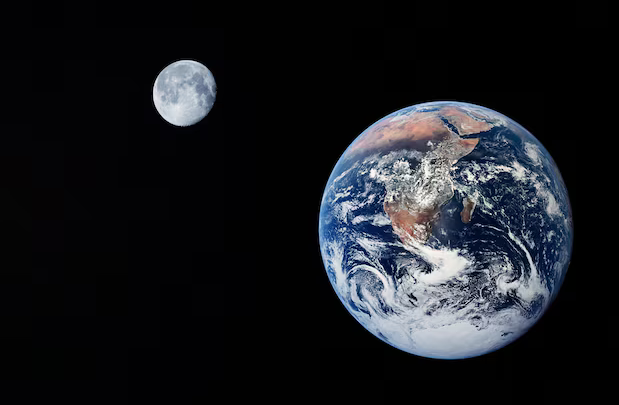
The average radius of the Earth (slightly smaller at the poles than at the equator) is approximately 6,370 km, meaning its circumference is approximately 40,000 km. Therefore, an electromagnetic signal traveling at 300,000 km/s would circle the planet 7.5 times in one second.
Here are some interesting measurements to compare:
– The thickness of the troposphere, where virtually all meteorological phenomena occur and almost all water vapor is concentrated, varies from about 8 km (at the poles) to about 20 km (at the equator), or, on average, 14 km. That is, if the Earth were the size of a soccer ball (radius about 11 cm), the troposphere would be roughly the thickness of two sheets of paper (about 0.24 mm).
– The highest mountain (Everest, about 8.8 km) and the deepest ocean (Mariana Trench, about 10.9 km) are of the same order of magnitude as the height of the troposphere. As if to say that if you held that soccer ball in your hand you would almost not notice their presence.
– The Moon, which has a radius of 1,737 km, would be slightly smaller than a tennis ball (radius about 3 cm) compared to the soccer ball sized Earth, see Figure 2. Its average distance from Earth is about 380,000 km, so an electromagnetic signal takes about 1.3 seconds to arrive; in the proportions calculated for the balls, the distance between them would be about 6.5 meters.
Figure 2 – Soccer ball and tennis ball in the proportions of Earth and Moon

– The altitude at which airliners fly, about 10 km, is little more than the thickness of a sheet of paper. Seen from space they appear to crawl more than fly. The International Space Station (ISS) is maintained at an altitude of about 400 km, about 7 mm above the soccer ball, at a speed of about 28,000 km/h, or it would move about 8 mm per minute.
– Considering the Earth’s rotation in 24 hours, the tangential velocity of a point at the equator is almost 1,700 km/h; at our latitudes of about 45°, the speed is just under 1,200 km/h. For this reason, spacecraft launch pads are positioned at low latitudes, near the equator, to take advantage of the higher linear velocity. The escape velocity required to overcome gravitational pull (about 40,000 km/h on Earth) is more easily achieved by exploiting the velocity of the launch point (with a starting direction toward the east for maximum effect, considering that the Earth rotates towards the east and the speeds can add up).
Note that escape velocity is not tied to ‘up’; it’s the minimum speed at a given altitude to be unbound, in any direction, as long as you don’t collide with the planet.
Next episodes:
Understanding the Sizes : 2 – Solar System
Understanding the Sizes : 3 – Milky Way
Understanding the Sizes : 4 – galaxy clusters and beyond


Interesting INDEED
thanks <3