In Rome, in Campo de’ Fiori, one of the countless murders perpetrated throughout history for conquest and, as in this case, for maintaining imperial power over free thought and ultimately over peoples.
That the killing of the enemy has always been an anthropic standard is evident. Borrowed, as a degeneration, from the animal struggle for survival, to the point of turning it into a ‘moral rule’. Yet the physical violence of domination by the stronger is still understandable in a confrontation ‘on equal terms’. In ancient wars soldiers faced each other directly. Then, perhaps, the victors also abused civilian populations, but in some way they had demonstrated a physical superiority, at least in violence.
The qualitative leap to the suppression of ideas, ideas that differ from the theoretical framework of those in command, is typical of religions, which have often provided a moral and identity-based framework of legitimation for the violence of political and economic powers.
Starting from the common celebratory dating of an event of a religious nature (sun worship later becoming the birth of the ‘son of a god’), one underestimates the conditioning power of religions, namely of those responsible for managing religious sects, founded on the human weakness of the need for a superior being and for its interpreters. Each one claiming to be the bearer of the only truth, incidentally different from that of the others. All fine, if it ended there. But when a different idea is not confronted with better ideas, but by suppressing the bearer of the idea, what is at stake is not truth: what is at stake is power.
Nature is incredibly violent in its evolution, just think of a volcano or an earthquake on our small planet, or, with infinitely greater power, the explosion of a supernova or a black hole, or the gravitational merger of galaxies. We cannot apply criteria of morality or justice to Nature in events that vaporize entire planets in a few instants. But we can to the bipedal mammals of this mild and quiet planet. Endowed with the faculty of rational thought, we should respect this potential in others in order to respect it in ourselves. Yet the ambition for the power of domination has always won by a landslide. And so the bearers of opposing ideas, of a freedom of thought that could weaken one’s own positions as monopolists of ‘truth’, are killed, if possible amid atrocious suffering. Thus small, petty little men of a sect which, in the name of a revealed truth, resorted to coercion and to the killing, after years of imprisonment, of a visionary genius such as Giordano Bruno. Fortunately, however, he managed to pass on to us his thoughts, his visions, still relevant after more than four centuries.
And religious sects are still active today in many parts of the world and, by merging with political power, they become coercive apparatuses that often translate into systematic persecutions and violence—now industrialized in modern ways, but always with the same aim: the suppression of people’s freedom and of ideas, to impose their own dominion through violence and not comparing better ideas on a rational level.
For a more in-depth look at the life and thought of Giordano Bruno, the Wikipedia page is comprehensive.
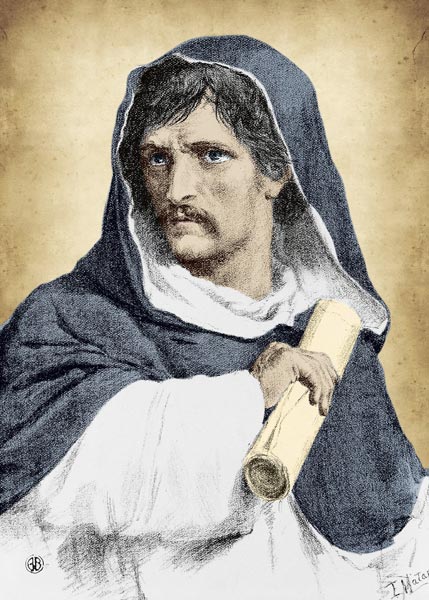
Giordano Bruno (source copia-di-arte.com)


Beh
Niente da dire: hai fatto una dotta disanima
Bravo e basta
polemico come sempre 😉
La polemica è sintomatica di lavoro cerebrale
ah, su quello mai risparmiato
cmq grazie del buon feedback
<3