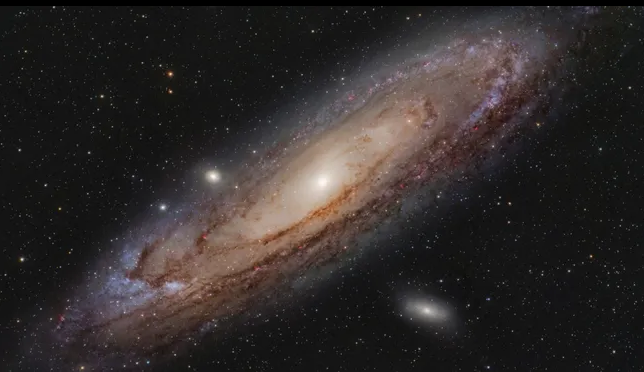
Let’s consider a disc galaxy with billions of stars forming the disc, which rotates (the Andromeda galaxy in the photo, to give a well-known example). We can consider for each of these stars that the centripetal acceleration
[1] a’ = v²/R
is equal to the gravitational acceleration
[2] a” = G M/R²
therefore from [1] = [2] we obtain:
[3] v = √(G M/R)
where v is the local velocity of the source considered, R is its distance from the galactic center, G is the gravitational constant, M is the total mass contained within the radius R (which determines the gravitational attraction).
Measuring the rotational velocities of galaxies is relatively easy, if they are not seen face on, and it is generally observed that throughout the disk the rotational velocities of the sources (stars but also gas clouds) are almost constant. Therefore, from relation [3] it follows that the mass M must increase in proportion to the radius R , since G is a constant. Indeed, the mass contained within the radius R increases as R increases, but what is observed is not sufficient to justify the constant value of v . These considerations leads to the hypothesis that there is a substance that is invisible and non-baryonic in nature (i.e., not made up of protons and neutrons, which are not detected) that manifests itself only through gravitational behavior, which is called dark matter.
Processed photograph of M31, Andromeda. It was not possible to obtain the author of this beautiful photograph.